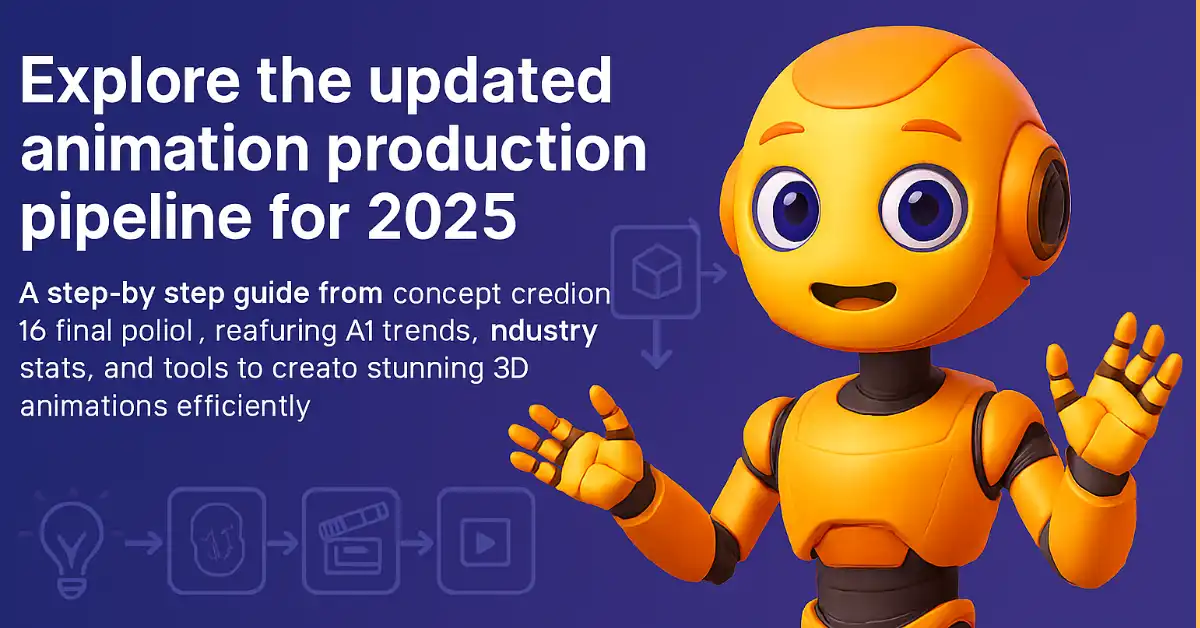
Have you ever thought of creating a 3D animated project? If yes, then my friend, you have landed on the right article. In this read, you are going to learn about the animation production pipeline and how you can create compelling and captivating animation for your targeted audience.
So, let’s not waste time and jump right into it!
What is Animation Production Pipeline?
An animation production pipeline does not only involve animated creation. It is a complete process or system that involves stakeholders, hardware, and software to execute the animation and complete the project in the provided timeline.
The basic animation production starts with a concept and finishes with a final visual product. As an animator or animation company, before beginning with 3D animation project, first, you gather requirements from the client, and then the project manager creates a “plan of action” that contains the budget, the project scope, and the production team.
The animation production pipeline varies depending on the animation type the client chooses for the project.
In 2025, with the global animation market projected to hit $400 billion, pipelines have evolved to incorporate AI tools for efficiency, reducing production times by up to 40% according to industry reports. Real-time collaboration via cloud platforms like AWS or Google Cloud ensures seamless workflows for remote teams, while sustainability practices, such as energy-efficient rendering farms, address environmental concerns in an industry growing at a 5% CAGR toward $528.8 billion by 2030.
The Types of Animation
There are various animation styles that can be used to portray your message effectively to your audience. But the most frequently used and preferred are hand-drawn/cell animation, vector-based/2D animation, 3D animation, and stop motion animation.
In recent years, hybrid styles blending 2D and 3D have surged in popularity, offering flexibility for projects like animated films and games. Additionally, procedural animation using AI algorithms is emerging as a trend, allowing for dynamic, non-linear content creation that’s cost-effective and scalable.
1. Hand-Drawn Animation
Hand-drawn or cell animation is a traditional animation technique where each frame of the video or movie is drawn by hand and was frequently used by animators of old times.
The animator draws rough drawings scene by scene on white paper frames and runs them in a sequence to give the scene a sense and bring the story into motion. Once the drawing phase is complete, the animator captures each frame and animates the whole movie/video frame by frame.
Today, digital tools like Toon Boom Harmony enhance this process with AI-assisted in-betweening, making it faster for indie creators while preserving the artisanal feel.
2. Vector-Based or 2D Animation
2D animation is the most popular animation style in animation and is majorly used to tell the story effectively. It is as same as hand-drawn animation, but these days animators use computer software and animation tools to create each frame of 2D animation.
With advancements in 2025, tools like Adobe Animate integrate AI for automated lip-sync and motion tracking, streamlining production for explainer videos and social media content, which now dominate 80% of animated distribution on platforms like YouTube and Netflix.
3. 3D Animation
3D animation is quite similar to 2D animation but is pretty much more challenging than simple 2D animation. In 3D animation, the images are generated using computer software and animation tools.
The animator begins with character modeling; then, the character is animated using a skeleton. Each pose is created, and the animator jumps to the next pose using interpolation for character movements.
The 3D market is set to double to $40 billion by 2028, driven by hyper-realistic renders in films like recent Pixar releases. AI tools like Meshy.ai assist in generating base models, cutting initial setup time.
4. Stop Motion Animation
This animation is also known as Claymation, which is created by using clay models or puppets of plasticine. The clay models are positioned and re-positioned in various poses to motion to the static art. The animator captures each movement of the clay model and creates an illusion of motion.
In 2025, 3D-printed armatures and AR previews modernize stop motion, as seen in projects blending it with digital VFX for a hybrid appeal in commercials and short films.
The 3D Animation Production Phases
Most of the animation styles use the same animation production phases, but the 3D animation production is slightly different from the rest. Let’s understand why:
In 2025, pipelines emphasize automation and real-time feedback, with VR tools for virtual production allowing directors to “walk through” scenes early. This reduces rework, especially in large studios where teams exceed 100 members for feature films.
1. 3D Animation Pre-Production
The 3D animation pre-production stage includes concept creation, scriptwriting, storyboarding, and character creation. Once you are done with all these steps, the project moves to the production stage.
Pre-production now often includes AI brainstorming tools for idea generation, ensuring concepts align with budget constraints from the start. For instance, timelines for short videos range from 6-10 weeks, while features can take 12-24 months.
Concept Creation
The first thing in pre-production is concept creation which involves the creative content team of the project to brainstorm multiple ideas to set up the script for the animation.
The most important thing to keep in mind is to understand the animation and software limitations before imaging way out of the box.
In 2025, tools like ChatGPT or Midjourney aid in rapid prototyping, helping teams visualize ideas quickly and incorporate trends like anthropomorphic characters or minimalist designs.
Scriptwriting
The scriptwriter writes a script that outlines a story around the characters and talks about every necessary point.
A script gives strong imaginative support to an animator for better the animation and representation. The scriptwriter writes dialogues for the characters and passes them on for the storyboarding.
Technical scripts now include notes for AI-enhanced elements, such as procedural simulations for dynamic scenes.
Storyboards
The Next step in pre-production is storyboarding, where the graphic designer creates storyboards that illustrate all the scenes of the video/movies so that the animator gets the idea of how to animate the particular scene.
Good storyboards include captions that label the outline story. Storyboarding helps with camera placements and animation timing.
It also gives the animator the freedom of visualization and creates something different from the mentioned script.
A storyboard is not only helpful for the animator; it benefits the director as well as the actors involved in the project.
Digital storyboarding apps like Storyboard That integrate AR previews, allowing for interactive reviews.
Animatics
(Added for expansion): Animatics are rough, timed versions of storyboards with basic audio, helping refine pacing and transitions before full production. In 2025, AI tools automate animatic creation from scripts, saving weeks in planning.
Character Creation
This is the step where characters are created. Animators now begin with character creation and decide how the characters will move, interact, or look in the digital environment.
The props, backgrounds, theme, and color palette are also part of character creation. The animation team collects all the assets and begins creating a 3D environment with the help of 3D animation software.
Concept art now uses AI for variations, ensuring diversity in designs while adhering to trends like vivid colors or retro aesthetics.
2. 3D Animation Production
This is the stage where all the magic happens – the production. The production stage includes 3D modeling, surfacing, 3D rigging, lighting, and 3D rendering. After the production phase completion, the next stop is post-production.
With cloud rendering, production is faster; farms like GarageFarm handle complex simulations, supporting trends like oddly satisfying motion graphics.
3D Layout
(Added): Rough shots are built with placeholders to define composition and camera moves, using tools like Blender for quick iterations.
3D Modeling
3D modeling is the most important part of 3D animation production, where the animator animates the characters and environment from scratch.
First, the animator understands the story and animate the character accordingly. Autodesk Maya and 3D Studio Max are the software that are highly used by animators for 3D modeling.
With a base object selected from a cube, sphere, cylinder, or cone, 3D modeling creates a representation of the surfaces and objects, and later the 3D objects are then manipulated using faces, vertices, and edges to form a final character.
In 2025, AI models like those in Houdini generate base meshes, with costs per minute ranging $100,000-$300,000 for high-end work.
Surfacing
In 3D animation, surfacing is the step where the animator enhances the characters and environment’s appearance.
Surface tells that how a 3D character or prop will appear in a 3D animated environment. Surfacing artists tore down a complex scene into small understandable elements, which later combined to create a complete 3D animation.
Texturing maps now include AI-generated details for realism, like procedural skin pores.
3D Rigging
The 3D character models are represented through skeletal animation in 3D rigging. An animator created the skeleton, which manipulates the 3D models with a series of organized digital boxes.
While rigging, a 3D object can be controlled by altering the rotation, scale, or position. It helps simplify the production process and create smooth animation.
AI rigging tools in Maya auto-detect joints, speeding up for complex characters with hundreds of controls.
Visual Effects (VFX)
(Added): Elements like fire or explosions are simulated, with the VFX market growing at 9.43% CAGR to add $10.5 billion by 2028.
Lighting
Light is the most important part of the production phase. The lighting includes object shadows and light reflection that bounces back from the object in the digital environment.
There are various lighting techniques that animators can use to give a distinctive look to the scene. 3D Lightning includes directional light, point light, ambient light, and spotlight.
The lighting is placed according to the need of the scene to illuminate animation and the environment.
Real-time lighting in Unreal Engine allows instant previews, enhancing mood for VR/AR projects.
3D Rendering
The animated scenes are processed in 3D rendering, where the final output of the animated scene is created frame by frame. Software like Autodesk Maya is preferred by animators for the 3D rendering job.
Cloud rendering accelerates this, with procedural tools handling simulations efficiently.
3. 3D Animation Post-Production
This is the final phase where the animator and editor finalize the masterpiece. In this phase, composition, sound design, and editing are included.
Post-production now leverages AI for auto-editing, ensuring polish in an industry where animated films yield 30% higher profits.
3D Composition
Once you are done with rendering comes the 3D composition. It is the first step of the 3D animation post-production phase, where the renders are combined together to create a cohesive composition.
The animator creates sequenced tracks to create a transition between the frames. This is where the final look of animation is revealed with motion, elements, and lights.
Seamless transitions are key in 2025, with AI aiding fluid blends.
Sound Design
In this step, the audio, music, or voice-overs are added to the animation.
Color Correction
(Added): Tones are balanced for consistency, using tools like DaVinci Resolve.
Polishing
Polishing is the final step of the overall 3D animation production, where the color fixing, sound alteration, and final touch-ups are done.
P.S: If you are interested in 3D animation, here are the top 3D animation production companies that you can pick for your project or animation career.
The Editor’s Choice
3D animation is quite tricky but one of the most creative and live-looking animations which require tons of skill and creative minds.
In my recommendation, If you are interested in creating a 3D animated video or movie production, BuzzFlick should always be your first choice.
The NYC-based animation studio has a team of experts who know their way to animation.
Hopefully, you have found all the necessary information about the animation production pipeline, and creating a project won’t be a challenge for you.
Happy Animation!
Conclusion
Mastering the animation production pipeline in 2025 means embracing innovation while honoring timeless creativity. With AI streamlining workflows, real-time tools accelerating production, and a booming market offering endless opportunities, animators can craft immersive stories that captivate global audiences. Whether you’re a beginner or pro, focus on structured phases, the right software, and emerging trends like hybrid animation to stay competitive. Start your next project today— the future of animation is brighter than ever, promising growth, efficiency, and unparalleled visual storytelling.
FAQs
What is the animation production pipeline?
The animation production pipeline is a structured process from concept to final output, including pre-production (planning), production (creation), and post-production (polishing). In 2025, it integrates AI for efficiency, reducing times by 40%, and supports trends like real-time rendering for immersive 3D projects.
How long does the 3D animation pipeline take?
Timelines vary: short videos take 6-10 weeks, while feature films span 12-24 months. Factors include complexity, team size (5-100+), and tools like AI-assisted modeling. In 2025, cloud rendering speeds up production, but detailed VFX can extend post-production.
What software is best for the animation production pipeline in 2025?
Top tools include Autodesk Maya for modeling/rigging, Blender for free procedural work, Houdini for VFX, and Unreal Engine for real-time rendering. AI integrations in these reduce manual tasks, making them ideal for hybrid 2D/3D pipelines.
How has AI changed the animation production pipeline?
AI automates rigging, in-betweening, and scene generation, cutting production time by 40%. It enables procedural animations and style transfers, enhancing creativity in trends like anthropomorphic characters and VR experiences, while keeping human oversight key.
What are key trends in the animation production pipeline for 2025?
Trends include hybrid 2D/3D blends, AI integration for efficiency, real-time VR/AR, and sustainable cloud rendering. Bold colors, minimalist designs, and procedural simulations dominate, driven by a $400 billion market growth.