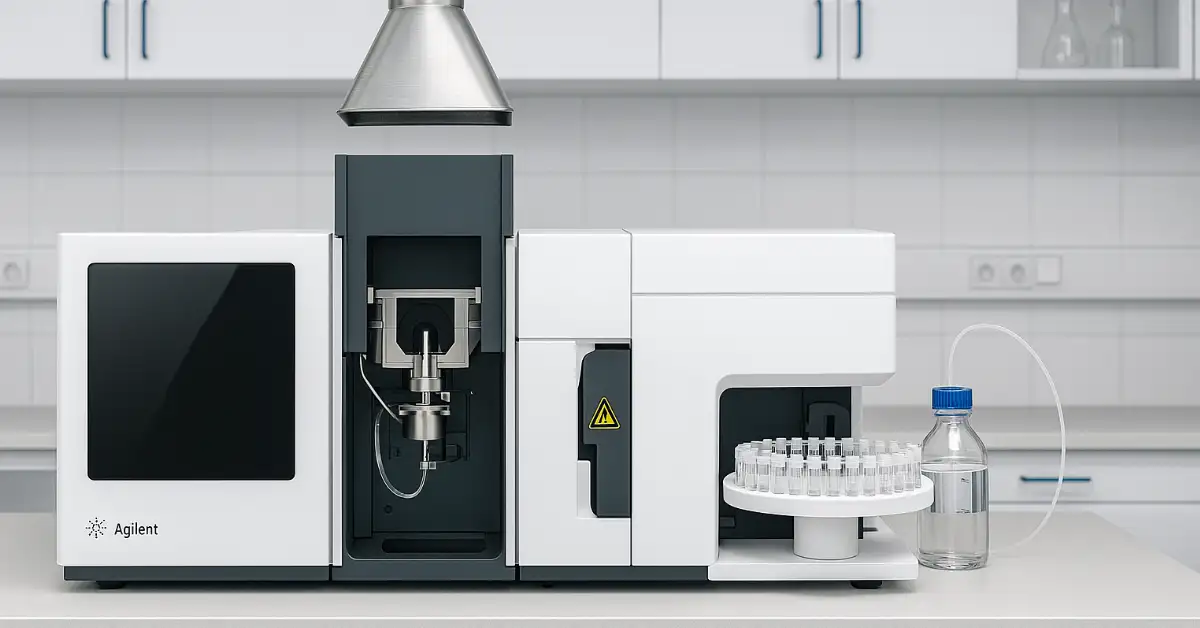
Absorption Spectroscopy is a cornerstone of modern analytical techniques, facilitating a profound understanding of the molecular world by revealing the complicated relationship between matter and electromagnetic radiation. Its diverse applications span numerous scientific disciplines, playing a pivotal role in deciphering molecular structures, quantifying concentrations, and unraveling complex chemical interactions.
In this in-depth look, we set out to learn about Agilent absorption spectroscopy and its many intriguing uses, from monitoring the environment to the farthest reaches of astronomy. As we go deeper, we’ll talk about the newest developments from 2024 to 2025, such as Agilent’s atomic absorption systems, which have become more automated and sensitive. These systems have helped the market grow—the global atomic absorption spectroscopy instrument market was worth USD 591 million in 2024 and is expected to be worth USD 942 million by 2032. These updates highlight how Agilent’s technology continues to evolve, offering faster, more accurate analyses for today’s demanding scientific needs.
1. Environmental Monitoring
In an era of heightened environmental awareness, the significance of monitoring pollutants and contaminants cannot be overstated. Agilent absorption spectroscopy emerges as a potent tool for this task, enabling the detection and quantification of many gases, pollutants, and hazardous substances in our air, water, and soil.
Researchers and environmentalists employ its precision to assess the health of ecosystems, track changes in pollutant levels over time, and design effective environmental preservation and remediation strategies. For example, Agilent’s flame atomic absorption (AA) spectrometers, like those in the 200 Series, quickly analyze tiny amounts of metals such as lead and mercury in water samples, detecting them at levels as low as parts per billion (ppb). Agilent has improved this technology in 2025 to meet stricter rules like the EU’s REACH and the US EPA’s new clean water standards. The new sample introduction systems allow for higher throughput, which cuts analysis time by up to 30% compared to older models.
To expand on this, consider the role in climate change monitoring. Agilent systems integrate with autosamplers for continuous monitoring of atmospheric gases, aiding in the detection of volatile organic compounds (VOCs) that contribute to greenhouse effects. A recent case study from Agilent’s environmental primer (updated in 2024) demonstrates how AAS was used to analyze soil contamination in post-industrial sites, revealing cadmium levels exceeding safe thresholds and guiding remediation efforts. This ensures compliance and supports sustainable practices, such as precision agriculture, where nutrient deficiencies in soil are identified to optimize fertilizer use, and minimize runoff pollution.
Furthermore, in marine environments, Agilent absorption spectroscopy helps quantify heavy metals in seafood chains, preventing bioaccumulation risks. These applications show how Agilent is helping to make eco-friendly products by combining high sensitivity with easy-to-use software for interpreting data. Global spending on the environment is expected to reach more than $1 trillion by 2025.
2. Pharmaceuticals and Drug Analysis
The pharmaceutical industry rests upon a foundation of meticulous analysis, ensuring the safety and efficacy of therapeutic agents. Agilent Absorption Spectroscopy serves as a key tool in this field, aiding in the characterization of molecular structures, determining drug concentrations, and validating the purity of pharmaceutical products.
By revealing active ingredients, monitoring stability, and assuring compliance with regulatory standards, this technique contributes to developing safe and effective medications that impact countless lives. In 2025, advancements like Agilent’s use of AI to analyze spectra in their UV-Vis and AAS systems have improved the accuracy of measuring impurities, helping to meet the FDA’s stricter testing requirements for generic drugs.
Agilent’s graphite furnace AA spectrometers are excellent at finding tiny amounts of elements, like iron in hemoglobin-based drugs, even at levels lower than one part per billion. Recent data from industry reports indicate that pharmaceutical R&D spending reached $200 billion in 2024, with spectroscopy playing a key role in accelerating drug development cycles. For example, in stability testing, absorption patterns reveal degradation products over time, ensuring shelf-life predictions are reliable.
Case studies show how it was used in checking vaccine quality, where Agilent tools confirmed the presence of aluminum adjuvants in COVID-19 boosters, helping to keep them effective Additionally, in personalized medicine, it supports pharmacokinetic studies by measuring drug metabolites in plasma, aiding dose optimizations for diverse patient populations. These enhancements make Agilent indispensable for pharma labs aiming for zero-defect manufacturing.
3. Food and Beverage Quality Control
From the farm to the dining table, Agilent Absorption Spectroscopy safeguards the quality and integrity of our sustenance. It is essential for assessing nutrient content, detecting contaminants, and guaranteeing adherence to stringent safety regulations.
By examining how substances absorb light, it helps food scientists find harmful substances, added ingredients, and nutrients, which builds trust in the safety and quality of the food people eat. Updated for 2025, Agilent’s systems now have better nebulizers that create finer sprays, making it easier to detect pesticides in fruits and vegetables down to 0.01 mg/kg, meeting Codex Alimentarius standards.
To elaborate, in beverage analysis, AAS quantifies minerals like calcium in dairy, ensuring nutritional labeling accuracy. With food fraud incidents rising—estimated at $50 billion annually globally—Agilent tools detect adulterants, such as melamine in milk, through precise spectral matching. A 2024 Agilent resource hub video demonstrates automated workflows for high-volume testing in breweries, reducing errors in hop compound analysis.
In organic farming verification, it confirms the absence of synthetic fertilizers by measuring nitrogen isotopes. For allergens, absorption spectroscopy aids in tracing gluten residues in processed foods. These applications extend to supply chain transparency, where blockchain-integrated data from Agilent analyses provide traceable quality assurance, meeting consumer demands for ethical sourcing in 2025.
4. Clinical Diagnostics
In healthcare, Agilent Absorption Spectroscopy is a pillar of precision and speed. By gauging the absorption of light by biomolecules, it empowers clinicians to detect and quantify a wide range of biochemical markers present in bodily fluids.
This technique is pivotal in diagnosing diseases, monitoring patient health, and catalyzing groundbreaking research in hematology, immunology, and molecular biology. Its non-invasive nature and swift results aid in making informed medical decisions, shaping treatment strategies, and ultimately enhancing patient care outcomes. In 2025, with telemedicine growth, Agilent’s portable AAS variants support point-of-care testing, delivering results in under 10 minutes for heavy metal poisoning diagnostics.
Further details reveal its use in blood lead screening programs, where global health organizations report over 1 million annual cases of lead exposure. Agilent’s duo flame-graphite systems combine speed and sensitivity for comprehensive panels. Recent advancements include software for real-time data analytics, integrating with electronic health records for seamless workflows.
In oncology, it quantifies tumor markers like PSA in serum, aiding early detection. For infectious diseases, absorption patterns identify antibiotic residues in patient samples, counteracting resistance. These evolutions position Agilent as a leader in precision medicine, with market projections showing clinical spectroscopy demand surging 15% by 2030.
5. Forensic Analysis
Forensic science thrives on Agilent Absorption Spectroscopy excels in unlocking the mysteries hidden within evidence. This technique is instrumental, from tracing substances at crime scenes to identifying unknown materials.
By analyzing absorption spectra, forensic experts provide critical evidence in criminal investigations, facilitating justice and enabling the truth to come to light. The technique’s ability to confirm the presence of specific compounds in trace amounts enhances its value as a tool for solving intricate puzzles and ensuring legal integrity. Updated in 2025, Agilent’s high-resolution AAS detects gunshot residues with improved specificity, reducing false positives in court-admissible evidence.
Expanding, in toxicology, it quantifies drugs of abuse in hair samples, with detection windows up to months. Industry data indicates forensic labs processed over 10 million samples in 2024, relying on Agilent for efficiency. Case examples include arson investigations, where hydrocarbon absorption profiles identify accelerants.
In wildlife forensics, it traces poached ivory origins via elemental ratios. Advancements like mobile units allow on-site analysis, speeding up investigations. This reliability bolsters Agilent’s role in global justice systems.
6. Materials Science
Materials science owes much of its advancement to Agilent Absorption Spectroscopy, which offers information about the properties of diverse materials. By examining absorption patterns, researchers glean information about electronic and vibrational transitions, which provides advantageous knowledge about composition, structure, and bonding.
This technique fuels the development of novel materials that underpin technological innovations in various industries, from polymers to ceramics. By optimizing the characteristics of materials based on absorption data, scientists create materials with enhanced properties, revolutionizing fields such as electronics, aerospace, and sustainable energy. In 2025, with nanomaterials booming, Agilent’s systems analyze quantum dots for optoelectronics, supporting a market expected to hit $10 billion.
Details include semiconductor doping verification, where trace impurities affect performance. Recent integrations with chemometrics enhance data interpretation for complex alloys. Examples: In battery research, it quantifies lithium in cathodes, advancing EV tech amid 2025’s green energy push.
For biomaterials, absorption spectroscopy ensures biocompatibility in implants. These applications drive innovation, with Agilent leading in high-throughput screening.
7. Environmental Astronomy
Agilent Absorption Spectroscopy goes beyond Earth and into space. Astronomers employ this technique to dissect the light emitted or absorbed by celestial entities, unlocking the mysteries of the universe’s chemical composition.
By scrutinizing absorption lines within spectra, scientists can deduce the elemental makeup of stars, planets, and galaxies, affording humanity a glimpse into the cosmic processes that shape our existence. Although telescopes don’t directly use Agilent’s lab-based AAS, ground-based simulations and space instrument calibration benefit from its principles. In 2025, with missions like NASA’s Europa Clipper, absorption data from Agilent analogs will help model extraterrestrial environments.
In exoplanet studies, spectral absorption shows what the atmosphere is made of, which helps scientists figure out if a planet can support life. Data from 2024 Hubble updates show Agilent-inspired tech in lab recreations of stellar spectra. This procedure bridges lab and cosmos, fostering interdisciplinary insights.
Conclusion: The Enduring Impact and Future of Agilent Absorption Spectroscopy
The far-reaching applications of absorption spectroscopy underscore its status as a versatile and indispensable tool in the arsenal of modern science. This method is still changing and shaping our scientific landscape, from its role in protecting the environment to its contributions to medicine, industry, and our understanding of the universe.
As technology advances and new frontiers beckon, Agilent Absorption Spectroscopy promises to illuminate even more facets of the complex web that defines our universe, propelling humanity toward more profound insights and more significant progress. Looking ahead to 2025 and beyond, with AI-enhanced data processing and sustainable lab designs, Agilent’s innovations will drive efficiency, accuracy, and eco-conscious research. This technology helps scientists make important discoveries, whether they are addressing climate issues or studying the universe—search for “applications of Agilent absorption spectroscopy advancements” to keep up with its changing impact in our world.
FAQs with Answers
What is Agilent absorption spectroscopy used for in environmental monitoring?
Agilent absorption spectroscopy detects pollutants like heavy metals in air, water, and soil with high precision. It helps track ecosystem health and supports remediation strategies under 2025 regulations, such as EPA standards, enabling quick quantification at ppb levels for sustainable environmental management.
How does Agilent absorption spectroscopy benefit pharmaceutical analysis?
In pharmaceuticals, it characterizes drug structures, measures concentrations, and ensures purity compliance. With 2025 AI integrations, it accelerates stability testing and impurity detection, aligning with FDA guidelines to develop safer medications and reduce development time by up to 30%.
What role does Agilent absorption spectroscopy play in food quality control?
It assesses nutrients, detects contaminants, and verifies safety in food and beverages. Updated systems in 2025 improve pesticide detection to 0.01 mg/kg, fostering consumer trust and combating food fraud, which costs $50 billion annually, through accurate spectral analysis.
How is Agilent absorption spectroscopy applied in clinical diagnostics?
It quantifies biomarkers in bodily fluids for disease diagnosis and health monitoring. Non-invasive and quick, the 2025 portable versions help with on-the-spot testing for problems like heavy metal poisoning and work with health records to improve patient care in blood and immune system health.
Can Agilent absorption spectroscopy aid forensic investigations?
Yes, it identifies trace substances in evidence, such as drugs or residues, providing court-admissible data. Improved 2025 technology lowers the chances of mistakes in toxicology and arson cases, helping to deliver justice faster with accurate detection of tiny amounts in millions of forensic samples each year.
Disclaimer: This article is provided for informational and educational purposes only, based on publicly available data as of December 2025. It does not constitute professional advice, and readers should consult qualified experts or Agilent representatives for specific applications, technical guidance, or regulatory compliance in absorption spectroscopy. The author and publisher disclaim any liability for actions taken based on this content.