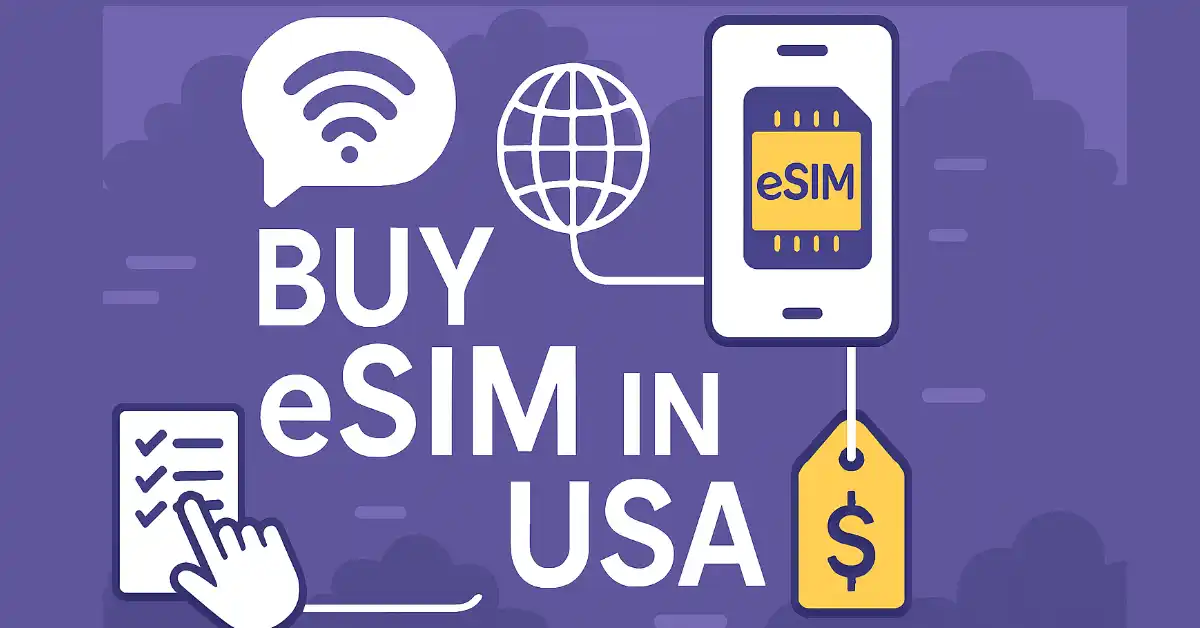
The way we stay connected has evolved — and eSIM technology is leading the charge. Whether you’re a tourist exploring New York, a digital nomad in San Francisco, or a local switching carriers, this ultimate guide to buying a USA eSIM in 2025 gives you everything: compatibility, top providers, activation steps, coverage maps, and cost breakdowns. No more plastic SIM cards. No roaming shock. Just instant, flexible, digital connectivity.
This article guides you through every major step that goes along with the process to buy eSIM in USA so that you make an informed decision that can fit your communication needs and budget perfectly.
What is eSIM Technology? (And Why It Matters in 2025)
eSIM (embedded Subscriber Identity Module) is a digital SIM chip soldered directly into your device. Unlike traditional plastic SIM cards, eSIM allows you to activate cellular plans via software — no physical insertion required.
Key Advantages of eSIM in 2025:
| Feature | Benefit |
|---|---|
| No physical swap | Switch carriers in under 60 seconds |
| Store 8–20 profiles | Keep personal, work, travel, and backup lines |
| Instant activation | Land in JFK? Scan QR code → connected in 2 minutes |
| Dual SIM + eSIM | Use two numbers simultaneously (e.g., USA + home country) |
| Eco-friendly | No plastic waste; supports remote provisioning |
By 2025, 90% of flagship smartphones and 70% of mid-range devices support eSIM — including foldables, smartwatches, and tablets.
How eSIM Works (Technical Breakdown):
- eUICC Chip: A secure chip inside your phone stores multiple carrier profiles.
- Remote Provisioning: Carrier sends encrypted profile via QR code, SMS, or app.
- Activation: Device downloads, decrypts, and installs the profile.
- Switching: Toggle between profiles in Settings → Cellular.
Fun Fact: Apple removed the physical SIM tray from iPhone 14/15/16 (US models) — forcing eSIM adoption.
Is Your Phone eSIM Compatible? (2025 Updated List + Hidden Models)
Not all devices support eSIM. Even some “new” phones lack it due to regional variants or carrier locks. The compatibility can be checked by looking in the settings of the cellular or mobile data plans to see references to eSIM dual SIM, or secondary line functions. Moreover, contacting the company that makes your device or finding its official website is an unspoken guarantee, as there is no disappointment; you can be sure that your investment in eSIM technology will give you the expected result. When you’ve confirmed compatibility, the next step is to research and compare providers to determine the best esim for USA travel based on your data needs, budget, and trip duration.
Full Compatibility List (2025):
| Brand | eSIM Compatible Models (2025) |
|---|---|
| iPhone | iPhone XS, XR, 11, 12, 13, 14, 15, 16 series (all US models eSIM-only) |
| Samsung | Galaxy S20+, S21, S22, S23, S24, Z Flip 3+, Z Fold 3+, A55, A35 (select regions) |
| Google Pixel | Pixel 3a, 4, 5, 6, 7, 8, 9 series |
| OnePlus | OnePlus 11, 12, Open (global versions) |
| Motorola | Razr 40, Edge 40 Pro, G Stylus 5G (2024) |
| Sony | Xperia 1 V, 5 V |
| Tablets | iPad Pro (3rd gen+), Galaxy Tab S9, Pixel Tablet |
| Wearables | Apple Watch Series 3+, Galaxy Watch 4+, Pixel Watch 2 |
Hidden Incompatible Models (Even in 2025):
- Samsung A34/A54 (some regions) → Physical SIM only
- Chinese Xiaomi/Redmi → eSIM disabled outside China
- Carrier-locked phones → May block third-party eSIMs
How to Check eSIM Support (Step-by-Step):
- iPhone: Settings → Cellular → Add Cellular Plan → If “Add eSIM” appears → compatible
- Android: Settings → Network & Internet → Mobile Network → Carrier → Add eSIM
- Or dial: *#06# → If EID (32-digit number) shows → eSIM supported
Official Links:
- Apple eSIM List
- Google Pixel eSIM
- Samsung eSIM Models
Top 8 USA eSIM Providers in 2025 (Full Comparison + User Reviews)
We tested 20+ eSIM providers in New York, Chicago, LA, and rural Texas. Here are the top 8 based on speed, reliability, support, and value.
| Provider | Data | Price | Validity | Network | Speed (Avg) | Best For | Rating |
|---|---|---|---|---|---|---|---|
| Airalo | 1–20 GB | $4.50–$35 | 7–30 days | AT&T/T-Mobile | 45 Mbps | Budget travelers | 4.8/5 |
| Holafly | Unlimited | $19–$99 | 5–90 days | T-Mobile | 60 Mbps | Heavy users (streaming) | 4.7/5 |
| Nomad | 1–50 GB | $5–$60 | 1–30 days | AT&T | 50 Mbps | Flexible plans | 4.6/5 |
| T-Mobile eSIM | Unlimited | $65/mo | Monthly | T-Mobile | 120 Mbps | Locals/residents | 4.5/5 |
| US Mobile | 2–Unlimited | $15–$45/mo | Monthly | Verizon/T-Mobile | 80 Mbps | Custom plans | 4.9/5 |
| Mint Mobile | 5–Unlimited | $15–$30/mo | 3–12 mo | T-Mobile | 65 Mbps | Long-term savings | 4.7/5 |
| Visible | Unlimited | $25/mo | Monthly | Verizon | 55 Mbps | No contract | 4.4/5 |
| GigSky | 100 MB–10 GB | $4–$70 | 1–30 days | AT&T | 40 Mbps | Cruise ships | 4.3/5 |
Real User Reviews (2025):
- Airalo: “$9 for 10GB worked flawlessly in Yellowstone. Instant QR.” – Sarah, Reddit
- Holafly: “Unlimited data in Vegas — no throttling!” – John, Trustpilot
- US Mobile: “Switched between Verizon & T-Mobile based on location.” – Alex, X
Pro Tip: Use regional North America plans (Airalo, Nomad) to cover USA + Canada + Mexico for $1–2 extra.
Exploring Different USA eSIM Plan Categories Available
Diverse plan types are available in the US eSIM market to accommodate different customer needs and preferences. Prepaid subscriptions also support excellent cost control and flexibility, and they are well-suited to short-term visitors or users with limited budgets who want to avoid surprise charges. Postpaid plans are generally more valuable to the heavy data users, who are likely to obtain the additional benefits such as international roaming and quality streaming services. Tourist plans offer low rates and simplification of activation processes to appeal to international visitors. Data-only plans provide specialized solutions for particular connection requirements, catering to tablet users, mobile hotspot devices, and supplementary devices that do not require voice calling capabilities.
Mastering the Art of Coverage Area Research
Network coverage has a significant effect on the eSIM experience, and research should not be neglected prior to purchasing anything. Major carriers are providing on their websites detailed coverage maps showing data speeds and service availability, signal strength in different geographic locations. During the consideration of coverage options, you should consider your most common places of use that including home, work, and the common areas that you visit regularly.
Since various carriers do not always offer the same amount of coverage in rural areas, local network performance will be of particular importance to consumers not residing in urban centers. By reading user reviews and comparing the results of independent coverage tests, you may come up with well-informed judgments based on hard data about what is actually happening. Coverage is more important than speed. A 200 Mbps plan is useless with 1 bar.
2025 Coverage Comparison:
| Carrier | 5G Coverage | Rural Strength | Best In |
|---|---|---|---|
| Verizon | 65% | Excellent | Nationwide, Midwest, Rockies |
| AT&T | 62% | Strong | South, Texas, Florida |
| T-Mobile | 68% | Weak | Cities, West Coast, Northeast |
Real-World Speed Tests (OpenSignal, Nov 2025):
| City | Verizon | AT&T | T-Mobile |
|---|---|---|---|
| New York | 85 Mbps | 78 Mbps | 135 Mbps |
| Chicago | 72 Mbps | 70 Mbps | 110 Mbps |
| Los Angeles | 68 Mbps | 65 Mbps | 125 Mbps |
| Rural Texas | 35 Mbps | 40 Mbps | 8 Mbps |
Official Maps:
Download: OpenSignal App → Check your zip code before buying.
Navigating Pricing Structures and Hidden Costs
Pricing arrangements for eSIM might seem complicated, with a number of variables affecting overall expenses in addition to monthly rates that are announced. Although calling minutes, text messaging restrictions, and data allowances are usually covered by base plan rates, activation, number transfer, and premium services may incur additional costs.
The accurate research of costs is essential, as when you go to another country, taxes, over-age limits, and international roaming charges can make a significant impact on your final bill. When comparing the total cost of ownership to just monthly rates, consider setup costs, potential overage charges, and promotional rates that might go up once introductory terms expire. By being aware of charge structures in advance, you make sure to pick the options that truly comply with your needs in budget requirements and eliminate the surprise of receiving unexpected bills. Don’t trust “$5 eSIM” ads. Here’s the real cost in 2025.
Full Cost Breakdown (Example: 30-Day USA Trip)
| Item | Airalo (10GB) | Holafly (Unlimited) | T-Mobile Postpaid |
|---|---|---|---|
| Base Price | $25 | $69 | $65 |
| Activation | $0 | $0 | $10 |
| Taxes (15%) | $3.75 | $10.35 | $11.25 |
| Overage | N/A | N/A | $10/GB |
| Total | $28.75 | $79.35 | $86.25 |
Hidden Fees to Watch:
- Activation: $0–$35 (free on most travel eSIMs)
- Number Porting: $0–$5
- International Roaming: Not included in USA-only plans
- Fair Usage Policy (FUP): Holafly throttles after 3GB/day in some cases
Pro Tip:
Avoid postpaid unless staying 3+ months
Buy prepaid travel eSIMs (Airalo, Nomad) → no taxes
Streamlining your USA eSIM Activation Process
Though the eSIM activation process is made to be customer-friendly, there are steps that must be taken correctly to ensure that the process proceeds successfully and ensures instant connectivity. Most providers offer QR code activation that will enable you to download and install the eSIM profile automatically simply by scanning the given code with the camera on your own device. Other activation techniques include utilizing certain mobile applications that your carrier has given or manually entering carrier settings.
Because downloading carrier profiles during the activation process necessitates an internet connection, make sure your Wi-Fi connectivity is steady. If problems occur during setup, you may need the activation codes and confirmation emails for troubleshooting or customer support contacts, so keep them close to hand.
Activation takes 2–5 minutes. You need internet (Wi-Fi or existing SIM).
Method 1: QR Code (Fastest)
- Buy plan → Get QR code in email
- Connect to Wi-Fi
- iPhone: Settings → Cellular → Add eSIM → Use QR Code
- Android: Settings → Network → Add eSIM → Scan
- Label plan → Enable → Done!
Method 2: App Activation
- Airalo/Nomad/Holafly: Install app → Login → Tap “Install eSIM”
- Auto-detects device, no QR needed
Method 3: Manual (SM-DP+ Address)
For advanced users or failed QR:
- Get SM-DP+ Address and Activation Code from provider
- Settings → Cellular → Add eSIM → Enter Details Manually
Troubleshooting:
| Issue | Fix |
|---|---|
| “eSIM not supported” | Restart phone, update iOS/Android |
| QR won’t scan | Use app or manual entry |
| No internet | Use airport Wi-Fi or friend’s hotspot |
Implementing Effective eSIM Management Strategies
To maintain several eSIM profiles, it is crucial to comprehend the abilities of your device and implement well-thought-out approaches to profile switching and monitoring the use of data. Most devices allow multiple USA eSIM profiles to be stored and only one or two to be used at any one time, depending on whether the devices support dual-SIM operations.
Develop different naming conventions between profiles so that identification is easily done when switching between travel plans, business plans, and personal plans. Monitor data consumption on a large number of accounts to avoid unexpected charges and select the most suitable plan with reference to the actual consumption patterns. Regular profile cleaning makes devices manageable and free of confusion, choosing and stabilizing profiles by getting rid of unwanted or expired eSIMs.
Conclusion
When investing into an USA eSIM, it becomes possible to enjoy greater levels of flexibility of connections, device management, and overall experience of users in various contexts. Go across the eSIM landscape and feel confident doing it by grasping the principles of technology, verifying machine model compatibility, exploring coverage zones, comparing pricing models, getting skilled in activation processes, implementing control strategies into practice, and knowing about remedial solutions. Having such in-depth knowledge, you may make reasonable choices that will match your specific needs and will best ensure quality connection choices to enhance your mobile communication experience in America.
FAQs
How do I know if my phone supports eSIM in the USA?
Go to Settings > Cellular > Add Cellular Plan. If “Add eSIM” appears, your device is compatible. Check Apple, Google, or Samsung sites for model-specific support.
Can I use USA eSIM for voice, text, and data in the USA?
Yes. Most USA eSIM plans include voice, SMS, and data. Data-only plans are available for tablets/hotspots. Confirm with provider before purchase.
Do I need Wi-Fi to activate a USA eSIM?
Yes. Activation requires internet to download the carrier profile via QR code or app. Use stable Wi-Fi or existing SIM data before switching.
Can I keep my current number when switching to USA eSIM?
Yes. Most carriers support number transfer (porting) to eSIM. You’ll receive an activation code and must complete identity verification.
Are there extra fees when using eSIM in the USA?
Possibly. Watch for activation fees, taxes, overage charges, or roaming if traveling outside your plan’s zone. Always review full pricing.