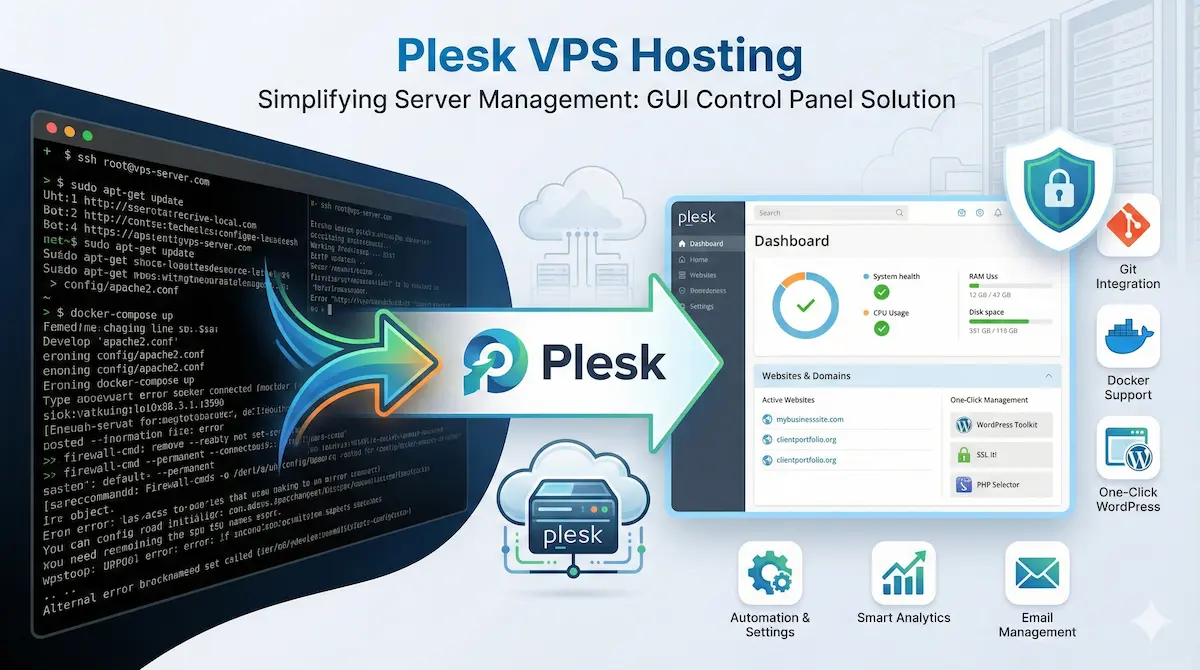
In the world of web hosting, the power of a Virtual Private Server (VPS) is often contrasted with the complexity of managing it. For those who want dedicated performance without requiring deep knowledge of the Linux command line, Plesk VPS Hosting is the perfect solution. Plesk is a powerful, intuitive web hosting control panel that transforms a complex, unmanaged VPS into a user-friendly platform, simplifying everything from website creation to email setup and security maintenance.
What is Plesk VPS Hosting and how does it compare to cPanel VPS?
Plesk VPS Hosting is a service where the Plesk control panel is pre-installed and configured on a Virtual Private Server. Like cPanel, Plesk provides a graphical interface to manage all server tasks.
| Feature | Plesk VPS Hosting | cPanel VPS Hosting |
| Primary OS | Strong support for both Linux and Windows | Predominantly Linux (via cPanel/WHM) |
| Interface | Modern, clean, and highly centralized dashboard | Traditional, function-based interface |
| Target User | Developers, Agencies, Multi-site hosting | Individual site owners, Resellers |
| Key Advantage | Centralized security, and robust development tools (e.g., Docker, Git) | Maximum market share and familiarity |
Plesk is often favored by developers and agencies because of its modern, extensible architecture and its superior support for diverse applications and platforms, including native integration with Docker and Git repositories.
How does Plesk simplify the development and deployment process?
For developers, a standard VPS means manual deployment using SSH and command-line tools. Plesk removes these painful, repetitive steps by integrating powerful developer tools directly into its interface:
- Git Integration: Plesk allows you to connect a website directly to a Git repository (like GitHub or GitLab). A developer can simply push code to the repository, and Plesk automatically pulls the latest changes and deploys the application to the correct directory on the VPS.
- Docker Management: Plesk has a native Docker extension. This allows developers to browse the Docker Hub, pull images, configure environmental variables, and run containers—all from a simple graphical interface—eliminating the need for command-line management.
- One-Click CMS Installers: Like cPanel, Plesk offers one-click installers for popular Content Management Systems (CMS) like WordPress, Joomla, and Drupal, significantly reducing setup time for new sites.
This developer-friendly approach ensures that a technical user can get maximum power from their VPS with minimal administrative effort. If you need to buy vps for a development team, Plesk’s features are highly valuable.
What are the key security and maintenance advantages of using Plesk on a VPS?
Maintaining security and keeping a server updated can be the most daunting aspects of unmanaged VPS hosting. Plesk simplifies these mission-critical tasks:
- Plesk Advisor/Security: This tool actively scans the server and provides actionable recommendations to improve security, such as fixing open permissions, securing email settings, and updating software.
- Automatic Updates: Plesk allows administrators to schedule and automate updates for the VPS operating system, the Plesk software itself, and, critically, for installed applications like WordPress, keeping the entire platform patched against vulnerabilities.
- SSL Management: The platform provides free, automated integration with Let’s Encrypt, making the process of generating, installing, and renewing SSL certificates for all hosted domains a matter of simple clicks, ensuring all sites benefit from secure HTTPS encryption.
Conclusion
Plesk VPS Hosting offers the ideal combination of dedicated, high-performance resources and an accessible, feature-rich control panel. It is the perfect choice for web professionals, developers, and agencies who require the guaranteed power and isolation of a VPS but need an intuitive way to manage multiple websites, automate security, and streamline modern deployment processes (like Git and Docker). By simplifying server administration, Plesk allows you and your team to focus on development and growth, not system maintenance.
FAQ (Frequently Asked Questions)
Does Plesk VPS support Windows?
Yes, this is one of the key differentiators for Plesk. While cPanel is almost exclusively for Linux, Plesk is fully developed to run on both Linux and Windows Server operating systems, making it ideal for hosting ASP.NET or other Windows-dependent applications on a VPS.
Can I manage my clients’ websites separately on a Plesk VPS?
Yes. Plesk is designed for hosting and web agencies. It offers a powerful Reseller Management mode, allowing you to create separate accounts for clients, set resource limits for each, and give them limited access to manage only their specific websites, all while you maintain control of the core VPS.
Is it difficult to move my existing website to a Plesk VPS?
Plesk includes a Migration Manager tool that is one of the best in the industry. If you are moving from another cPanel or Plesk server, the tool can automate the entire transfer of your domains, email accounts, files, and databases with high reliability and minimal downtime.
Can I customize the software stack on a Plesk VPS?
Absolutely. Plesk gives you complete control over your environment via the control panel. You can easily manage multiple versions of PHP for different sites, configure NGINX or Apache web servers, and manage databases (MySQL/MariaDB/PostgreSQL) without touching the command line, ensuring your applications run in their optimal environment.