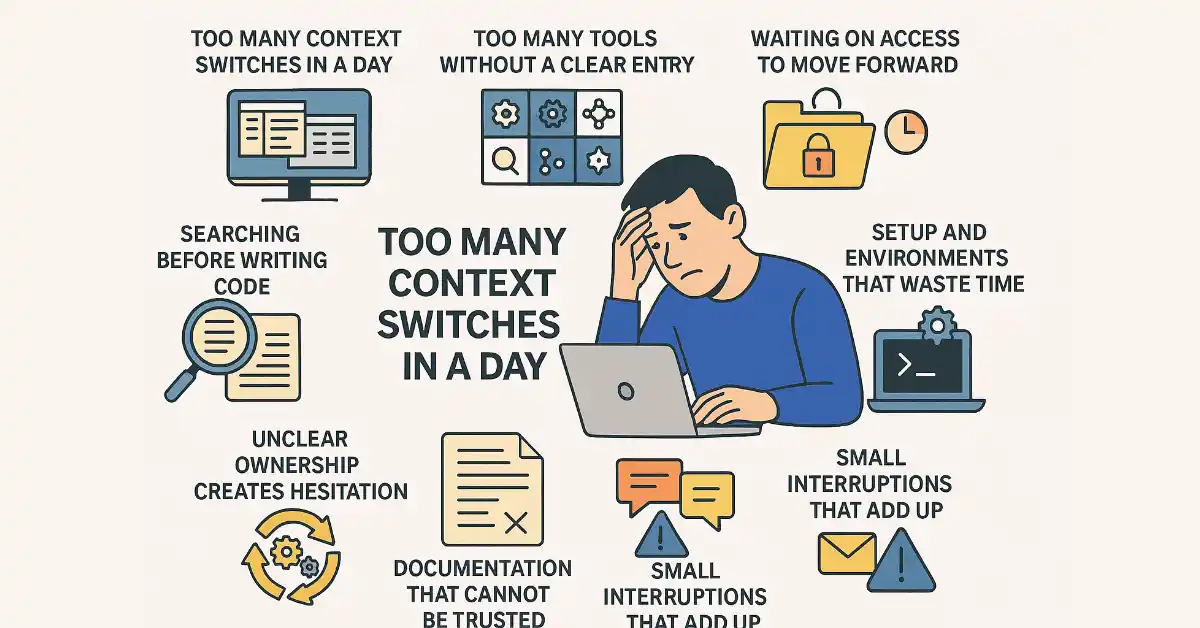
Most developers do not struggle because the code is hard. They struggle because the work around the code keeps getting in the way. A typical day includes switching tools, searching for answers, waiting on access, and fixing setup issues. By the time a developer starts writing code, focus is already gone. Teams often blame slow delivery on bad code or a lack of skill. That misses the real problem. Developer flow breaks long before code quality becomes an issue. If teams want faster and calmer delivery, they need to understand what actually interrupts focus.
Too Many Context Switches in a Day
Developer work requires focus. Even small interruptions can break it. Switching between tools forces the brain to reset. A developer may move from an editor to a dashboard, then to chat, then to documentation. Each switch takes time to recover from. These moments seem harmless on their own. Over a full day, they add up.
Most teams underestimate this cost. They add tools to solve problems without thinking about how they connect. Developers end up remembering where things live instead of working on the task. The flow breaks not because the work is complex, but because attention keeps shifting.
Too Many Tools Without a Clear Entry
Most engineering teams use many tools. Each one solves a real problem. Over time, the list grows. Dashboards, pipelines, incident tools, cloud consoles, and chat apps all compete for attention.
The issue is not the number of tools. The issue is the lack of a clear starting point. Developers must remember where to go for each task. An Internal Developer Portal can help by giving teams one place to discover services, workflows, ownership, and links without replacing existing tools.
Searching Before Writing Code
Many developers spend a lot of time searching before they write a single line of code. They look for the right document. They try to find who owns a service. They scan old tickets for clues. This work feels invisible but it slows everything down.
The problem grows as teams scale. Knowledge spreads across tools and people. New engineers feel it first, but senior engineers feel it too. When information is hard to find, developers hesitate. They second guess decisions. The flow breaks before work even starts.
Waiting on Access to Move Forward
Access issues stop progress right away. A developer may know exactly what needs to be done. They still cannot act without the right permissions. They open a ticket or message someone. Then they wait.
This waiting time does more damage than it seems. Developers switch to other tasks while they wait. When access finally arrives, they must reload the context. Focus does not return instantly. Over time, these delays create frustration and slow delivery across teams.
Unclear Ownership Creates Hesitation
Clear ownership matters more than most teams admit. When developers do not know who owns a service, they slow down. They avoid changes. They ask around. They wait for replies.
This hesitation leads to extra messages and meetings. It also leads to safer but slower choices. Developers avoid improving things they do not fully understand. The flow breaks because decisions feel risky instead of clear.
Setup and Environments That Waste Time
The environment setup should feel routine. Often it does not. Developers hit missing steps, outdated instructions, or hidden dependencies. They retry the same process several times. They ask for help. They compare notes with teammates.
This problem hits hardest during onboarding. It also appears during feature work and incident fixes. When setup feels fragile, developers lose confidence. Time goes into fixing the setup instead of solving the problem. Focus fades fast in these moments.
Repetitive Tasks That Drain Energy
Many teams still rely on manual steps for common work. Creating a service. Requesting an environment. Running standard checks. These tasks repeat every week. Sometimes every day. Each step takes time and attention.
Developers do not struggle with the difficulty of these tasks. They struggle with the repetition. Manual work pulls focus away from problem solving. It also increases the chance of mistakes. When developers spend time on routine steps, the flow breaks before real work begins.
Documentation That Cannot Be Trusted
Documentation only helps when it stays current. In many teams, docs fall behind fast. Tools change. Processes evolve. Pages stay untouched. Developers follow instructions that no longer apply.
This leads to confusion and retries. Developers lose trust in the docs. They stop reading them. They ask people instead. This adds interruptions for everyone. The flow breaks because the source of truth feels unreliable.
Small Interruptions That Add Up
Interruptions rarely look serious. A quick message. A short meeting. A simple question. Each one seems harmless. Together, they break focus many times a day.
Developers need time to think through problems. Interruptions force mental resets. After each one, it takes effort to return to the task. Teams often accept these breaks as normal. Over time, they slow delivery and increase fatigue.
Measuring Speed Instead of Focus
Many teams track output. Tickets closed. Commits merged. Deployments shipped. These numbers matter. They do not show how often the flow breaks.
When teams focus only on speed, they add pressure. Pressure leads to more interruptions and more meetings. Focus suffers. Teams that care about flow look at friction. They remove blockers before pushing for speed.
Bad code slows teams down. Broken flow slows them even more. The biggest causes of lost focus often sit outside the editor. Developers lose time searching for information, waiting on access, fixing setup problems, switching between tools, and handling constant interruptions. These issues rarely show up in metrics, but they affect delivery every day.
Teams that want better outcomes should look at these friction points first. Reducing friction helps developers stay focused for longer periods of time. Sustained focus leads to clearer thinking and fewer mistakes. It also improves collaboration and confidence in day-to-day work. It is imperative to safeguard developer flow. It is a requirement for healthy and productive engineering teams.
Conclusion—What Breaks Developer Flow More Than Bad Code
Developer flow—that precious state of deep, uninterrupted focus—is far more fragile than most realize. While bad code frustrates, everyday interruptions like constant context switches, tool overload, unclear ownership, and accumulating small notifications destroy productivity far worse. These hidden frictions force mental resets, erode momentum, and lead to burnout, delayed delivery, and lower-quality work.
Keeping developers focused requires careful steps: bringing tools together, making roles clear, keeping reliable documentation, automating setups, and keeping engineers safe from unnecessary distractions. Teams that prioritize flow over mere output unlock faster velocity, happier developers, and sustainable excellence. In modern engineering, preserving developer flow isn’t optional—it’s the ultimate competitive advantage.