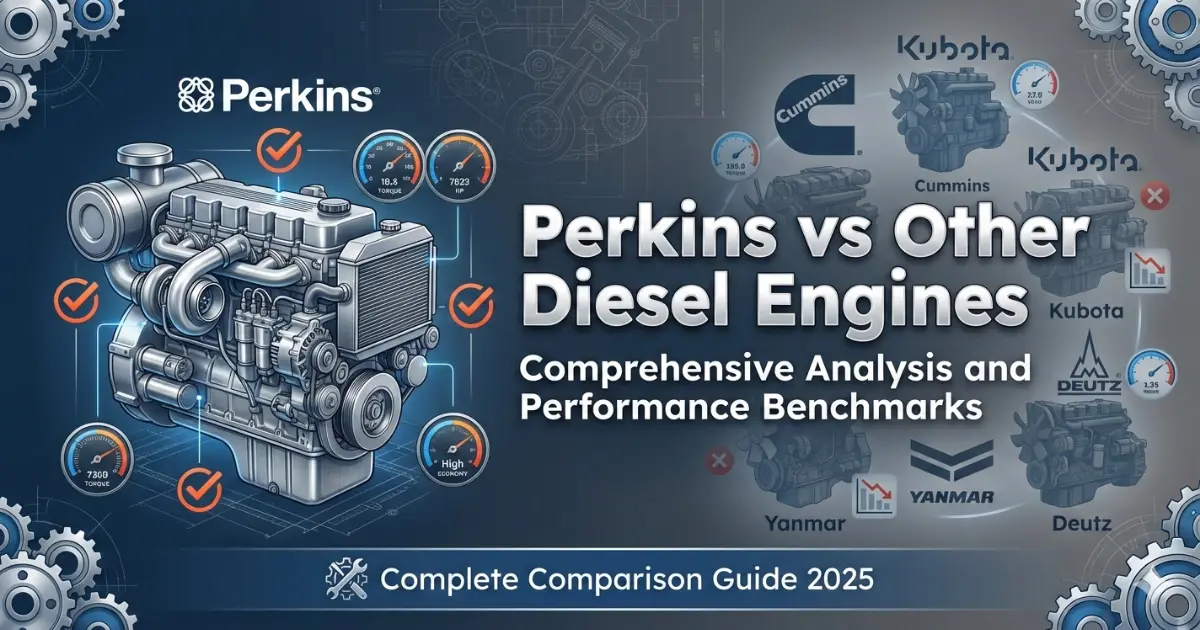
When it comes to selecting a diesel engine for industrial, agricultural, marine, or power generation applications, the choice of manufacturer can significantly impact your operation’s efficiency, reliability, and long-term costs. Perkins engines have maintained a strong reputation in the diesel engine industry for decades, but how do they truly compare against other leading manufacturers? This comprehensive guide examines Perkins engines alongside their main competitors to help you make an informed decision.
Understanding Perkins Engines
Perkins Engines Company Limited, now a subsidiary of Caterpillar Inc., has been at the forefront of diesel engine manufacturing since 1932. With over 90 years of engineering expertise, Perkins has established itself as a global leader producing compact diesel and gas engines ranging from 4 to 2000 kW. The company’s reputation rests on three fundamental pillars: unwavering reliability, exceptional fuel efficiency, and innovative engineering solutions that consistently meet or exceed stringent global emissions standards.
The company’s manufacturing facilities span multiple continents, with production centers in the UK, US, China, India, and Brazil. This global manufacturing footprint ensures consistent quality while providing regional support and reducing delivery times for customers worldwide. If you’re looking for reliable power generation solutions, finding a trusted Perkins generator supplier is essential for accessing genuine Perkins-powered equipment and comprehensive support services.
Major Competitors in the Diesel Engine Market
The diesel engine industry features several formidable manufacturers, each with unique strengths and market positioning:
Cummins stands as one of America’s premier diesel engine manufacturers, offering high-performance engines across virtually every power range imaginable. Their extensive product line serves everything from light-duty pickups to massive industrial applications. Founded in 1919, Cummins has built a reputation for innovation and durability that rivals Perkins in many market segments.
Kubota represents Japanese precision engineering, specializing in compact diesel engines that have become the backbone of agricultural and construction equipment worldwide. Their focus on smaller displacement engines has carved out a significant market niche, particularly in the sub-100 horsepower range where their engines are known for exceptional reliability and fuel economy.
Yanmar brings another dimension of Japanese engineering excellence, with particularly strong presence in marine and industrial applications. Their engines power everything from sailboats to backup generators. Founded in 1912, Yanmar was the first company to succeed in making a compact diesel engine practical for commercial use.
Deutz carries the legacy of German engineering, with a distinguished reputation for both air-cooled and water-cooled diesel engines. They’ve been innovating since 1864, making them one of the oldest engine manufacturers still operating. Deutz engines are particularly respected in European markets and for specialized applications.
John Deere Power Systems leverages the agricultural giant’s engineering prowess to produce engines specifically optimized for agricultural and construction equipment, with deep integration into their machinery ecosystem. While primarily serving John Deere’s own equipment, they also supply engines to select OEM partners.
Isuzu brings automotive-derived technology to the industrial space, with particular expertise in light to medium-duty diesel engines that benefit from decades of automotive refinement. Their engines are widely used in commercial trucks and increasingly in industrial applications.
Performance Comparison: Power, Efficiency, and Responsiveness
Power Output and Fuel Efficiency
Perkins engines have earned recognition for their exceptional power-to-weight ratio, a critical factor in mobile applications where every kilogram matters. The Perkins 1100 Series, delivering between 60 to 130 kW, exemplifies this balance while achieving remarkable fuel efficiency. Independent testing comparing Perkins engines to Kubota’s D1105 series in similar power ranges shows that Perkins engines typically demonstrate 5-8% better fuel consumption under sustained load conditions.
This efficiency advantage translates into real-world savings. For an engine operating 2,000 hours annually, a 6% fuel efficiency improvement can save hundreds of liters of diesel fuel per year. Over the typical 10,000-hour service life, these savings accumulate to thousands of dollars, often exceeding the initial purchase price difference between engine options.
When examining the higher power segments, Cummins engines, particularly their B Series and QSB lines, compete directly with Perkins’ 1500 Series. While both manufacturers produce robust, reliable engines, Perkins engines generally provide smoother operation at lower RPMs. This characteristic makes them particularly well-suited for generator applications where consistent power delivery and reduced vibration are paramount.
Torque Characteristics and Power Delivery
Low-end torque delivery represents one of Perkins’ most significant competitive advantages. The Perkins 1200 Series engines produce peak torque at considerably lower RPMs compared to many Yanmar equivalents. This translates directly into better real-world performance in heavy-duty applications such as excavators, wheel loaders, and agricultural tractors.
The practical benefits are substantial. Lower RPM peak torque means reduced transmission stress, improved operator control in demanding situations, and the ability to maintain productivity even when engine speed varies. Deutz engines also offer strong torque characteristics, particularly their TCD series, but Perkins maintains an edge in torque rise, which measures how much additional torque becomes available as engine speed drops under load.
Reliability and Durability: Built to Last
Engine Block Construction and Material Science
Perkins utilizes high-grade cast iron engine blocks with sophisticated cooling passage designs, an approach similar to Deutz’s proven methodology. However, Perkins has invested significantly in computer-aided design and finite element analysis to optimize block strength while simultaneously reducing weight. This engineering approach produces engines capable of withstanding extreme operating conditions without the weight penalties that compromise mobile equipment performance.
The casting process itself contributes to reliability. Perkins employs advanced foundry techniques including controlled cooling rates and stress-relieving procedures that eliminate internal stresses that could lead to cracking or distortion over time. The cylinder bores receive special surface treatments that reduce friction and wear while improving oil retention for better lubrication. These protective coatings and treatments are somewhat similar to the protective layers used in automotive applications, such as PPF brands for clear and glossy finish that protect vehicle surfaces from damage.
When compared to Kubota engines, which typically achieve similar power outputs through smaller displacement designs, Perkins’ larger displacement approach at comparable power levels generally results in lower internal stresses and, consequently, longer engine life.
Mean Time Between Failures and Real-World Reliability
Industry data consistently shows that Perkins engines achieve Mean Time Between Failures (MTBF) figures exceeding 10,000 hours in industrial applications when maintained according to manufacturer specifications. This metric compares very favorably with Cummins engines (typically 9,000-11,000 hours) and significantly surpasses many Isuzu industrial engines (generally 7,000-9,000 hours in similar applications).
Several engineering factors contribute to Perkins’ excellent reliability record. The premium filtration systems protect critical components from contamination that causes the majority of diesel engine failures. The fuel injection systems employed by Perkins feature proven durability even when operating with varying fuel quality. Advanced engine management systems continuously monitor operating parameters and implement protective measures that prevent harmful operating conditions before damage occurs.
Maintenance Requirements and Service Accessibility
Service Intervals and Maintenance Schedules
Perkins engines typically feature standard service intervals of 500 hours for oil changes in industrial applications, matching industry norms. However, Perkins has introduced extended service intervals reaching 750 hours on newer models when using approved synthetic lubricants and operating under normal conditions. This matches or exceeds the extended intervals offered by competitors like Cummins and Deutz, reducing operational downtime and maintenance costs.
Kubota engines, while generally reliable, sometimes require more frequent maintenance attention in dusty or high-load environments. Their compact design and resulting higher internal operating temperatures can stress lubricants more quickly. The larger cooling capacity and oil reservoir of Perkins engines provide additional buffers that extend component life between services.
Parts Availability and Service Network
One of Perkins’ most significant advantages lies in their extensive global service network and parts availability. As a Caterpillar company, Perkins benefits from Cat’s worldwide distribution infrastructure, ensuring parts availability even in remote locations. This represents a crucial consideration for operations in developing markets or areas far from major cities.
Cummins matches this global reach with their own extensive dealer network, making both Perkins and Cummins superior choices for international operations compared to more regionally focused manufacturers. Kubota and Yanmar maintain strong networks in Asia and increasingly in North America, but may have limited presence in Africa, the Middle East, and parts of South America.
Parts pricing represents another consideration. Perkins parts generally fall in the middle of the price spectrum—more expensive than Kubota or Yanmar for comparable components, but typically less expensive than Deutz or specialized manufacturers.
Emissions Compliance and Environmental Performance
Meeting Global Emissions Standards
Modern diesel engines must comply with increasingly stringent emissions regulations across different global markets. Perkins has demonstrated strong capability in meeting Tier 4 Final (US), Stage V (EU), and equivalent standards in other markets. Their approach typically employs a combination of technologies including high-pressure common rail fuel injection, exhaust gas recirculation (EGR), diesel particulate filters (DPF), and selective catalytic reduction (SCR) systems.
Cummins has taken a somewhat different technological approach in some engine families, sometimes relying more heavily on SCR systems and less on EGR. Both approaches successfully meet emissions requirements, but have different implications for maintenance requirements and operational considerations.
Fuel Consumption and Carbon Footprint
Beyond regulatory compliance, actual fuel consumption directly impacts both operating costs and environmental footprint. Perkins engines consistently rank among the most fuel-efficient in their respective power classes. The 1200 Series, for instance, typically achieves 3-7% better fuel economy than equivalent Yanmar engines in agricultural applications, according to independent testing.
This efficiency advantage stems from several factors including optimized combustion chamber geometry, precise fuel injection timing and quantity control, advanced turbocharging systems, and sophisticated engine management algorithms that continuously optimize performance parameters for maximum efficiency.
Application-Specific Comparisons
Agricultural Applications
In agricultural equipment, reliability and fuel efficiency during extended operating periods become paramount. Farmers often run equipment from dawn to dusk during critical planting and harvesting windows, making unexpected breakdowns particularly costly.
Perkins has long dominated agricultural applications, with engines powering tractors, combines, and other farm equipment from numerous manufacturers including AGCO (Massey Ferguson, Fendt, Valtra), CNH Industrial (Case IH, New Holland), and many smaller manufacturers worldwide. Their engines deliver strong low-end torque ideal for implement work, maintain consistent power output during extended operations, and tolerate the dusty, variable load conditions typical of agricultural use.
John Deere Power Systems engines naturally dominate John Deere equipment, and they perform admirably in these applications with deep integration into the machinery’s hydraulic and electronic systems. However, for manufacturers seeking engine suppliers or farmers considering equipment from multiple brands, Perkins’ broad OEM relationships and proven agricultural performance make them a compelling choice.
Construction and Industrial Equipment
Construction applications demand durability, power density, and reliable performance in challenging conditions including high ambient temperatures, dusty environments, and shock loading. Perkins engines excel in these conditions, with ruggedized components and robust cooling systems that maintain performance when competitors overheat.
Deutz engines also perform well in construction applications, particularly their air-cooled variants in applications where liquid cooling systems might be compromised by debris or damage. However, modern water-cooled Perkins engines generally offer better fuel efficiency and lower noise levels, which increasingly matter in urban construction environments.
Marine Applications
Marine environments present unique challenges including constant vibration, corrosive salt air, limited ventilation, and the catastrophic consequences of failure far from shore. Yanmar has traditionally held strong positions in marine applications, particularly in sailboat auxiliary engines and small commercial vessels.
Perkins marine engines, particularly their M-series, compete effectively in this space with excellent corrosion resistance through advanced coating technologies, smooth operation that minimizes vibration transferred to the vessel, and proven reliability in continuous-duty applications. Perkins marine engines power everything from pleasure craft to commercial fishing vessels and passenger ferries.
Generator and Power Generation
For standby and prime power generation, consistent operation at fixed RPM, low vibration, and exceptional reliability become the primary selection criteria. Perkins has established a dominant position in the generator market, with engines specifically optimized for these applications.
Compared to Cummins, which also maintains strong presence in power generation, Perkins engines often provide slight advantages in fuel consumption at partial loads, which matters significantly for applications that rarely operate at full capacity.
Total Cost of Ownership Analysis
Initial Purchase Price
Initial engine cost varies significantly based on power rating, emissions compliance level, and OEM relationships. Generally speaking, Perkins engines fall in the mid-to-upper price range. Kubota and Yanmar engines typically offer lower initial purchase prices, particularly in smaller displacement ranges. Deutz engines often command premium pricing, especially for specialized applications.
However, focusing solely on initial purchase price overlooks the more significant factors that determine total cost of ownership over an engine’s service life.
Operating Costs Over Engine Lifespan
Fuel costs typically represent 60-70% of total operating costs for diesel engines in industrial applications. Perkins’ 5-8% fuel efficiency advantage over some competitors translates into substantial savings over a 10,000-hour service life. For an engine consuming 10 liters per hour, a 6% efficiency improvement saves 600 liters per thousand hours, or 6,000 liters over the engine’s expected life.
Maintenance costs constitute another major expense category. Perkins’ longer service intervals and robust component design reduce maintenance frequency and parts consumption compared to engines requiring more intensive service schedules.
Downtime and Reliability Costs
For commercial operations, unexpected downtime often costs far more than direct repair expenses. A construction company losing a day’s productivity from a failed excavator engine might forfeit thousands in revenue while still paying operators and facing project delays with associated penalties.
Perkins’ superior MTBF figures translate directly into reduced downtime risk. Over a 10-year service life, the difference between 10,000-hour MTBF (Perkins) and 7,000-hour MTBF (some competitors) could mean 2-3 fewer major failures, potentially preventing weeks of cumulative downtime.
Resale Value and Equipment Longevity
Equipment resale value correlates strongly with engine reputation. Equipment powered by Perkins engines typically commands premium resale prices compared to equipment with lesser-known engine brands, all else being equal. Buyers in the used equipment market recognize that Perkins engines offer reliability, parts availability, and known maintenance requirements—reducing their risk in purchasing used equipment. When evaluating used equipment, understanding how to properly inspect the engine and overall condition is crucial, similar to how to inspect a used car before making a purchase decision.
Technology and Innovation Comparison
Engine Management Systems
Modern diesel engines rely heavily on sophisticated electronic control systems that optimize performance, ensure emissions compliance, and protect engines from harmful operating conditions. Perkins’ engine management systems feature advanced algorithms that continuously adjust fuel injection timing and quantity, turbocharger boost pressure, and EGR rates to optimize performance across varying loads and conditions.
Cummins has also invested heavily in electronic controls, with their ADEPT system (Advanced Diesel Engine Protection Technology) providing comprehensive engine protection. Both systems perform admirably, with differences being primarily in user interface and integration with specific equipment manufacturers’ overall vehicle systems.
Turbocharging and Air Management
Perkins employs advanced turbocharging technology including variable geometry turbos on many models, which provide excellent transient response and maintain boost pressure across broad RPM ranges. This results in better acceleration, improved load acceptance, and reduced turbo lag compared to fixed-geometry alternatives.
Traditional fixed-geometry turbochargers compromise between low-speed response and high-speed efficiency. Variable geometry turbos optimize for both conditions, using small effective areas at low speed for quick boost buildup, then opening to larger areas at high speed to reduce back pressure and improve efficiency.
Future-Proofing and Alternative Fuels
As the industry gradually transitions toward alternative fuels and hybridization, Perkins has demonstrated commitment to evolution through development of engines compatible with biodiesel blends, introduction of gas-powered variants for applications where natural gas offers advantages, and collaboration on hybrid powertrains combining diesel engines with electric motors.
Most modern Perkins engines are approved for B20 biodiesel blends (20% biodiesel, 80% petroleum diesel) without modifications, with some models approved for higher blends. This compatibility provides pathways to reduce carbon footprint as alternative fuels become more widely available.
Customer Support and Training
Technical Support Quality
Perkins maintains comprehensive technical support through multiple channels including 24/7 phone support, extensive online resources and technical documentation, factory-trained technician networks, and specialized support for large fleet operators. This support infrastructure matches or exceeds most competitors with the exception of Cummins, which offers similar comprehensive support.
Smaller manufacturers like Kubota and Yanmar offer good support within their primary markets but may have limited technical resources in regions where they have less market presence.
Operator and Technician Training
Perkins offers extensive training programs for both equipment operators and maintenance technicians. These programs cover proper operation techniques to maximize efficiency and engine life, preventive maintenance procedures, diagnostic and troubleshooting methodologies, and major repair procedures for authorized service centers.
Investment in proper training yields returns through reduced downtime, better diagnostic accuracy, and improved maintenance quality that extends engine life and maintains performance.
Making Your Decision: Which Engine Is Right for You?
Selecting the optimal diesel engine requires careful consideration of your specific application requirements, operating environment, support infrastructure availability, and total cost of ownership projections.
Choose Perkins engines when you need:
- Proven reliability in mission-critical applications where downtime costs are high
- Superior fuel efficiency to minimize operating costs over engine lifespan
- Global parts availability and service support for international operations
- Strong low-end torque for heavy-duty applications
- Engines optimized for stationary power generation
- Manufacturer with long-term commitment to the diesel engine industry
Consider Cummins engines when you need:
- Similar reliability and performance to Perkins with alternative brand preference
- Specific power ratings where Cummins offers optimal solutions
- Integration with Cummins-based equipment ecosystems
- Regional preferences in North American markets where Cummins has particularly strong presence
Evaluate Kubota or Yanmar when you need:
- Compact engines where space constraints are paramount
- Lower initial purchase price with acceptance of potentially higher operating costs
- Equipment already designed around these engines
- Primary operations in Asian markets where these manufacturers have strongest support
Examine Deutz when you need:
- Specialized applications where air-cooling offers advantages
- European equipment integration
- Unique engineering solutions for challenging applications
For most general industrial, agricultural, construction, and power generation applications, Perkins engines represent an excellent choice that balances initial cost, operating efficiency, reliability, and global support. Their consistent performance across diverse applications and operating conditions has earned them the trust of equipment manufacturers and end users worldwide.
Conclusion
Comparing Perkins diesel engines against other leading manufacturers reveals that while many excellent options exist, Perkins maintains competitive advantages in fuel efficiency, reliability, global support infrastructure, and total cost of ownership across most applications. The company’s 90-year history, combined with Caterpillar’s resources and commitment, positions Perkins as a manufacturer likely to continue supporting customers for decades to come.
The optimal engine choice depends on your specific circumstances, but for most operators seeking a balance of performance, efficiency, reliability, and support, Perkins engines deserve serious consideration. Their proven track record across millions of engines operating in virtually every environment and application worldwide demonstrates that they can deliver the performance and longevity that make the difference between profitable operations and costly disappointments.
Whether you’re running construction equipment, agricultural machinery, marine vessels, or power generation systems, understanding these engine comparisons helps you make informed decisions. For more insights into automotive and machinery topics, visit NetworkUstad.com – your trusted source for comprehensive guides and expert advice. From vintage car lights to modern diesel technology, we cover everything you need to know about vehicles and machinery.