
Bitcoin, an enigmatic digital asset, first surfaced in 2008 when an individual or group operating under the pseudonym Satoshi Nakamoto introduced the concept through a whitepaper titled ‘Bitcoin: A Peer-to-Peer Electronic Cash System.’ This event began a paradigm shift in the global economic landscape.
Bitcoin’s emergence is rooted in a decentralized framework, operating on the principle of a peer-to-peer network. Its significance lies in challenging traditional financial systems and offering an alternative value transfer and wealth storage approach. Amidst the dynamic landscape of Bitcoin’s trajectory, exploring transformative tools like the Immediate 500 Evex becomes pertinent. This innovative solution opens new avenues for navigating the cryptocurrency space, bringing a fresh perspective to the evolving narrative of digital assets.
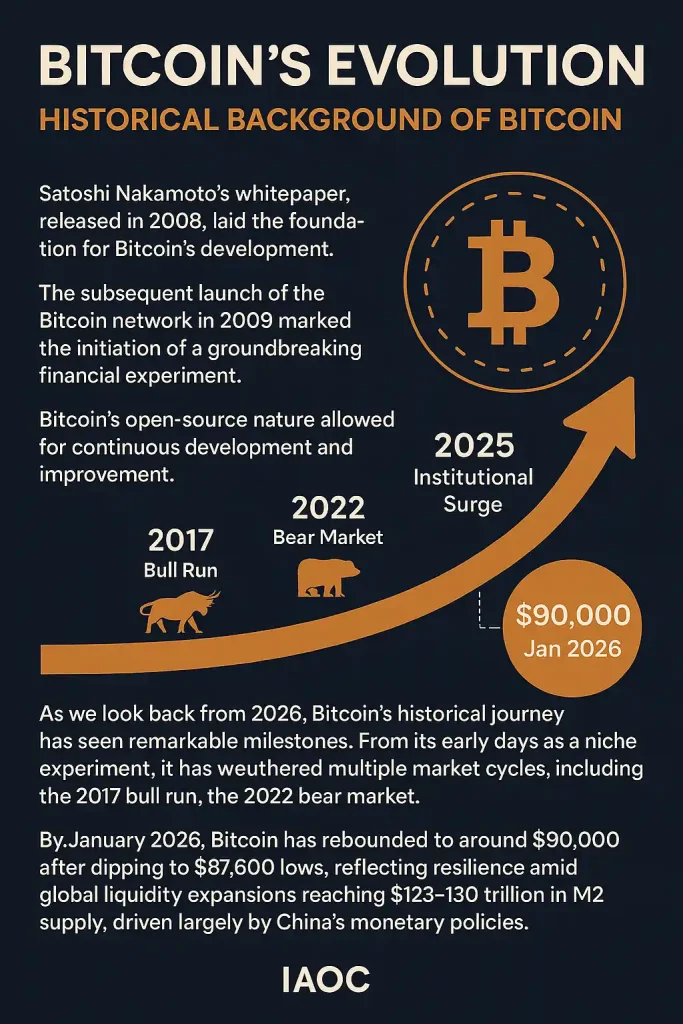
Bitcoin’s Evolution
Historical Background of Bitcoin
Satoshi Nakamoto’s whitepaper, released in 2008, laid the foundation for Bitcoin’s development. The subsequent launch of the Bitcoin network in 2009 marked the initiation of a groundbreaking financial experiment. Bitcoin’s open-source nature allowed for continuous development and improvement.
As we look back from 2026, Bitcoin’s historical journey has seen remarkable milestones. From its early days as a niche experiment, it has weathered multiple market cycles, including the 2017 bull run, the 2022 bear market, and the institutional surge of 2025. By January 2026, Bitcoin has rebounded to around $90,000 after dipping to $87,600 lows, reflecting resilience amid global liquidity expansions reaching $123-130 trillion in M2 supply, driven largely by China’s monetary policies.
Technological Aspects of Bitcoin
At its core, Bitcoin relies on blockchain technology—a distributed ledger that records all transactions across a network of computers. This decentralized nature ensures transparency, security, and resistance to censorship. The concept of decentralization is a pivotal aspect of Bitcoin’s evolution, challenging the centralized control of traditional financial institutions.
In 2026, technological advancements have further solidified Bitcoin’s role. Layer-2 solutions like the Lightning Network have scaled transactions to handle millions per day, reducing fees and improving efficiency. Moreover, concerns over quantum computing threats to wallet security have prompted innovations in post-quantum cryptography, ensuring Bitcoin’s network remains robust against emerging risks. These developments align with Bitcoin’s ongoing adaptation to a world where digital assets intersect with AI-driven economies and renewable energy integrations for mining.
Economic Drivers of Bitcoin
Store of Value
Bitcoin has garnered attention as a potential “digital gold,” serving as a store of value analogous to precious metals. Its finite supply, capped at 21 million coins, positions it as a hedge against inflation and economic uncertainty. This characteristic has prompted comparisons with traditional assets like gold.
Entering 2026, this narrative holds stronger amid persistent inflation and mixed global growth. While Bitcoin lagged gold in early 2026—trading at $89,000-95,000 versus gold’s $4,665—analysts predict a “catch-up” phase as liquidity surges. Predictions from figures like Binance’s CZ forecast a “super-cycle” breaking historical patterns, potentially pushing Bitcoin beyond $100,000 by mid-year, fueled by institutional demand and its role as a non-sovereign asset in uncertain times.
Medium of Exchange
Bitcoin transactions have experienced substantial growth, with an increasing number of businesses and financial institutions accepting the cryptocurrency. The decentralized nature of these transactions offers a borderless and efficient medium of exchange, challenging traditional payment systems.
By 2026, stablecoin supply has exploded to $311 billion, enhancing Bitcoin’s utility as a settlement layer. Real-world asset (RWA) tokenization is accelerating, with projections for $120 billion in institutional lending. This shift underscores Bitcoin’s evolution from speculative asset to a core component of global trade, especially in regions facing currency devaluation.
Bitcoin and Financial Inclusion
Breaking Down Barriers
Bitcoin’s global accessibility is a transformative force, enabling financial participation for individuals in regions with limited or no access to traditional banking services. The decentralized nature of Bitcoin eliminates the need for intermediaries, fostering financial inclusion on a global scale.
In 2026, this impact is evident in emerging markets, where Bitcoin adoption has surged amid energy wars and metal shortages. For instance, in Venezuela and parts of Asia, Bitcoin serves as a hedge against hyperinflation, with mobile wallets enabling cross-border remittances without fees eroding value.
Challenges and Opportunities
While Bitcoin presents opportunities for financial inclusion, regulatory considerations remain a challenge. Striking a balance between empowering the unbanked and addressing regulatory concerns is crucial for the sustainable integration of Bitcoin into the global financial landscape.
Regulatory clarity in 2026, via acts like FIT21 and CLARITY, has reduced barriers, with 74% of family offices exploring digital assets. However, challenges like tariff risks and geopolitical tensions could spark volatility, yet they also highlight opportunities for Bitcoin as a neutral, unfreezable asset.
Bitcoin’s Role in Shaping Monetary Policy
Influence on Central Banks
The rise of Bitcoin has prompted central banks to explore the development of Central Bank Digital Currencies (CBDCs). This response reflects a reevaluation of traditional monetary policy frameworks in light of the disruptive potential posed by decentralized digital currencies.
As of 2026, over 100 countries have launched or piloted CBDCs, influenced by Bitcoin’s model. The Fed’s pivot toward rate cuts to 3% amid liquidity injections positions Bitcoin as a high-beta play on easing cycles.
Policy Responses to Bitcoin’s Rise
Governments and financial authorities worldwide are formulating policies to address Bitcoin’s challenges and opportunities. The dynamic interplay between Bitcoin and traditional monetary systems necessitates adaptive policy responses.
Global rules are going live in 2026, per PwC, reshaping stablecoins and compliance. In the U.S., the Digital Asset Market Clarity Act of 2025 provides frameworks, accelerating institutional integration and potentially driving Bitcoin to $124,000-$150,000 in Q1.
Risks and Challenges
Market Volatility
Bitcoin’s price volatility is a well-documented phenomenon, influenced by factors ranging from market sentiment to regulatory developments. Understanding the dynamics of price fluctuations is essential for investors navigating the cryptocurrency landscape.
In early 2026, volatility persists, with Bitcoin stalling at $89,500 amid rising wedges risking 13% drops. Macro uncertainties, like U.S. job data and tariffs, weigh on sentiment, though long-term holders continue accumulating.
Regulatory Uncertainties
The regulatory landscape for Bitcoin varies globally, with governments adopting diverse approaches. Navigating these regulatory uncertainties is critical to Bitcoin’s journey, impacting its acceptance and integration into mainstream financial systems.
While 2026 brings clarity, uncertainties remain in areas like quantum risks and international order shifts, where cryptocurrencies correlate more with stocks during panics.
Future Outlook
Potential Scenarios for Bitcoin’s Role
Anticipating Bitcoin’s future role involves considering various scenarios, including increased adoption, regulatory clarity, or technological advancements. The dynamic nature of the cryptocurrency space requires ongoing assessment of potential outcomes.
For 2026, scenarios include a “dawn of the institutional era” per Grayscale, with prices from $75,000 to $225,000. BlackRock forecasts accelerated adoption, driven by profound shifts.
Integration with Traditional Financial Systems
Bitcoin’s trajectory suggests a potential integration with traditional financial systems, challenging the existing currency and financial intermediation paradigms. Collaboration and coexistence may become key themes in the evolving relationship between Bitcoin and traditional finance.
By 2026, crypto ETPs bridge blockchain and finance, with mergers and vertical institutional capital. Coinbase predicts transformative growth, deepening Bitcoin’s core role.
Innovations and Developments
Ongoing innovations within the cryptocurrency space contribute to Bitcoin’s dynamic nature. Developments such as layer-two solutions, scalability improvements, and novel use cases continually shape the evolving narrative of Bitcoin’s role in the global economy.
Innovations like AI-crypto integrations and omnichain infrastructure promise efficiency, with analysts eyeing Q1 targets amid policy support.
For more on crypto trends, explore Bitcoin and Crypto Currencies. Insights on halvings in Assessing the Influence of Bitcoin Halvings on Market Dynamics. Future crises in Anticipating the Future Role of Bitcoin Amidst Global Financial Crises. Online ideas in Online Business Ideas Start from Home. Tech updates in Technology.
External resources: CoinDesk for policy news, Forbes for market analysis.
Conclusion – Bitcoin’s Role in Global Economic Shifts
In summary, Bitcoin’s journey from a conceptual whitepaper to a global financial disruptor is marked by technological innovation, economic exploration, and regulatory scrutiny. Bitcoin’s decentralized and transparent nature challenges established norms, opening avenues for financial inclusion and reshaping monetary policy. As the world navigates the complex intersection of tradition and innovation, Bitcoin’s role in global economic shifts remains a compelling and evolving narrative.
In 2026, with institutional adoption accelerating and liquidity tailwinds, Bitcoin solidifies as a macro asset. Stay vigilant on regulations and innovations for sustained growth in this dynamic space.
FAQs
What is Bitcoin’s current price in 2026?
As of January 2026, Bitcoin trades around $90,000, rebounding from $87,600 lows amid liquidity surges. Predictions range from $75,000 to $225,000, driven by institutional inflows and regulatory clarity, but volatility remains a key risk.
How has institutional adoption of Bitcoin changed in 2026?
In 2026, 74% of family offices explore digital assets, with $300B projected inflows. Acts like CLARITY and FIT21 provide frameworks, accelerating ETPs and treasury holdings by 170+ companies, marking the institutional era.
What role does Bitcoin play as a hedge in 2026’s economy?
Bitcoin acts as “digital gold” amid inflation and $123-130T M2 liquidity. Though lagging gold at $4,665, it’s poised for a super-cycle, potentially breaking $100,000 as a non-sovereign asset in uncertain global shifts.
What are the regulatory updates for Bitcoin in 2026?
Global rules go live per PwC, reshaping stablecoins. U.S. FIT21 and Digital Asset Market Clarity Act clarify SEC/CFTC roles, reducing uncertainties and boosting adoption, though geopolitical risks persist.
What innovations are shaping Bitcoin’s future in 2026?
Layer-2 scalability, quantum-resistant tech, and RWA tokenization drive growth. Stablecoins hit $311B, with AI integrations and omnichain efficiency projecting $120B in lending, transforming Bitcoin into infrastructure.