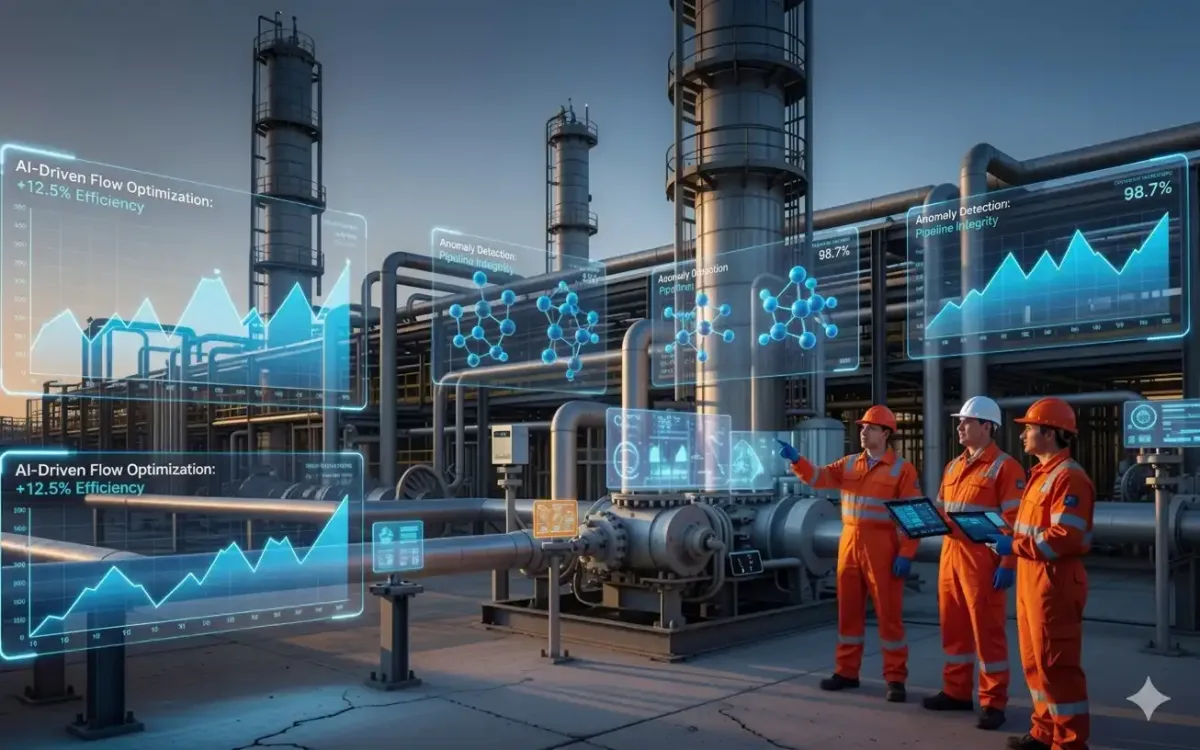
It’s no secret that AI has transformed (and is still transforming) businesses across virtually every sector; oil and gas firms are definitely no exception. If your company can’t keep up, chances are it’ll quickly get left behind; in this post, we’ll explain this wave and why you need to ride it.
Why is AI Growing in O&G?
No surprise here, the answer is simply that AIs are getting better by the day. LLMs are getting to the point where they can replicate human decision-making, meaning some firms are even trying agentic models that can act independently. Just this November, SLB launched Tela, which goes beyond mere automation and “takes action” against drilling issues. Sounds promising, right?
Refining industrial processes with AI makes oil and gas companies more efficient than ever, but there’s a reason the “human-in-the-loop” approach still drives the industry. See, AI has a strange tendency to hallucinate. It can generate decision flows that sound like they make sense, but you absolutely *need* an expert on hand to check they’re all suitable.
How are Companies Adapting?
You’d be hard-pressed to find a thriving oil and gas firm that isn’t currently using AI in some way, whether that’s to check equipment, reduce emissions, or just automate menial tasks. Upstream, midstream, and downstream operations all benefit from it — here are just a few examples:
BP
BP uses Palantir’s AI-driven solutions to “accelerate human decision-making” by analyzing over two million sensors and providing targeted recommendations. It also utilizes digital twins, virtual copies of physical assets that use data to run “what-if” scenarios safely. Though the companies claim to have safeguards against AI hallucinations, BP presumably still needs a human being to approve everything, just in case.
Saudi Aramco
Saudi Aramco’s massive Khurais oil field now uses 40,000 sensors to monitor around 500 wells. For example, it utilizes fiber optics to detect potential leaks during transportation. Saudi Aramco reported that this halved their troubleshooting response times whilst improving production. This also served as a pilot program for the company’s Advanced Process Control strategy, one that’s clearly succeeded. This is just one of their AI-driven solutions; they also use detailed geological data to create digital twins of reservoirs.
Shell
One of the most striking examples of Shell’s AI strategy is its predictive maintenance system — which the firm created independently after finding no suitable product on the market. It originally helped with just sixteen specific types of valves to ensure they ran smoothly. Now, the company has scaled its solution to fit every valve used across its many facilities. The company has since expanded its use of AI by partnering with C3.ai, and aims to utilize automation to reach net zero by 2050.
ExxonMobil
ExxonMobil currently uses AI in its Guyana and Permian Basin operations. The former employs closed-loop autonomous drilling, which improves penetration rates and avoids any human errors that could lead to breaching a dry spot by mistake. Meanwhile, their Permian Basin setup relies on a big data partnership with Microsoft, which enables them to refine their existing workflows and reduce methane emissions over time.
What New Business Models are Emerging?
Of course, finding ways to save money *also* means finding new ways to make it, as O&G firms can sell their digital twin data and AI models to other companies. For example, Shell could make a fortune leasing out its predictive maintenance tech — and Saudi Aramco’s digital wing plans to sell edge AI devices to boost industrial plants across the Middle East and likely beyond.
This does mean that oil and gas giants will benefit massively more than mid-budget firms (which might include your own). But AI-as-a-service lets companies of virtually any size access proven automated solutions at a (relatively low) ongoing cost. Certainly a lot cheaper, and MUCH faster, than setting up a multi-million dollar partnership or building a tool from scratch, that’s for sure.
What Should Oil and Gas Firms Do?
The big question… if you haven’t jumped on the AI wave, there’s no time like the present; and to be blunt, companies that don’t do this might not have much of a future to speak of. Here’s a quick step-by-step look at how to get started:
- Build a minimal viable data lake for critical assets
- Fix all telemetry gaps (SCADA, PLCs, etc.)
- Plan a high-ROI pilot, such as fixing a recurring pump failure
- Set up third-party automation software
- Check that your deployment fits regulatory frameworks
- Use implementation specialists to tie your workflows together
- Train your staff to use the software
- Set up “automation champions” who’ll liaise with the vendor
Once your pilot’s seen results, you can broaden your AI use and ride the wave that’s carrying so many firms toward greater profits. In our opinion, the best way forward is to find third-party tools that’ll get the job done — their implementation experts can even make sure it meshes perfectly with your usual way of working.