Music creation is becoming more accessible, but many creators still struggle to turn rough ideas into polished tracks without spending hours inside traditional production software. That is why an ai song agent can be so useful: instead of forcing users to handle every technical step manually, it helps translate creative intent into structured, usable music. SongAgent presents itself as a professional AI-powered music platform that can generate songs, compose melodies, and support full music creation workflows through a conversational interface.
For creators who want a faster path from concept to finished song, SongAgent stands out by combining musical understanding, guided planning, refinement, and export tools in one workflow. The platform emphasizes music-theory-aware generation, commercial-use options on paid plans, and support for both quick creation and more detailed iterative refinement.
Why AI Song Agent Tools Matter for Modern Creators
The biggest problem in music creation today is not a lack of ideas. It is the gap between inspiration and execution.
-
Technical complexity Many users know the mood, style, or emotional direction they want, but they do not know how to arrange chords, structure a song, or produce a polished track. SongAgent positions its product around understanding genre, mood, structure, and emotional intent rather than making users build everything manually.
-
Slow creative workflows Traditional music production often means moving between writing, composition, arrangement, editing, and export tools. SongAgent instead describes a workflow where users describe an idea, review a musical blueprint, generate the track, refine it, and export the result.
-
Limited control in simple music generators Some entry-level tools can make songs quickly, but they often feel random or shallow. SongAgent claims its system applies music theory principles and lets users continue the conversation to request changes such as making a chorus more energetic or adding strings to a bridge.
-
Difficulty creating music at scale For creators who need a soundtrack package, an album concept, or a branded set of tracks, making multiple songs that still feel cohesive is hard. SongAgent highlights batch composition and specifically describes use cases such as complete albums, podcast music packages, and game soundtracks.
-
Commercial licensing concerns Content creators, marketers, and businesses need clarity on whether they can actually use generated music in professional work. SongAgent says every track generated comes with complete commercial rights and zero royalty obligations on paid tiers, while its pricing and music pages also distinguish between free usage and premium commercial use.
These pain points explain why more users are searching for an ai song agent rather than just a generic song generator. They want speed, better musical understanding, and a workflow that supports both experimentation and usable final output.
Why SongAgent Works as an AI Song Agent
If this article is meant to support your own site, the strongest positioning is not simply “AI can make songs.” It is that SongAgent tries to act more like a music collaborator than a one-click novelty tool.
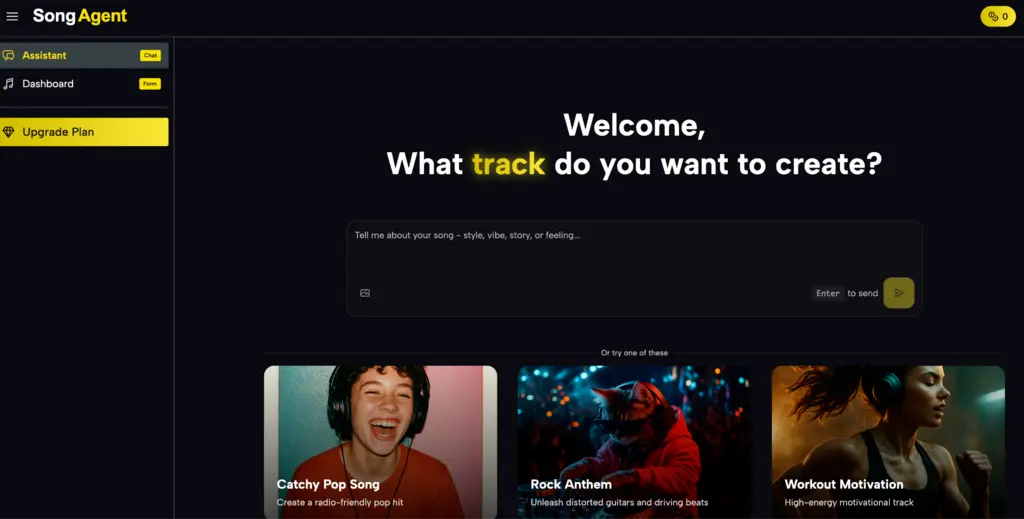
For creators who want an intelligent music workflow, ai music agent features on SongAgent are built around more than just instant generation. The homepage describes Intelligent AI Song Agent, Efficient Batch Composition, Copyright-Free Commercial Use, and End-to-End Music Creation as core advantages. The platform also says users can start with a prompt, review a proposed musical plan, refine the result through conversation, and then download professionally mixed and mastered tracks in multiple formats.
Feature Highlight 1: Musical Intelligence Instead of Random Output
One of SongAgent’s clearest claims is that it understands music theory, genre conventions, structure, and emotional intent. That matters because many users do not just want “a song.” They want something that feels intentionally composed for a specific use case, such as an uplifting pop ballad, a podcast intro package, or a cinematic soundtrack. SongAgent’s positioning around musical intelligence is one of its strongest differentiators.
Feature Highlight 2: Guided Workflow With Review and Refinement
Another practical advantage is its staged workflow. Instead of going straight from prompt to final file with no visibility, SongAgent says users first describe their vision, then review a musical blueprint including structure, instrumentation, key signature, tempo, and style elements, and only then move into generation and refinement. This review-before-generation approach is a meaningful strength, because it gives users more control over direction before they spend time iterating.
Feature Highlight 3: Production and Export Features for Real Use
SongAgent also positions itself around complete creation rather than raw demos. Its pages mention professional editing, track extensions, advanced vocal separation, WAV and MP3 downloads, and stems. The pricing page says even the free plan includes private generation, unlimited chat, MP3 and WAV downloads, vocal separation, and stems up to 10 tracks, while premium plans unlock broader commercial usage and higher-end capabilities. That mix of creation plus production support makes the tool more useful for real workflows, not just experimentation.
How to Use an AI Song Agent More Effectively
A tutorial-style section usually performs better for SEO because it aligns with real informational search intent.
Step-by-step workflow
-
Describe your musical idea clearly Start with the mood, genre, instruments, tempo, and purpose. SongAgent’s homepage explicitly says users can be as simple or detailed as they like when describing a song idea.
-
>ng>Review the proposed musical plan Before generation, SongAgent says it presents a blueprint with structure, instrumentation, key signature, tempo, and style elements so users can confirm the direction matches their intent.
-
Generate and refine the track Once the plan looks right, generate the song and continue refining it through conversation. SongAgent gives examples like asking for a more energetic chorus or adding strings to the bridge.
-
Export and repurpose the result SongAgent’s music page says generated songs can be exported and repurposed for video editing, podcast production, or game design, while download options include MP3 and WAV, with stems available on supported plans.
Common use cases
-
Content creators who need original background music for YouTube, short-form video, or branded content. SongAgent’s site specifically mentions YouTube videos and streaming platforms as supported commercial scenarios on paid tiers.
-
Podcast producers creating intros, transitions, suspense beds, and outros as a coherent package. This is one of the example workflows described on the homepage.
-
Game developers building looping fantasy, battle, village, or ambient soundtrack sets. SongAgent explicitly uses video game soundtrack creation as one of its sample projects.
-
Album-minded creators who want multiple songs with stylistic consistency across a larger project. SongAgent highlights complete album creation and batch composition as a core capability.
AI Song Agent Comparison and Buying Advice
A good comparison should focus on workflow fit rather than hype.
| Tool | Core Advantage | Best For | Free Version |
|---|---|---|---|
| SongAgent | Music-theory-aware generation, guided review workflow, batch composition, export tools, stems, and commercial-use path on paid plans | Creators who want more structure and refinement than a simple one-click song generator | Yes |
| Suno | Large mainstream AI music platform with consumer-friendly generation flow | Users who want easy, high-visibility AI song creation | Yes |
| Udio | AI music generation with consumer and subscription-style workflow | Users focused on fast music creation and iteration | Yes / limited |
| AIVA | Composition-oriented AI with structured licensing and creative exports | Users who want more composition-first workflows | Yes |
For most users, the best tool depends on whether they care more about instant novelty or structured control. SongAgent’s strongest position is its attempt to function as an actual ai song agent: it guides users through intent, planning, refinement, and export, instead of only producing a quick draft. That makes it especially relevant for creators who need repeatable, project-ready results rather than one-off experiments.
Final Thoughts
The value of an ai song agent is not just that it can generate music quickly. It is that it can reduce the distance between an idea and a finished, usable track. SongAgent stands out because it combines musical understanding, guided blueprint review, iterative refinement, batch composition, and production-ready export options in one platform.
If you want a music tool that feels more like a collaborative creative assistant than a basic generator, SongAgent is a strong place to start.