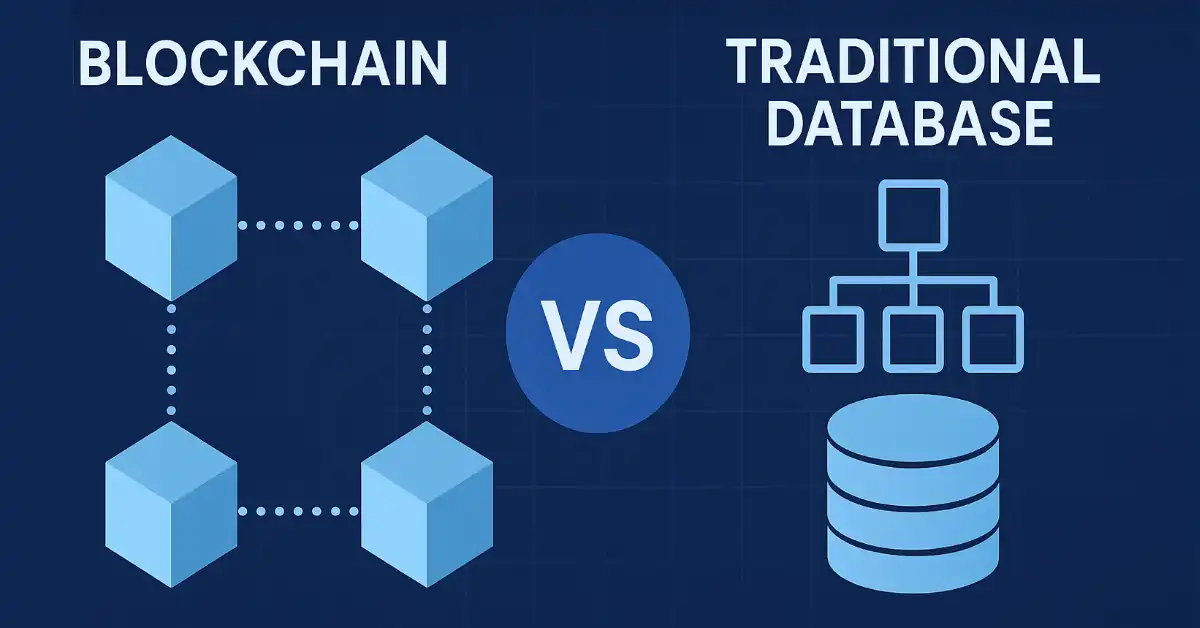
There’s a belief that blockchain technology offers better architectural features than traditional databases. Although this belief is popular, it is rarely the case that one is outright better than the other.
Rather, it is a case of centralized data systems versus decentralized ledgers. In this article, we will compare both of them, evaluating their system design principles, performance metrics, and operational complexity.
What are the core architectural differences?
In traditional databases, systems operate on a client-server model. In this model, a single authority controls operations like data writes, validation, and access. Examples of these centralized architectures include Oracle, MongoDB, PostgreSQL, and MySQL.
It is common to have them deployed as cloud-managed database services, monolithic applications with just one database, or microservices architectures with shared databases. In traditional database systems, the trust assumption is simple, and it rests on the database administrator.
Blockchain systems, on the other hand, use a decentralized ledger architecture to run a “trustless” architecture. Instead of trusting a database administrator, control is shared via peer-to-peer replication and via consensus. Examples of blockchain architectures include Bitcoin, Ethereum, and Hyperledger Fabric, which every top crypto trading platform uses to store final trading data.
In these environments, every node maintains a copy of the ledger, and consensus has to be reached by every node before an update is accepted. As mentioned earlier, the trust assumption here is that no single party is trusted, so trust is distributed across multiple parties.
In the next section, we will compare and contrast both types of databases from the perspective of IT architecture experts.
Differences between blockchain and traditional databases

To make it easier to understand, we will discuss how blockchain differs from traditional databases under key themes.
Data ownership
Governance in traditional databases is clear and centralized. An admin or company retains full control over the database schema, data, read/write permissions, and the rules of the operation which is the CRUD (Create, Read, Update, Delete). In this type of governance, access control is enforced through permissions and roles. Also, to meet regulatory needs, data can be modified or deleted.
In blockchain systems, governance methods differ. Here, ownership is distributed across different participants called nodes. The distribution follows a predefined protocol, and changes are not easy to implement because they must meet a broad consensus. Unlike in traditional systems, deleting data is extremely difficult or even impossible.
Transaction throughput
Transactions on traditional systems are relatively faster because they can process several thousand transactions per second in optimized environments. Well, these transactions depend on optimized indexing, write-ahead logging, and controlled concurrency to function properly.
Blockchain transactions are not as fast due to obvious reasons. The major one is consensus mechanisms, where every write has to be validated by multiple nodes. Because of this, public blockchains often handle only tens to hundreds of throughput per second.
Latency
It usually takes only milliseconds for database transactions to commit finally. However, for blockchain, the transactions must be propagated across a network, be included in a block, and reach finality after multiple confirmations. This is why latency often takes some seconds to a few minutes, depending on network strength.
Read performance
When it comes to processing complex queries, traditional databases do better. That’s because indexes, query planners, and joins and aggregations optimize traditional systems for complex queries.
This is not the case for blockchains because they are not originally designed to be query engines. To improve read performance, blockchain systems have to get external indexing services and off-chain data stores. This is why traditional systems are preferred for workloads that involve heavy analytics.
Consistency models and the CAP trade-off
When it comes to consistency, traditional databases come with predictable transactional behavior and stronger consistency. They also offer the ACID guarantees, which are Atomicity, Consistency, Isolation, and Durability.
For blockchains, the consistency is eventual, and in the case of public chains, finality is probable. According to the CAP theorem, there are some trade-offs. While traditional databases favor consistency and availability, Blockchains, on the other hand, favor partition tolerance and performance.
Approach to scaling
When it comes to scaling, traditional databases use methods that are already well understood and mature. For instance, sharding (horizontal scaling) and stronger hardware (vertical scaling) are mature and widely supported. Catching layers is also a way to scale traditional databases.
Scaling blockchain systems requires architectural compromises. Scaling these systems can require off-chain computation, layer 2 solutions, and sharding at the protocol level. Now, for the compromise being talked about, each improvement may reduce the level of decentralization or security.
Security structure
Ordinary, traditional databases have a tight level of protection, such as role-based access control and firewalls plus network segmentation. Encryption is also at rest and in transit, but these hardly protect the system from insider attacks.
Security in blockchain appears tighter due to immutable transaction history and cryptographic access. Here, there’s nothing like privileged admin access. The risk here, however, moves from people to code correctness. Security risks in blockchain include protocol-level attacks and smart contract vulnerabilities.
Resource efficiency
When it comes to cost efficiency, traditional databases perform better. They manage storage efficiently, have minimal data duplication, and have lower compute overhead.
Blockchain systems consume more storage, bandwidth, and compute. Also, they replicate data across many nodes, and public chains may attract transaction fees.
How do you choose the right architecture?

From an IT architecture perspective, the following insights should guide your decision-making and not just hype.
If you seek high throughput and low latency, go for traditional database systems. Also, when the application is within a single trusted domain, such as one company, and data needs to be mutable, traditional databases work best. Traditional databases also help protect the privacy and confidentiality of critical data. Of course, the management also has to be comfortable with centralized control.
On the other hand, consider a blockchain ledger when multiple untrusted parties need to share a single source of truth. In such settings, an immutable and independently verifiable audit trail has to be the primary requirement. If the business logic can be encoded into deterministic smart contracts, then blockchain systems are preferable. Participants, however, have to be willing to accept higher latency and costs for decentralized benefits.
Can there be hybrids of traditional databases and blockchain ledgers?
Recently, there have been systems like BigchainDB that attempt to blend the features of both by running decentralized databases. In some environments, like crypto trading platforms, blockchain is used as a specialized database layer for storing the final transactions, while the traditional database receives and processes fast moving trading data in real time.
We also find hybrids in managed blockchain services like Azure Confidential Ledger and other cloud providers, where ledger services are used to simplify deployment.
To wrap it up,
As you must have observed, one is not the replacement of the other. Rather, they both solve different problems while bearing different forms of risk. While traditional databases support centralized governance models where data confidentiality is critical, blockchain ledgers work best for environments where different trustless parties have to share a single resource. Traditional databases have better query processors and storage efficiency, but blockchain systems eliminate the chances of insider attacks.
The onus is on the enterprise to choose a data system depending on their unique needs, although there are certain hybrids available in the market.