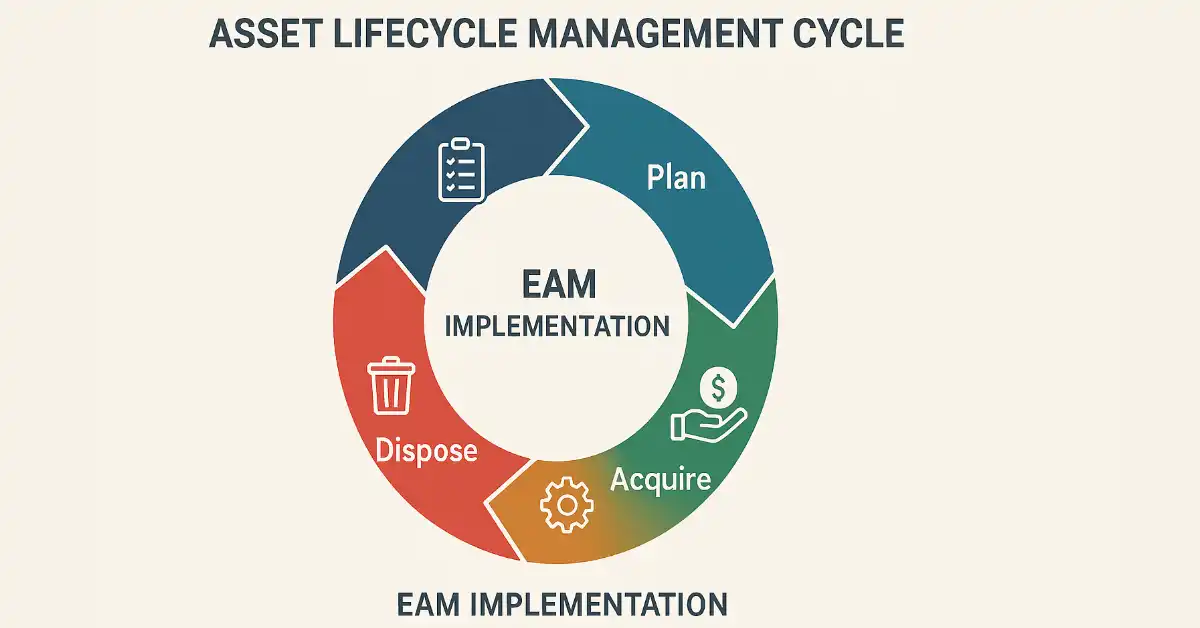
Enterprise asset management software is a powerful tool that helps keep track of your assets through their entire lifecycle. It stores all information about an asset, starting from its initial procurement and its deployment to its final retirement. Along with this, the tool also simplifies maintenance operations by helping stakeholders take proactive measures to keep assets running smoothly at all times.
All these advantages make enterprise asset management tools an important investment. At this point, a common problem that arises is related to the implementation of enterprise asset management tools. The enhanced features of the EAM also bring a wide range of complexities. So, without the right EAM implementation, you may end up making costly mistakes. In the article below, we will look at some of the common mistakes that you must avoid when implementing an EAM in your organization.
Why Is the Right EAM Implementation Important?
The right EAM implementation is important because the wrong implementation doesn’t just lead to underperformance; it also causes chaos. Through correct implementation, organizations can save money and time and prevent numerous challenges.
With the help of the right implementation, organizations can enjoy the following advantages:
- Prevent surprised failures, production stoppages, and costly downtime.
- Prevent rapid asset wear and tear, which helps organizations save money.
- Have a clean workflow where technicians spend less time searching for information and more time on the actual work.
- Allow organizations to maintain compliance with industry rules and regulations.
- Help align maintenance tasks with business goals.
The right EAM implementation leads to improved reliability, efficiency, safety, and overall savings. On the other hand, a poor implementation can result in unexpected downtime, mistrust, wasted investment, and frustration.
Mistakes to Avoid When Implementing an EAM Tool
Here are the common mistakes that you must avoid when implementing an EAM tool for your business:
- Not Having a Clear Strategy in Place:
One of the most common mistakes stakeholders make is talking to vendors before deciding what their organization needs. Every decision about the tool must be based on the goals you want to achieve with an EAM.
Solution: You must clearly understand what you want to achieve with the EAM solution. Also, identify the data, metrics, and processes you will need to meet these goals. It is important to establish KPIs to determine whether the tool is able to meet the goals.
- Not Understanding the Complete Implementation Cost:
To win your business’s trust, many EAM vendors might hide the complete implementation cost of the tool. They may be reluctant to show you a detailed cost breakdown, as it may lead to a loss of potential customers.
Solution: Choose vendors that offer transparent pricing to ensure that you have a full understanding of the actual implementation cost. Also, check whether they are willing to offer you assistance throughout the implementation process to align your organization’s processes with the core features of the software.
- Implementing EAM Software Without Training Your Employees:
Without preparing your employees for the new operational processes and tools, you won’t be able to use the software to its full potential.
Solution: Before rolling out new EAM software, it is important to clearly communicate the changes. Moreover, provide role-specific training that includes practical implementation of the software. This will help your employees understand how the tool will function in real work scenarios.
- Selecting the Wrong Enterprise Asset Management System:
Operational failures can sometimes arise not due to a lack of skills but because leaders chose the wrong EAM platform.
Solution: Listen to your end users and understand what they truly need. The tool that you have chosen must be beneficial to the users/your employees. Also, avoid tools that require a high level of customization to meet your organization’s needs and instead choose a platform that intrinsically aligns with your goals. These steps will help avoid the hassle of software customization and intensive planning.
- Not Considering the Integration Options:
Without understanding the integration options offered by the EAM software, you won’t be able to offer ease of use to your employees.
Solution: To ensure ease of use, closely examine the solutions your EAM platform should integrate with. Work with the IT team to secure reliable integrations and train your employees about the same. Make sure to roll out the implementations gradually and expand over time to avoid confusion.
- Choosing a Platform that Doesn’t Offer Scalability:
Ignoring the platform’s scalability options will force you to change your EAM software later.
Solution: Always inquire with vendors about the platform’s ability to expand its services to meet the evolving needs of your organization. This will help you avoid frequent software changes and offer operational stability.
Conclusion
A successful EAM implementation requires carefully understanding your organization’s structure and current capabilities and avoiding common mistakes. This will help you provide a stable work environment for your employees and help implement EAM software that offers measurable results.
By making the right choices, you are able to optimize workflow and take care of your asset health more efficiently.
FAQs
What is an Enterprise Asset Management (EAM) tool?
An EAM tool is software that tracks assets throughout their lifecycle, from procurement to retirement, storing detailed info and enabling proactive maintenance. It prevents failures, reduces downtime, ensures compliance, optimizes workflows, and aligns tasks with business goals for improved efficiency and cost savings.
What are common mistakes to avoid when implementing an EAM tool?
Common mistakes include lacking a clear strategy, ignoring hidden costs, skipping employee training, selecting the wrong system, overlooking integrations, and choosing non-scalable platforms. These lead to downtime, frustration, wasted investments, and inefficiency; avoiding them ensures smooth operations.
How can organizations develop a clear strategy for EAM implementation?
Start by understanding goals, required data, metrics, processes, and KPIs. Engage stakeholders before vendors, align with business needs, and plan for measurable outcomes. This prevents misalignment, reduces risks, and sets a foundation for successful deployment and long-term asset health management.
Why is employee training important in EAM tool implementation?
Training ensures users understand changes and system use, reducing resistance and errors. Provide role-specific, practical sessions before rollout for smooth adoption. Without it, implementation fails, causing mistrust and inefficiency; proper training boosts productivity and workflow optimization.
How to ensure scalability in an EAM platform?
Inquire about expansion capabilities during selection, choose adaptable systems that grow with needs, and avoid frequent changes. Collaborate with vendors for future-proofing. This prevents obsolescence, supports evolving operations, and maintains efficiency without costly overhauls or disruptions.