Most enterprises begin their digital asset management with standard solutions like Google Workspace or Microsoft SharePoint. These tools handle collaboration and file organization effectively. But when stakes rise—during M&A negotiations, legal proceedings, or sensitive IP transfers—standard cloud storage exposes critical vulnerabilities that can cost millions or derail major transactions.
Where Standard DAM Falls Short
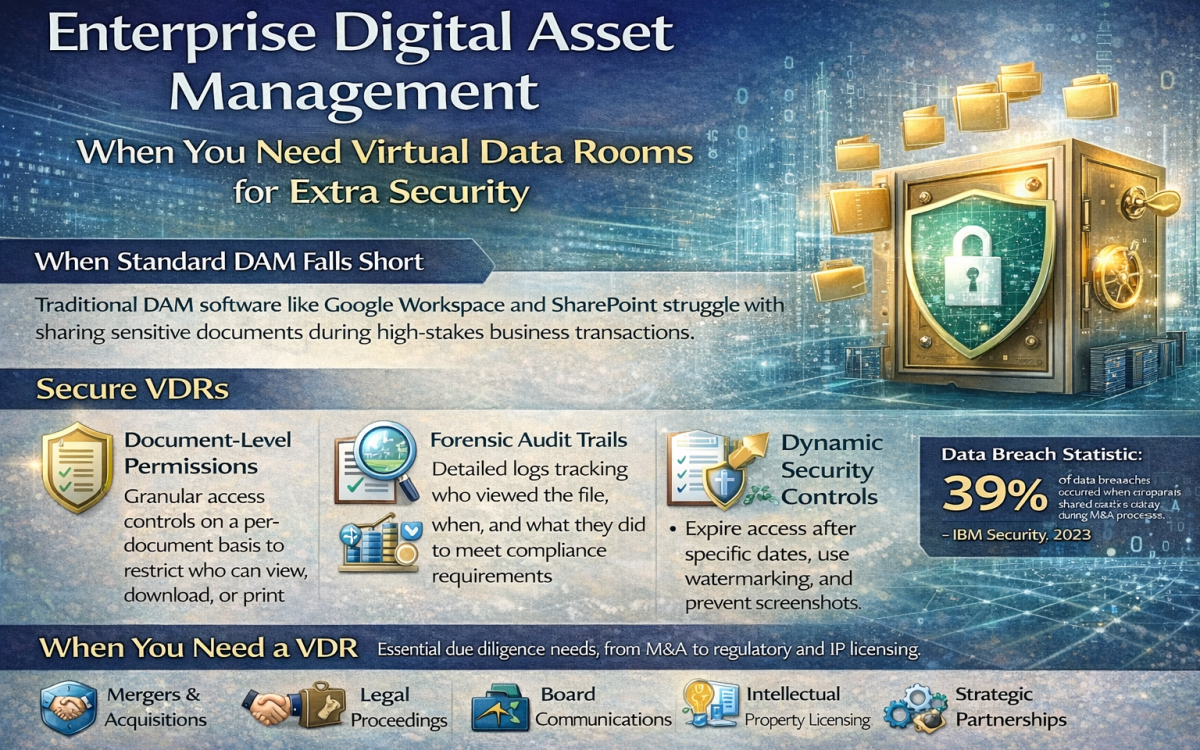
Traditional digital asset management systems excel at cataloging files and coordinating teams. However, they weren’t designed for sharing sensitive information with external parties during high-stakes business transactions.
Consider a typical acquisition scenario. You need to share financial statements, customer lists, and IP documentation with potential buyers. Your current DAM system organizes everything efficiently. But can it tell you exactly who read which document? Whether someone attempted to screenshot your proprietary formulas? Can you revoke access immediately if negotiations collapse?
These aren’t hypothetical concerns. According to IBM’s Cost of a Data Breach Report 2023, 39% of breaches occurred when companies shared data during partnerships or M&A processes. The average cost exceeded $4.5 million—before accounting for lost deal value when sensitive information reaches competitors.
Critical Stat: Companies using advanced security measures during M&A processes reduced breach costs by an average of $1.49 million compared to those using basic file sharing. —IBM Security, 2023
How VDRs Operate Differently
Virtual data rooms function on fundamentally different principles than standard enterprise document security systems. They were designed specifically for situations where control outweighs convenience.
Document-level permissions
Your DAM might allow folder-level restrictions. VDRs operate at a deeper level with granular access controls. User A can view Document X but cannot download it. User B can download but cannot print. User C remains unaware the file exists.
This granularity becomes essential for M&A data rooms where multiple parties require different information subsets. In a recent pharmaceutical acquisition, the buyer’s finance team needed revenue numbers, legal required contracts, and technical staff needed R&D data. The VDR managed this complex permission structure seamlessly.
Forensic audit trails
VDRs log comprehensive activity data that meets strict compliance file sharing requirements. Who opened files, when they accessed them, how long they spent on each page, and what search terms they used. These logs remain immutable—even system administrators cannot alter them retroactively.
Industry Insight: Organizations with comprehensive audit trail capabilities detected security incidents 27% faster than those without detailed logging. —Ponemon Institute, 2024
A private equity firm managing simultaneous deals recently identified suspicious behavior through VDR analytics. One potential buyer repeatedly accessed IP documents while largely ignoring financials. This pattern indicated competitive intelligence gathering rather than genuine acquisition interest. They terminated access before sensitive information could be compromised.
Dynamic security controls
Standard enterprise document security systems grant access that persists until manually revoked. VDRs implement adaptive controls. Documents can expire automatically after specific dates. “Fence view” technology prevents screenshots by requiring secure browser viewing only.
Dynamic watermarks display the viewer’s name and timestamp on every page. According to Gartner’s Market Guide for Content Collaboration Platforms, watermarking reduces unauthorized distribution by up to 73% in regulated industries.
For companies implementing this security level in Asian markets, platforms like dataroom offer localized solutions addressing regional compliance requirements.
When Enhanced Security Becomes Necessary
Not every document requires maximum protection. However, specific situations demand comprehensive VDR capabilities:
• Mergers and acquisitions: Exposing sensitive information to parties who might become competitors if negotiations fail. M&A data rooms protect financial data, customer relationships, and strategic plans during 60-90 day due diligence processes.
• Legal proceedings: Courts expect detailed documentation showing what information was shared, with whom, and when. According to the ABA’s 2023 Legal Technology Survey, 68% of law firms now require audit trail capabilities for e-discovery.
• Board communications: Materials containing market-moving information—unannounced earnings, executive compensation, or strategic changes. Board members access these from personal devices while traveling, creating security risks.
• Intellectual property licensing: Precise control over information flow prevents revealing enough detail for reverse-engineering without a license agreement.
• Regulatory compliance: Healthcare (HIPAA), finance (SOX, GLBA), and defense (ITAR) face mandatory controls. Enterprise document security must provide audit trails regulators require during inspections.
• Strategic partnerships: Sharing proprietary technology or operational procedures with potential partners requires staged disclosure and revocable access.
The Practical Hybrid Approach
Most enterprises adopt a dual-system strategy. They maintain standard DAM for everyday collaboration while deploying VDRs for high-stakes scenarios requiring advanced compliance file sharing capabilities.
This approach resembles having both regular office space and a secure vault. Daily work occurs in collaborative environments. The most valuable assets reside in secured M&A data rooms with restricted access and continuous monitoring.
This hybrid model optimizes both functionality and security. Teams avoid excessive restrictions during routine work. When stakes increase—during acquisition talks, regulatory audits, or sensitive partnerships—appropriate protection activates automatically.
The segmentation also proves cost-effective. VDR subscriptions for specific projects cost substantially less than enterprise-wide deployment. A mid-sized tech company reported spending $800 monthly on VDR services for two simultaneous partnership negotiations, compared to $15,000+ annually for upgrading their entire DAM infrastructure.
Implementation Strategy
If standard DAM feels inadequate, begin by identifying your highest-risk scenarios. Which documents would cause the most damage if exposed? What upcoming transactions will require sharing confidential information externally?
Use these scenarios for initial VDR deployment. Begin with limited scope—perhaps a single M&A process or board communication system. Most providers offer flexible monthly subscriptions that don’t require enterprise-wide deployment initially.
Develop clear protocols for when teams should use VDR versus standard DAM. Create simple decision criteria: external parties involved, document sensitivity level, regulatory requirements, and transaction value.
According to research from Verizon’s Data Breach Investigations Report, 61% of breaches in 2023 involved credentials and permissions mismanagement—exactly the vulnerabilities that enterprise document security through VDRs addresses.
The Bottom Line
Virtual data rooms represent strategic infrastructure for high-stakes business operations. They provide the control, visibility, and compliance file sharing capabilities that modern enterprise transactions demand.
The question facing organizations isn’t whether to implement this technology, but how quickly they can deploy it before the next critical transaction begins. Start by identifying your three highest-risk scenarios. Test the technology with an actual upcoming transaction rather than a hypothetical scenario.
Enterprise document security isn’t a luxury anymore. It’s table stakes for any organization handling sensitive information during external collaborations. The cost of implementation pales compared to the cost of a single significant breach or lost deal. Your standard DAM system serves you well for daily operations. But when millions hang in the balance, you need infrastructure designed specifically for those moments.