The fiber crews are hard to miss—bright trucks, fresh lines on the poles, and neighbors sharing speed-test screenshots that seem unreal. If you live in South Carolina, you’ve likely wondered whether it’s time to ditch cable and join the fiber crowd.
Roughly half the state still relies on coaxial service, yet only 46.6 percent of residents can order a fiber-optic plan, and South Carolina ranks 23rd for overall broadband performance (see this South Carolina broadband availability). That gap forces many households to choose between the familiar and the faster lane.
In the pages ahead, we’ll compare download punch, upload muscle, and the latency that decides whether a video call is crisp or choppy—grounding every claim in local data and real customer stories so you can decide with confidence.
South Carolina’s internet landscape in 2024–2025

South Carolina’s broadband story is one of steady progress and sharp contrasts.
Nearly 92 percent of households can order a basic 25 Mbps plan, yet just 46.6 percent have a fiber-optic option today. That gap explains why many families still lean on cable, even while fiber trucks criss-cross their streets.
South Carolina broadband and fiber availability coverage map.
South Carolina broadband and fiber availability map overview
Speeds reflect the split. The median download clocks in around 200 Mbps, but uploads limp along near 22 Mbps, classic signs of a cable-heavy market. Urban hubs such as Greenville or Charleston enjoy gigabit tiers from Spectrum or AT&T, while pockets of the Upstate still wrestle with 25 Mbps DSL.
State leaders are racing to close the divide. According to Telecompetitor, in 2024 the South Carolina Broadband Office completed $400 million in American Rescue Plan grants, funding dozens of rural fiber builds that push glass deeper into farm roads and forest lanes.
The payoff is visible already. Ookla’s latest figures show rural counties edging out urban neighbors on average speed, a rare “negative divide” that flips the usual script and proves those new fiber spools matter.
Providers are piling in. AT&T lights up multi-gig service in Columbia suburbs, Google Fiber plants a flag in North Charleston, and WOW! connected its first Upstate fiber customers in late 2023, touting symmetrical 2–5 Gbps tiers. undefined
Bottom line: half the state now faces a real choice. With fresh grant dollars flowing and new strands hitting the poles each month, that percentage grows quickly. The question is no longer “Will fiber come?”; it’s “Will you be ready when it does?”
Fiber vs. cable performance
Download speeds and throughput
Speed headlines grab attention, but sustained throughput tells the real story.
Across South Carolina, cable plans from Spectrum or Xfinity advertise 100 Mbps to 1 Gbps downloads. They hit those peaks off-hour, then sag when everyone streams after work. Fiber flips that script. Providers such as AT&T, Google Fiber, and WOW! deliver 300 Mbps to 5 Gbps, and the line barely budges during prime time. Why? Fiber pipes carry dedicated light pulses, while cable’s hybrid-coax loop shares bandwidth across the entire node.
Statewide tests show the effect. Median download speed sits near 200 Mbps, a number pulled down by congested cable blocks. Neighborhoods that switch to fiber routinely clock the full gig (or more) day and night. That consistency is gold if your household juggles simultaneous 4K streams, game updates, and cloud backups.
From a network engineer’s view, bandwidth is the highway’s max capacity, while throughput is the traffic’s actual flow. Fiber’s glass lanes stay open, so vehicles reach posted speed. Cable’s copper lanes clog as neighbors merge, and packets slow to a crawl.
In plain English, the speed you pay for is the speed you keep with fiber, according to InternetProviders.ai.
Upload capacity: where fiber leaves cable in the dust
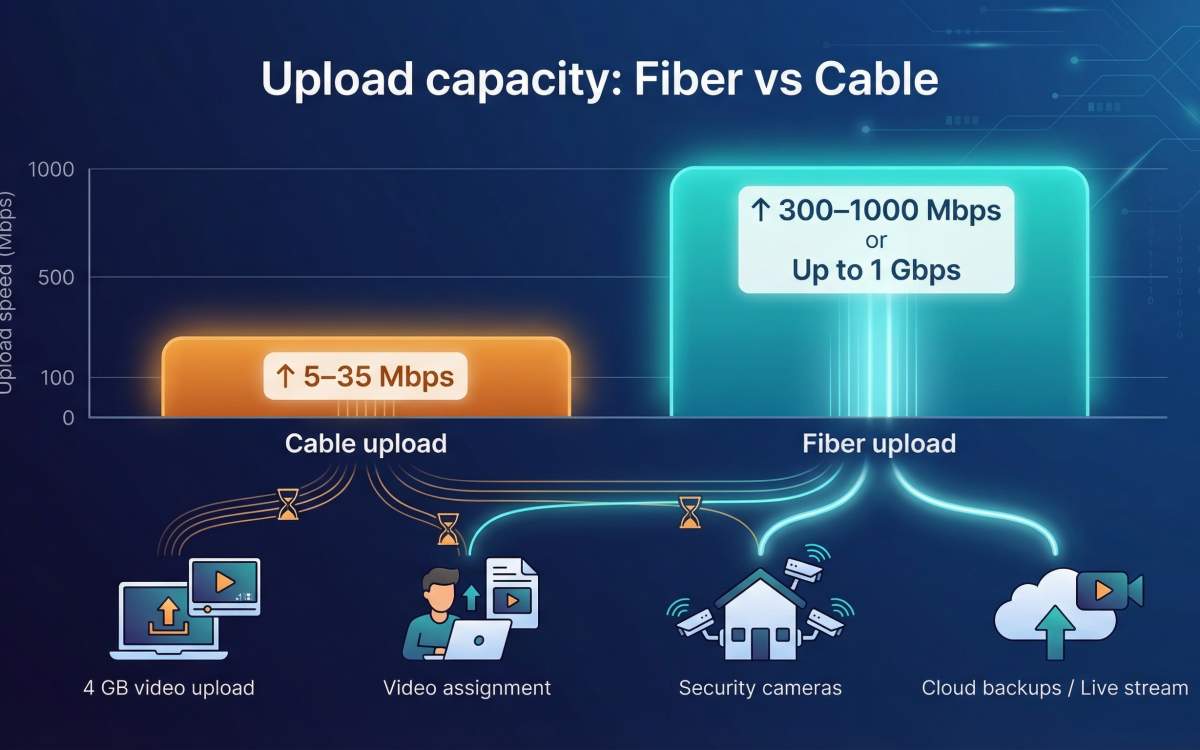
If download speed sets highway pace, upload is the on-ramp that lets you merge into the digital world. Cable keeps that ramp painfully narrow. Most South Carolina cable plans top out at 5 Mbps to 35 Mbps upstream. Hit “Send” on a 4 GB video and your connection gasps, pushing data out one small packet at a time.
Fiber is different. The same glass strand that pours 1 Gbps down can fire 1 Gbps right back up, giving perfect symmetry. A designer in Greenville can push a gigabyte-scale project folder to the cloud in minutes rather than hours, students in Sumter can submit video assignments without freezing the family Zoom call, and smart-home cameras keep streaming smoothly. Those everyday wins rank among the benefits of switching to fiber internet that WOW! highlights for both homes and small businesses.
Real tests confirm the gap. Statewide median upload hovers near 22 Mbps, a number dragged down by coax. Households that move to fiber jump into the hundreds of megabits, sometimes a full gig, instantly opening cloud backups, Twitch streams, and security-camera uploads cable users can only imagine.
The benefit is more than convenience. Video calls run clearer because the upstream has headroom. Online games handshake faster, shaving delay each time a packet leaves your PC. Even business VPNs feel snappier, as encryption overhead no longer strangles the line.
Cable engineers plan to address this with DOCSIS 4.0, but rollouts remain on the horizon. Fiber delivers symmetrical speed today without waiting for the next upgrade cycle, notes InternetProviders.ai.
Latency and real-time performance
Speed is great, but timing is everything. Latency—the round-trip a packet takes to say “hello” and hear “hi” back—defines how snappy your connection feels.
On fiber, pings to nearby Atlanta or Charlotte servers often sit between 5 ms and 15 ms. Cable starts closer to 25 ms and swings higher whenever the node fills. That extra heartbeat is the difference between a crisp Zoom reply and an awkward “Sorry, you froze.”
Gamers notice first. A Spectrum user in Columbia may watch ping spike to 60 ms at 8 pm, while a neighbor on AT&T Fiber holds steady at 15 ms. Consistency matters more than the absolute number; fiber’s light path keeps jitter almost flat, so no surprise lag spikes ruin the match.
Low latency also helps work VPNs, cloud desktops, and network protocols such as OSPF converge faster. If you run a home lab or manage remote sites, fiber makes the WAN feel local.
Electrical noise never touches glass, so packet loss stays near zero. Cable’s copper loop, exposed to lightning and RF interference, drops enough frames under stress that retransmissions creep in and compound delay.
Put simply, fiber doesn’t just move data faster—it moves it on time, every time, according to InternetProviders.ai.
Reliability, uptime, and security
Speed means little if the line blinks out when storms roll in.
Fiber keeps its edge here as well. Glass strands carry light, not electricity, so thunder, RF noise, and neighborhood voltage swings leave them untouched. With no powered amplifiers hanging from every pole, there are fewer failure points and fewer truck rolls. Many South Carolina fiber customers say outages have faded into background noise, with no more random modem reboots when the evening news starts.
Cable’s copper loop is tougher than old phone wire, yet it still feels the weather. Water in a splice, a loose tap, or a fried amplifier can slow an entire block. Add the congestion covered earlier, and reliability becomes a moving target rather than a promise.
Security follows the same pattern. Fiber emits no radio signal to sniff, and any physical tap drops light levels enough to trigger alarms. Coax, by contrast, radiates a faint RF halo that a determined snoop could capture with the right gear.
Power matters too. Your fiber ONT needs electricity, so plan a small UPS if internet-phone service is critical during an outage. Cable modems also draw power, but the plant often supplies backup to its nodes; in practice, both setups benefit from a local battery.
Taken together, fewer outages, cleaner signals, and built-in privacy make fiber a service you can trust when weather or work deadlines refuse to wait.
Cost and installation factors in South Carolina
Good news: moving to fiber rarely costs more.
Across the state, Spectrum’s 300 Mbps cable tier sits near $70 per month, while its gig tier lands just below $100. AT&T Fiber counters with 300 Mbps symmetrical for about $55, 500 Mbps for $65, and a full gig around $80, including Wi-Fi gear in most promos. Local co-ops such as HTC and CarolinaConnect price similar speeds in the $60–$80 band. Dollar for dollar, fiber often provides both higher ceilings and better upstream without a premium.
Intro deals can hide true cost. Cable likes a “12 months at $49.99” headline, then jumps once the calendar flips. Fiber plans usually start closer to their long-term rate, so your bill stays predictable.
Installation poses the bigger hurdle. If your home already has coax, a cable modem ships to your door and you’re online after dinner. Fiber needs a technician to run the drop, mount an optical network terminal, and test light levels. In Charleston suburbs that takes a morning; in fast-growing Greenville, high demand can stretch appointments into next week. Plan ahead, but know the install fee is often waived to win your business.
Equipment costs differ as well. Cable requires a DOCSIS modem; you either rent for $10 a month or buy your own. Fiber’s ONT stays with the provider, and most bundle a modern Wi-Fi 6 gateway at no extra charge. That swap alone can save about $120 a year over a cable modem rental.
Contracts are no longer a sticking point. Spectrum and AT&T both run month-to-month in South Carolina, so you can switch without early-termination fees. Bundle TV or phone only if you need them; streaming services plus a strong fiber line often cost less.
Add it all up: similar monthly outlay, lower surprise fees, and an install you tackle once—then you enjoy symmetrical speed for years.
Conclusion
Fiber-optic service now covers nearly half of South Carolina, unlocking faster downloads, symmetrical uploads, lower latency, and greater reliability at a price that often matches or beats cable. Grants and private investment continue to extend glass deeper into rural roads and suburban streets, widening the choice for households that once had none. If fiber is already on your block—or coming soon—switching means smoother video calls, quicker backups, and future-proof bandwidth without paying a premium. When the trucks roll by, it may be time to trade coax for glass and put slow, uneven service in the rear-view mirror.
had none. If fiber is already on your block—or coming soon—switching means smoother video calls, quicker backups, and future-proof bandwidth without paying a premium. When the trucks roll by, it may be time to trade coax for glass and put slow, uneven service in the rear-view mirror.