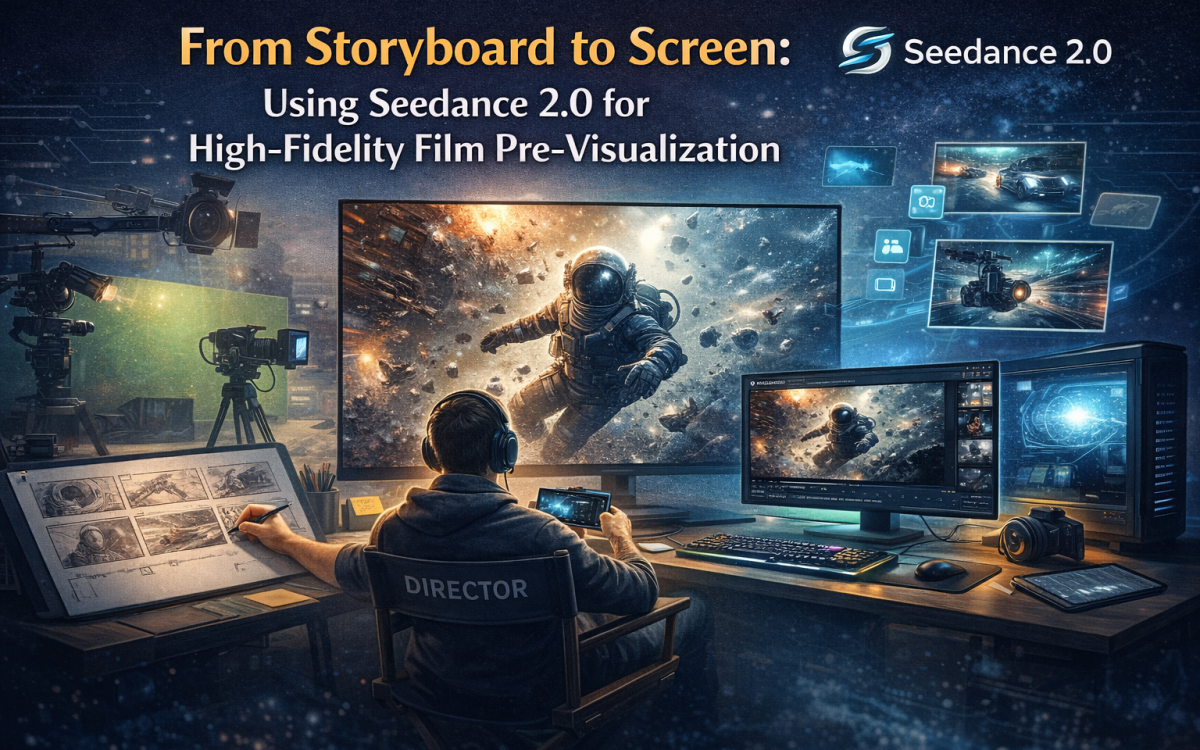
In the traditional film production pipeline, the transition from a script to the first day of shooting is often bridged by a process known as pre-visualization, or “Pre-vis.” Historically, this involved hand-drawn storyboards or crude 3D animations—low-fidelity representations intended to map out camera angles, character blocking, and timing. While functional, these methods often fail to capture the “soul” of a scene: the lighting, the emotional nuance, and the complex interplay of visual elements.
The emergence of Seedance 2.0 is fundamentally rewriting this chapter of filmmaking. By leveraging multi-modal AI video generation, directors and cinematographers can now transform static concepts into high-fidelity, cinematic previews in a fraction of the time and cost required by traditional CGI houses. This is the era of AI-driven pre-visualization.
The Problem with Traditional Pre-vis
For decades, directors have faced a “imagination gap.” A storyboard shows a frame, but it doesn’t show the rhythm of a camera pan. A 3D animatic might show the movement, but the “uncanny valley” of basic 3D models makes it difficult to judge if a lighting setup will actually work.
Furthermore, traditional Pre-vis is expensive. Large-scale productions spend millions on pre-rendering scenes in software like Unreal Engine or Maya. For independent filmmakers or small creative agencies, this level of preparation is often financially out of reach, leading to expensive mistakes on set when a planned shot turns out to be physically impossible or visually underwhelming.
Seedance 2.0: A New Pre-vis Paradigm
Seedance 2.0 closes the gap between the sketch and the screen. It allows production teams to create “living storyboards” that look and feel like finished film clips. This is achieved through three core pillars of the Seedance 2.0 engine: Reference Control, Multi-Modal Integration, and Temporal Consistency.
1. Instant Environment Exploration
Before a single light is rigged on set, a director can use Seedance 2.0 to explore a location’s potential. By uploading a single photo of a location (or even a rough AI-generated concept art piece), the model can generate a series of dynamic shots exploring different lighting conditions—magic hour, moody night-time neon, or harsh midday sun. This allows the Director of Photography (DP) to visualize the color palette and mood of the film long before the crew arrives.
2. Bringing Storyboards to Life (Image-to-Video)
The most direct application for Pre-vis is transforming 2D storyboards into fluid motion. A director can upload a keyframe sketch and use Seedance 2.0 to “animate” the internal motion. Unlike basic animation tools, Seedance 2.0 understands the physics of weight and light. If the storyboard shows a character walking through a rain-slicked street, the AI accurately simulates the reflections in the puddles and the way light interacts with the falling water droplets.
3. Blocking Complex Choreography
“Blocking”—the precise movement and positioning of actors—is one of the most time-consuming aspects of directing. Seedance 2.0’s video reference capability allows a director to film themselves or a stunt coordinator performing a rough version of a move on a smartphone. By uploading this “trashy” reference video and an image of the actual actor/character, the AI generates a high-fidelity version of the sequence. This “Video-to-Video” workflow allows the team to finalize the choreography and camera timing before the expensive talent even steps onto the set.
Enhancing the Pitch: Pre-vis as a Sales Tool
Beyond the technical benefits, high-fidelity Pre-vis with Seedance 2.0 is a powerful tool for producers and directors during the “pitch” phase. When trying to secure funding or “greenlight” a project, showing a studio executive a series of black-and-white sketches is one thing; showing them a 15-second, cinema-quality sequence that captures the exact tone of the final film is another entirely.
Seedance 2.0 allows filmmakers to create “Concept Trailers” that look indistinguishable from big-budget productions. By maintaining character consistency (ensuring the protagonist looks the same in every shot) and style consistency, directors can present a cohesive vision that builds confidence in investors and stakeholders.
The Technical Edge: Why Seedance 2.0 Excels in Pre-vis
What sets Seedance 2.0 apart from other generative models in a professional Pre-vis context is its multi-modal tagging system. In a professional workflow, you rarely start from “nothing.” You have a script (text), a character design (image), and perhaps a specific musical rhythm (audio).
Seedance 2.0 allows you to combine these:
- Input A (Text): “A high-speed chase through a neon-lit futuristic city.”
- Input B (Image Reference): A specific vehicle design.
- Input C (Video Reference): A camera movement reference from a classic action movie.
- Input D (Audio Reference): A fast-paced orchestral track.
The AI synthesizes these disparate inputs into a singular, beat-synced cinematic sequence. For a Pre-vis artist, this means the AI is no longer a “random generator”—it is a sophisticated compositor that follows instructions.
Case Study: Visualizing a Sci-Fi Action Sequence
Imagine a director planning a sequence where an astronaut is caught in a debris storm.
- Phase 1: The director uploads an image of the astronaut’s suit to ensure the AI uses the correct costume.
- Phase 2: The director uploads a reference video of a person spinning in a chair to simulate weightlessness and disorientation.
- Phase 3: Using the Video Extension feature, the director builds the scene frame by frame—first the impact, then the spin, then the recovery.
- Result: Within an hour, the production team has a high-fidelity Pre-vis clip that shows exactly how the debris should look, how the character should move, and how the camera should track the chaos.
This clip can then be handed to the VFX team as a “North Star” guide, drastically reducing the number of revisions needed in final post-production.
Efficiency and Cost-Effectiveness
Traditional Pre-vis cycles can take weeks. With Seedance 2.0, a director can iterate in real-time. If a shot doesn’t look right, they can simply adjust the prompt or upload a different reference image and have a new version in seconds. This speed allows for more creative experimentation. Directors can afford to “fail fast,” trying out radical camera angles or lighting setups that they might have been too afraid to suggest in a traditional, slow-moving production environment.
Conclusion: The Future of the Digital Backlot
As the film industry continues to evolve, the line between “pre-production” and “production” is blurring. Tools like Seedance 2.0 are enabling a future where the Pre-vis is the foundation of the final shot. By providing high-fidelity, controllable, and multi-modal generation, Seedance 2.0 empowers creators to see their movies before they even turn on a camera.
For the modern filmmaker, Seedance 2.0 is more than a creative toy; it is an essential piece of infrastructure. It turns the “impossible” into the “attainable,” allowing the next generation of storytellers to bring their most ambitious visions from the storyboard to the screen with unprecedented clarity.