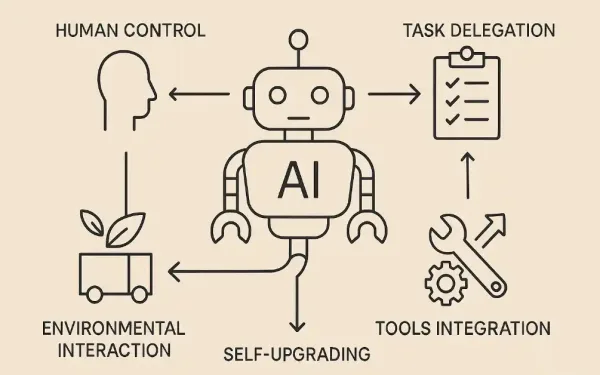
Traditionally, the practice of risk management was one of quarterly audits, static spreadsheet analysis, and data analysis based on historical trends. This was the world of the past, a world in which software was installed from a CD-ROM and stayed that way for years at a time. But the world has changed dramatically since then.
In the present day, it’s common for businesses and individuals alike to rely on a multitude of SaaS applications and web browser extensions in order to operate. This interconnected web of tools represents an unprecedented level of convenience but also an unprecedented level of risk that traditional risk models are unable to adequately address, making the need for an AI risk assessment tool more important than ever.
The sheer number of SaaS tools available creates an expansive attack surface. Every browser extension installed by an employee of an organization and every SaaS application implemented into the business workflow represents a potential point of security breach or data leakage. This is a world that requires a new level of risk assessment, one that is as dynamic as the world itself. This is where artificial intelligence enters the equation, changing the world of risk management forever.
The Static Models of the Past
The biggest weakness of the traditional risk management model was the reliance on quantitative models based on what was known to have occurred in the past. These models were excellent at identifying known risks but were unable to adequately address unknown risks. The move towards generative AI represents a move towards a more proactive approach to risk assessment.
Not only does AI analyze past data, but it also has the ability to create potential future scenarios. For the user of various browser extensions, this means that AI has the ability to analyze the code and behavior of an add-on in real-time, predicting the way in which it might interact with sensitive data in different scenarios. Instead of waiting for an exploit to be used and then reported, AI has the ability to identify anomalous code structures and permission sets that do not fall within standard safety protocols, effectively stopping an exploit before it begins.
Predictive Modeling and Market Volatility
Market volatility in the SaaS industry is often caused by rapid shifts in user sentiment, technological disruption, or cybersecurity threats. AI predictive modeling is fast becoming an essential tool for identifying and reacting to these shifts before they cause significant damage.
With the ability to analyze vast amounts of unstructured data, from social media and developer forums to dark web activity, AI has the ability to identify early warning signs of instability in software providers. If, for example, a popular software provider for product development suddenly alters their privacy policy or begins to receive an influx of negative user reports, AI has the ability to alert risk managers in an instant. This allows for swift and decisive action to be taken, allowing an organization to change software providers or revoke access to compromised browser extensions before operational integrity is threatened.
Automating Compliance and AI Risk Assessment
Regulatory compliance is another area in which human oversight is failing to keep pace. With new regulations like GDPR and CCPA emerging regularly, combined with the proliferation of new software, ensuring that all software used by an organization is compliant is a daunting and monumental task.
However, AI solves this problem by continuously monitoring the terms of service, privacy policies, and data management policies of all SaaS applications in use. AI ensures that third-party vendors meet strict regulatory requirements without any need to intervene manually.
Moreover, as we develop our own AI applications, AI risk assessment becomes an important new field. We now use AI to monitor AI to ensure our own AI applications are unbiased and operate within ethical boundaries.
The Future of Scenario Modeling
Looking forward to the future, AI will be used to model complex scenarios to ensure global financial and operational stability. Future AI systems will run millions of simulations daily to predict how a failure in a major cloud service or widespread vulnerability in a commonly used browser extension could affect the global economy. Such levels of foresight will enable businesses to build resilience to catastrophic failures that may seem unlikely today but are certain in a hyper-connected future.
Embracing a Smarter Defense
The addition of AI to risk management is not an upgrade; it is a necessity to survive in a SaaS economy. By using predictive modeling and AI-powered compliance, we can successfully navigate the complexities of the digital world. The applications we use to get work done are getting smarter, and the systems we use to protect ourselves need to be just as smart!