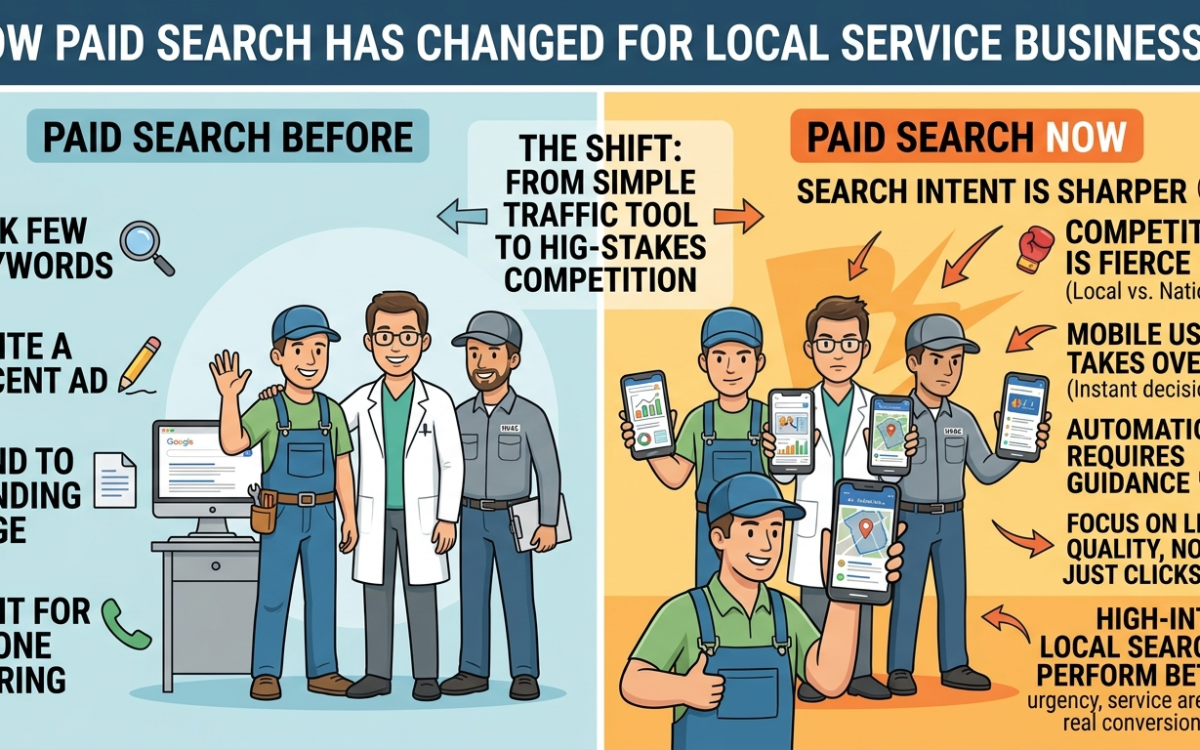
Paid search used to feel pretty simple for local service businesses. Pick a few keywords. Write a decent ad. Send people to a landing page. Wait for the phone to ring.
That version of PPC is mostly gone.
Now, local paid search is tighter, faster, and far less forgiving. A plumbing company, pest control provider, roofer, dentist, or HVAC team is not just bidding on clicks anymore. They are competing for attention in crowded search results, trying to win over people who are often on their phones, in a hurry, and ready to decide in minutes. Sometimes seconds.
And that shift matters. A lot.
Because when local service businesses treat paid search like a basic traffic tool, they usually waste money. Clicks come in, but leads are weak. Calls sound vague. Forms are submitted by people outside the service area. Or the account gets enough activity to look busy, while revenue stays flat. That is the painful part. Campaigns can appear healthy on paper yet perform poorly in real life.
So what changed? Quite a bit, actually. Search behavior changed. Ad costs climbed. Mobile usage took over. Google’s ad platform became more automated. Customer expectations got sharper. And businesses learned, sometimes the hard way, that not all clicks are worth paying for.
It’s Not Just About Keywords Anymore
Keywords still matter. Of course they do. But they are only one piece of the puzzle now.
A local service business can bid on “emergency plumber near me” or “termite control [city name]” and still struggle if the rest of the campaign is messy. Search intent is more specific now. People are not browsing the way they used to. When they search for a local service, they usually have a problem they want solved fast. They want clear proof, fast answers, and an easy next step.
That changes how PPC should be built.
Search Intent Got Sharper
Years ago, broad targeting could sometimes work. You could cast a wider net, sort things out later, and still get decent returns. Now that approach gets expensive fast. Broad traffic often means low-fit traffic. And low-fit traffic burns the budget.
A person searching “pest control cost” is in a different mindset from someone searching “same-day exterminator near me.” A person looking up “best wedding venue in Napa” is not acting like someone searching “24-hour locksmith downtown.” Same channel, very different buying behavior.
That means local campaigns need tighter groupings, more focused ad copy, and landing pages that match what the searcher actually wants. Not kind of wants. Actually wants.
Relevance Carries More Weight
Google rewards relevance because users do. That is really what is happening underneath all the platform language. If your ad promises one thing and your page delivers something vague, performance slips. Click-through rate drops. Conversion rate drops. Cost per lead climbs. It all stacks up.
So paid search now works less like a megaphone and more like a chain reaction. Keyword to ad. Ad to page. Page to action. If one link in that chain feels off, the rest suffers.
The Click Is More Expensive, So the Mistakes Cost More
Here’s the thing. Rising ad costs changed the mood around PPC.
When clicks were cheaper, businesses had more room for waste. Not unlimited room, but there is room. A weak page or sloppy match type might sting a little, not wreck the month. That is no longer true in many local markets. Legal, home services, restoration, dental, med spa, and pest control campaigns can get expensive fast, especially in competitive cities.
And when each click costs more, every weak decision amplifies.
Competition Is Local, But It’s Fierce
Local service businesses are not only competing against nearby companies. They are also competing against national chains, lead aggregators, franchise groups, and advertisers with deeper budgets. Sometimes the local business has better service and stronger reviews, but the auction isn’t concerned about that alone. You still need the campaign structure to support it.
That is why more businesses are moving away from generic account setups. High-intent local searches tend to perform better when campaigns focus on urgency, service area, and real conversion intent. In markets where that level of focus matters, it makes sense to learn more about their PPC services and see what a more specialized approach actually looks like.
That kind of example matters because PPC is not the same across every vertical. A local service campaign often depends on speed, clarity, and fit.
Bad Leads Are More Expensive Than No Leads
This idea sounds backward at first, but it is true.
A weak lead can waste more money than no lead at all. Your office staff spends time on it. Your sales team follows up. Your technicians or estimators get pulled into conversations that never go anywhere. So even when a campaign generates “conversions,” the business may still feel disappointed. And for good reason.
That is why lead quality has become such a big part of PPC conversations. It is no longer enough to ask, “How many leads did we get?” You also need to ask, “Were they the right leads?”
Mobile Changed the Pace of Everything
Most local searches now happen in moments that feel rushed. Someone is standing in the kitchen and sees ants near the sink. Someone notices a leaking pipe before work. Someone locks themselves out of the car in a parking lot. This is not relaxed, desktop-style research. It is quick, immediate, and usually done on a phone.
That changes both user behavior and campaign expectations.
People Decide Faster on Phones
Mobile users are impatient, and honestly, that is not a criticism. It is just reality. They want to skim, tap, compare, and act. If the ad sounds confusing or the landing page loads slowly, they bounce. If the page hides the phone number or asks them to scroll through walls of text, they bounce. If the form feels annoying, they bounce again.
Local service PPC now has to respect that tempo. Fast load times matter. Clear calls to action matter. Message match matters. Click-to-call matters. And yes, design matters too, even for very practical businesses.
A clean page with one strong offer often beats a bloated page trying to say everything at once.
The Landing Page Has to Work Harder
This is where many campaigns quietly fall apart. The ads may be fine. The targeting may be decent. But the landing page is generic, outdated, or disconnected from the ad.
A user clicks because they need a service now. The page should meet them there. It should confirm the service, show the area served, build trust quickly, and make contact easy. Reviews, credentials, short service explanations, and visible contact options do more work than fluffy copy ever will.
You do not need to sound flashy. You need to sound credible.
Automation Helped, But It Also Made PPC Trickier
Google Ads has become more automated over time. Smart bidding, responsive search ads, automated recommendations, broad matching powered by machine learning, Performance Max, call tracking, and audience signals. There is a lot going on.
Some of it helps. Some of it creates a mess if you are not careful.
This is where the conversation gets a bit awkward, because automation can improve efficiency while also making advertisers lazy. Both can be true. The platform can save time, and it can encourage sloppy decision-making. That is the contradiction. And once you see it, it makes sense.
Automation Is Not a Strategy
Automation can help optimize bids, rotate combinations, and find patterns faster than a human can. But it does not replace judgment. It does not understand your real service radius the way you do. It does not know that leads from one ZIP code perform better than those from another. It is unclear whether your office cannot answer calls after a certain hour. Your team should tell it that you want more commercial jobs and fewer one-off residential calls this quarter.
That part still needs human input.
The better local advertisers use automation like a tool, not a substitute for thinking. They feed it clean conversion data. They guide it with a strong structure. They watch search terms, geography, call quality, schedules, and budget pacing. In other words, they stay involved.
Tracking Matters More Than It Used To
Old-school PPC could get away with rougher reporting. A business might look at total calls and total spending and make a judgment from there. Now, that is not enough.
You need better visibility. Which campaigns drove qualified calls? Which keywords produced short calls that went nowhere? Which devices converted best? Which locations looked promising on paper but underperformed in sales? Without that layer, the account becomes guesswork.
And guesswork can get expensive quickly in paid search.
Not All Local Customer Journeys Look the Same
This is where nuance matters.
People often discuss local PPC as if every service business works the same way. It does not. Some customers act fast because the need is urgent. Others compare, revisit, think it over, and loop in family or partners before deciding.
A burst pipe and a wedding venue are not the same buying process. Not even close.
That sounds obvious, but many marketers forget it when they build campaigns.
Some Businesses Win Fast, Others Need More Nurture
Urgent services often win through speed, convenience, and trust. The user wants a solution now. The ad should reflect that. The page should support that. The offer should be easy to act on.
Other local businesses need more patience. A venue, for example, depends more on visual appeal, emotional fit, and a longer research cycle. A quick mention of a wedding venue brand makes the point: some businesses earn conversions over time because people want to imagine the experience, compare options, and sit with the decision a bit longer.
That difference affects everything from keyword choices to landing page style to remarketing strategy.
Local Doesn’t Mean One-Size-Fits-All
And this is really the bigger lesson. Local PPC is still local, but it is no longer simple. It has layers now. Business model matters. Service urgency matters. Customer expectations matter. Competition matters. Even weather, seasonality, and time of day can shift performance.
So when a business asks why paid search feels harder than it used to, the honest answer is this: because the market got smarter, the tools got more complex, and the margin for waste got smaller.
So What Does Good Local PPC Look Like Now?
Good local PPC today feels focused. Not flashy. Focused.
It starts with a clear intent-based campaign structure. It uses ads that sound like they belong to the search. It sends traffic to pages that are actually useful. It pays attention to geography, mobile behavior, and lead quality. It tracks what happens after the click, not just the click itself. And it accepts a simple truth that many businesses resist at first: more traffic is not always better traffic.
That part is worth repeating. More traffic is not always better traffic.
The strongest campaigns are not trying to catch everyone. They are trying to reach the right people at the right moment with the right message. That is what makes them efficient. That is what makes them so profitable.
And for local service businesses, that is the whole game.
Paid search still works. Very well, actually. But it works differently now. It asks for more discipline, more relevance, and more awareness of how people actually make decisions. The businesses that understand that shift tend to do better. The ones that keep running old PPC playbooks usually feel like they spend more and get less.
Honestly, that is because they are.
So if your paid search account feels harder to manage than it did a few years ago, you are not imagining it. The channel changed. The users changed. The competition changed. The good news is that smart local businesses can still win. They just have to stop treating PPC like a simple ad buy and start treating it like what it has become: a fast-moving, high-stakes part of the sales process itself.