Your smartphone is arguably the most important device you own. It manages your schedule, connects you to people across the world, captures memories, and keeps you entertained during every quiet moment in between. Yet most people spend hundreds — sometimes over a thousand dollars — on the phone itself, then grab whatever cheap case or charger is sitting in a discount bin at the checkout counter. That approach is costing you more than you realize, in broken screens, dead batteries, and accessories that fail at exactly the wrong moment.
Building a smart accessory setup does not have to be expensive or complicated. You just need to know which categories matter, what quality looks like in each one, and how the pieces fit together. This guide walks you through everything — from protecting your device properly to keeping every gadget in your orbit consistently charged.
Start With Protection: The Foundation of Every Good Setup
No accessory decision matters more than how you protect your phone. Screen replacements are expensive and inconvenient. Frame damage can compromise water resistance. Even minor drops can cause internal damage that does not show up until weeks later. The good news is that today’s protective phone cases offer better impact absorption and slimmer profiles than ever before — you no longer have to choose between real protection and a phone that still feels good in your hand.
The market for protective phone cases has expanded enormously over the past few years. What was once a category defined by bulky rubber slabs has evolved into a sophisticated space where engineers balance drop protection, material science, slim profiles, and wireless charging compatibility — all at the same time.
When choosing among the many available protective phone cases, the first thing to look at is the drop-test rating. Cases that meet MIL-STD-810G certification have been independently tested against falls from four to six feet onto hard surfaces at multiple angles. Corner impacts are the most dangerous, so pay attention to whether the case has reinforced corner bumpers or a dual-layer construction that distributes impact energy away from the glass.
Material choice matters just as much as the rating itself. Polycarbonate is hard, scratch-resistant, and keeps the case thin — but it can crack under high-force impact. TPU (thermoplastic polyurethane) is flexible and grippy, with natural shock-absorbing properties, but it can feel soft or slippery in hand. The best protective phone cases on the market today combine both: a rigid polycarbonate back for structure and a TPU bumper along the edges where drops tend to land. This hybrid construction consistently outperforms single-material designs in real-world testing.
If you own a recent iPhone, MagSafe compatibility is also worth prioritizing. MagSafe cases embed a ring of precisely aligned magnets that interact with your phone’s internal magnet array, enabling snap-on accessories and faster wireless charging. Not all cases labeled “MagSafe compatible” are built equally — some use scattered magnets or thin magnetic films that weaken attachment strength and slow charging throughput. Stick with options that specify their magnet count and alignment, or look for MFi-certified products.
Raised bezels around the screen and camera module are another often-overlooked detail. A case that lets the screen sit flush with a table face-down is leaving your most vulnerable component exposed. Look for at least 1.5mm of lip around the display, and even more around the camera bump, which tends to protrude significantly on modern flagship phones.
Charging: Keeping Up With a Multi-Device Life
Phones are not the only devices that need power. AirPods, smartwatches, wireless earbuds from other brands, and even some newer wallets and trackers all compete for your attention on the charging front. Managing this efficiently requires a thoughtful approach rather than a collection of mismatched cables and adapters.
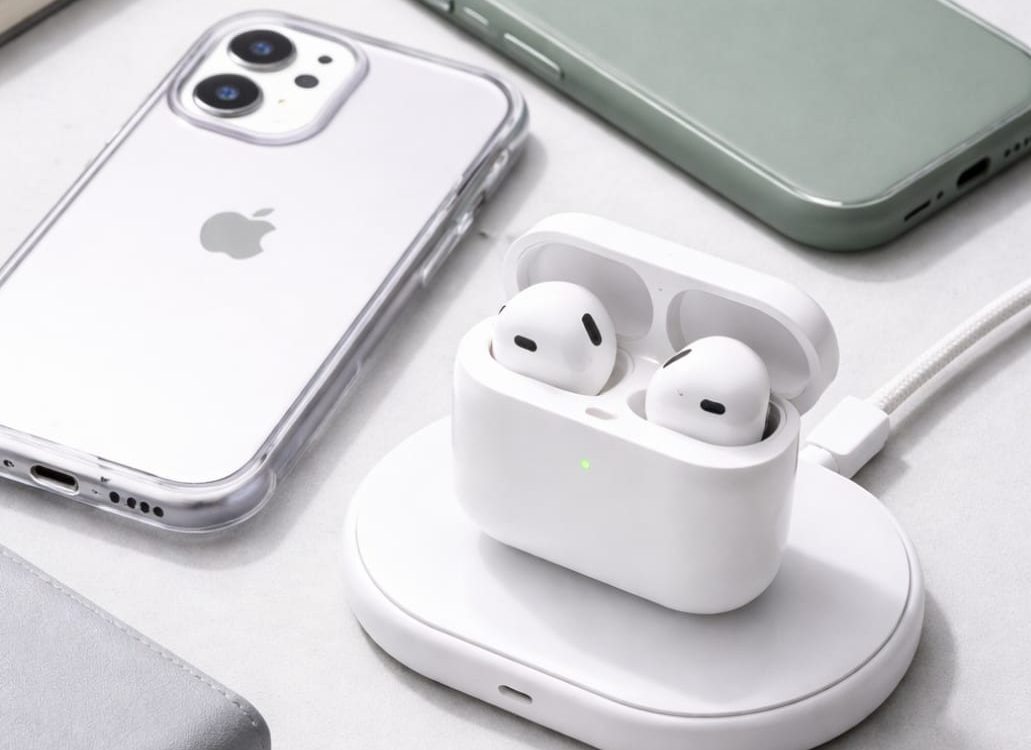
For iPhone users, the conversation about charging increasingly starts with MagSafe. A quality airpod charger and phone charger setup does not have to mean two separate devices cluttering your nightstand. Multi-device MagSafe charging pads can simultaneously power your iPhone, AirPods case, and Apple Watch from a single hub — keeping things clean and removing the friction from your morning routine.
When shopping for an airpod charger that works with a wireless pad, alignment is the key variable most buyers overlook. Standard Qi pads require you to place the AirPods case in a specific orientation with reasonable precision. If you set it down slightly off-center before bed, you may pick it up in the morning with far less charge than expected. MagSafe-based charging solves this with magnetic alignment that self-corrects positioning every time.
Travel is where charging setups tend to fall apart. Most people pack a collection of cables, wall adapters, and maybe a power bank, and end up with a tangled mess that barely fits in a tech pouch. A compact 3-in-1 travel airpod charger and phone charger combination — the kind that folds flat and weighs under 100 grams — dramatically simplifies this. The best versions include a built-in USB-C cable and support both MagSafe and standard Qi, so they work with any device regardless of brand.
One more consideration on the subject of wireless charging: speed versus longevity. Fast charging at 20W or higher is genuinely useful when you need a quick boost during the day. But sustained high-wattage overnight charging contributes to battery degradation over time. Smart chargers that detect when your battery hits 80% and throttle to a maintenance rate are worth the modest extra cost — your battery will thank you two years from now.
The MagSafe Ecosystem: Accessories That Actually Change How You Use Your Phone
Once you have a MagSafe-compatible case and a solid airpod charger setup, you unlock one of the most genuinely useful accessory ecosystems in the mobile world. The magnet array on the back of MagSafe-equipped iPhones supports a growing library of snap-on accessories that attach instantly and detach just as easily.
Magnetic car mounts are among the best of these. Traditional suction-cup or vent-clip mounts have always felt slightly precarious — adequate on smooth roads but nerve-wracking on rough pavement. MagSafe car mounts hold with confidence even on bumpy surfaces, and models with wireless charging pass-through mean your phone arrives home fully charged after a long drive, no cable required.
Magnetic wallet attachments are another category worth considering. Slim enough to hold two or three cards against the back of your phone, they eliminate the need to carry a separate wallet for short errands. The magnets are strong enough to stay put through normal movement but release instantly when you need a card. Third-party versions often add RFID-blocking layers for security.
Magnetic pop grips have also solved the oldest complaint about traditional pop sockets. Classic grip accessories prevented flat wireless charging because they sat directly in the charging zone. MagSafe pop grips attach to the back of your case with a strong magnetic connection and detach completely when you set your phone on a charging pad — giving you grip when you want it and unobstructed charging when you need it.
Putting It All Together
The best mobile accessory setups are not about owning the most gear — they are about choosing the right pieces that work together seamlessly. Start with a well-engineered case that matches your phone’s ecosystem and your lifestyle’s risk profile. Among all the protective phone cases available today, the ones worth buying share three things: honest drop ratings, MagSafe magnet quality, and materials that age well. Layer in a charging solution that keeps every device in your orbit powered without creating cable chaos — including a reliable airpod charger that handles alignment automatically so you stop waking up to half-empty earbuds. Then selectively add modular accessories that genuinely reduce friction from your daily routine.
The accessories you choose should feel invisible in the best possible sense — present when you need them, out of the way when you do not, and reliable enough that you never have to think about them. That is the standard worth holding your purchases to.
