A staggering 82% of organizations experienced a cyber breach in the past year, according to the 2023 Verizon Data Breach Investigations Report, underscoring the vulnerabilities in traditional perimeter-based security models. As attackers increasingly exploit remote work and cloud environments, implementing Zero Trust Architecture emerges as a critical strategy to verify every access request, regardless of origin. This guide draws from authoritative sources like NIST and Forrester to outline a practical roadmap for organizations seeking to fortify their defenses through this robust cybersecurity framework.
Understanding the Fundamentals of Zero Trust Architecture
Zero Trust Architecture rejects the outdated “trust but verify” approach, insisting on continuous verification for all users, devices, and applications. Developed by Forrester analyst John Kindervag in 2010, it assumes breach and designs security accordingly, focusing on micro-segmentation and least privilege access.
Historical Evolution of Zero Trust
The concept traces back to the early 1990s with concepts like Bell-LaPadula models, but it gained traction post-2010 as cloud adoption surged. By the mid-2010s, high-profile breaches like the 2013 Target hack, which compromised 40 million credit cards via stolen credentials, highlighted perimeter failures. NIST formalized it in SP 800-207 in 2020, providing a blueprint that has since influenced global standards.
Today, as of April 2026, adoption has accelerated, with Gartner reporting that 70% of enterprises have initiated Zero Trust projects, up from 40% in 2022, driven by hybrid workforces and sophisticated threats like ransomware.
Core Principles of the Zero Trust Model
At its heart, Zero Trust operates on seven principles outlined by Forrester: verify explicitly, use least privilege, assume breach, and more. Explicit verification involves multi-factor authentication (MFA) and contextual checks, such as device health and user behavior analytics.
- Never Trust, Always Verify: Every transaction requires authentication, authorization, and encryption.
- Least Privilege Access: Grant only necessary permissions, reducing lateral movement in breaches.
- Assume Breach Mindset: Design for inevitable compromise with real-time monitoring.
These principles integrate seamlessly with modern tools, enhancing overall network security.
Key Benefits and Statistics Driving Zero Trust Adoption
Organizations implementing Zero Trust report a 50% reduction in breach impact, per a 2022 Ponemon Institute study sponsored by IBM. This architecture minimizes dwell time for attackers, with IBM’s Cost of a Data Breach Report noting that Zero Trust adopters saved an average of $1.76 million per incident compared to traditional setups.
“Zero Trust isn’t just a technology; it’s a cultural shift that empowers security teams to stay ahead of evolving threats,” says Chase Cunningham, Forrester’s Zero Trust evangelist.
Additional benefits include improved compliance with regulations like GDPR and HIPAA, as granular controls ensure data protection. In cloud environments, it addresses misconfigurations, a factor in 32% of breaches according to the 2023 Cloud Security Alliance report.
For insights into how cloud computing influences cybersecurity practices, Zero Trust provides a layered defense that adapts to distributed infrastructures.
Step-by-Step Guide: How to Implement Zero Trust Architecture
Implementing Zero Trust requires a phased approach, starting with assessment and scaling to full deployment. This process, detailed in NIST guidelines, typically takes 12-18 months for mid-sized organizations but yields long-term resilience.
Step 1: Assess Your Current Environment
Begin by mapping assets, data flows, and user behaviors using tools like network scanners. Identify high-value assets and vulnerabilities; a SANS Institute survey found 60% of firms overlook shadow IT in this phase.
- Conduct a risk assessment to prioritize workloads.
- Inventory users, devices, and applications.
- Define trust boundaries with micro-segmentation in mind.
Step 2: Define Policies and Access Controls
Establish identity-centric policies using frameworks like OAuth 2.0 for API security. Implement MFA across all endpoints; Google’s BeyondCorp model, a pioneer, reduced unauthorized access by 90% through context-aware policies.
Integrate tools for continuous monitoring, ensuring every access request evaluates risk scores based on location, time, and behavior.
Step 3: Deploy Technical Controls and Monitoring
Roll out segmentation using software-defined networking (SDN) to isolate workloads. Deploy endpoint detection and response (EDR) tools; according to IDC, EDR adoption correlates with 40% faster threat detection.
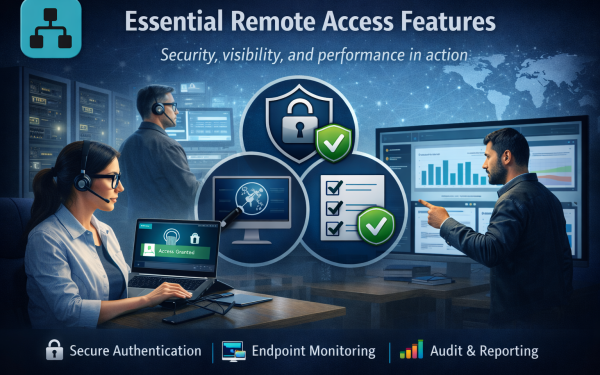
For remote access, consider features like secure tunnels in VPN alternatives. Explore essential remote access tool features that align with Zero Trust by enforcing granular permissions.
Step 4: Train Teams and Iterate
Cultural adoption is key; 75% of failures stem from human error, per Verizon. Provide training on phishing recognition and policy adherence, then use automation for ongoing validation and updates.
Test with red-team exercises to simulate attacks, refining the architecture iteratively.
Challenges and Drawbacks of Zero Trust Implementation
While powerful, Zero Trust demands significant upfront investment, with initial costs averaging $500,000 for enterprises, according to a 2023 Deloitte report. Complexity in legacy systems integration poses hurdles, potentially disrupting operations during migration.
Pros include enhanced visibility and reduced attack surface, but cons involve user friction from constant verifications, leading to shadow IT risks if not managed. Experts like those at Cisco advocate hybrid models to balance security and usability.
| Aspect | Pros | Cons |
|---|---|---|
| Cost | Long-term savings on breach remediation | High initial setup and training expenses |
| Implementation | Scalable for cloud/hybrid | Disruptive to legacy environments |
| User Experience | Personalized access improves efficiency | Increased authentication steps may frustrate users |
Addressing these requires executive buy-in and phased rollouts to mitigate resistance.
Real-World Examples of Zero Trust Success
Google’s BeyondCorp initiative, launched in 2009 and fully implemented by 2014, eliminated VPNs for 75,000 employees, relying on device compliance and risk-based access. This resulted in zero internal breaches from external threats since adoption.
Microsoft adopted Zero Trust post-2019 SolarWinds attack, integrating it into Azure Active Directory. A case study by Microsoft showed a 60% drop in identity-based incidents. Similarly, financial firm Capital One used Zero Trust to segment AWS environments, preventing the 2019 breach’s escalation.
These examples demonstrate practical applications across industries, from tech to finance, proving Zero Trust’s versatility in combating advanced persistent threats.
Comparing Zero Trust with Traditional Security Models
Traditional castle-and-moat security trusts internal networks, vulnerable to insider threats and lateral movement—issues Zero Trust eliminates through explicit verification. Perimeter models like firewalls suffice for static setups but fail in zero-trust’s dynamic world, where 81% of breaches involve weak internal controls, as per the 2023 IBM report.
Alternatives like defense-in-depth complement Zero Trust but lack its holistic verification. In hybrid clouds, Zero Trust outperforms VPNs by enabling secure, scalable access without full network exposure.
Future Trends and Predictions in Zero Trust
Emerging trends include AI-driven anomaly detection, with machine learning predicting 95% of threats proactively, according to a 2024 McKinsey analysis. Integration with edge computing and 5G will extend Zero Trust to IoT ecosystems, where billions of devices demand automated trust decisions.
Predictions point to full ecosystem adoption by 2030, with quantum-resistant encryption addressing future cryptographic risks. Organizations ignoring these trends risk falling behind, as regulatory pressures like the EU’s DORA framework mandate Zero Trust-like controls.
Staying ahead involves leveraging open standards from the Zero Trust Working Group to future-proof implementations.
In summary, implementing Zero Trust Architecture transforms cybersecurity from reactive to proactive, safeguarding assets in an era of relentless threats. Key takeaways include starting with a thorough assessment, prioritizing identity management, and fostering a security-first culture. Begin your journey today by auditing your environment and consulting NIST resources—secure your organization before the next breach strikes.