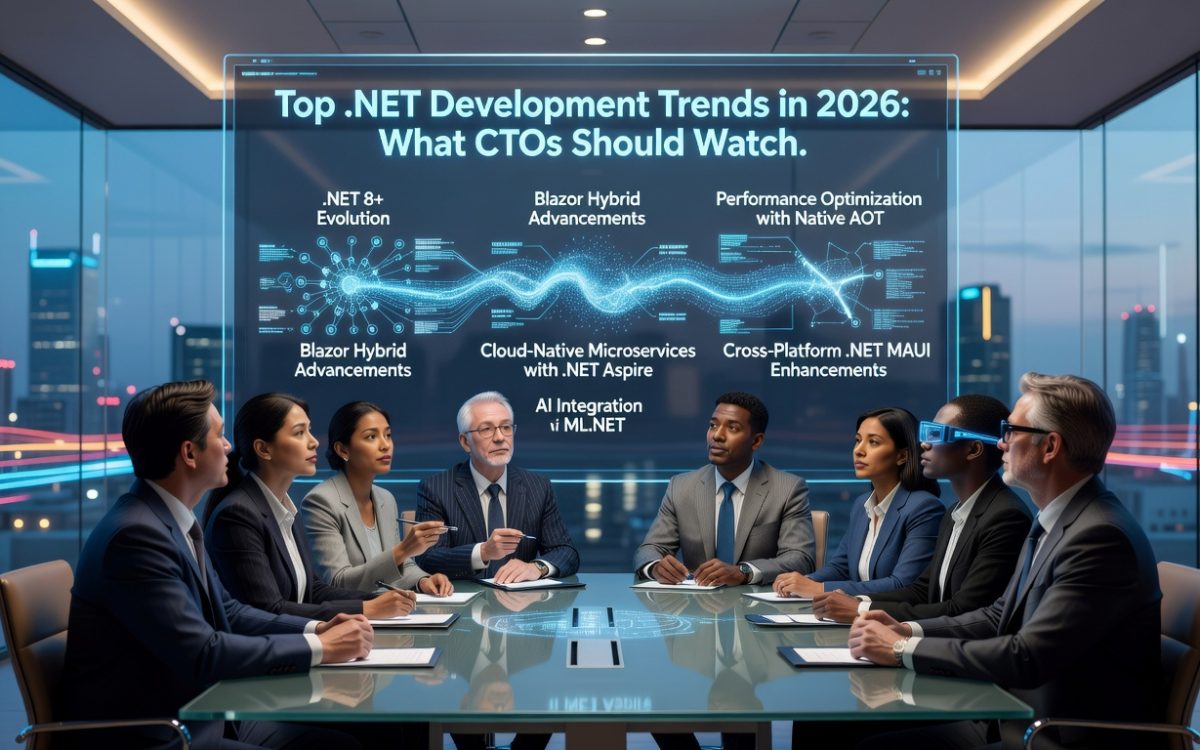
Technology leaders and development teams are under constant pressure to select platforms that deliver long-term value while keeping up with the market demands for new, innovative apps. For CTOs, .NET remains a relevant platform in 2026, with the latest release of .NET 10 taking another significant leap forward, offering enhanced performance, stronger security, improved developer tooling, and deeper cloud and AI integrations.
Over the years, .NET has evolved from a Windows-centric framework into a robust, cloud-native, and cross-platform platform. It now powers everything from enterprise-grade applications and microservices to AI-driven systems and modern mobile solutions. With the arrival of .NET 10, businesses can reduce technical debt, speed up release cycles, and enable scalable architectures.
This blog highlights the top .NET development trends CTOs should watch to stay competitive and build resilient, high-impact solutions for today’s digital-first customers.
The .NET platform is a single platform that meets the diverse requirements of today’s business. These reasons can help CTOs consider .Net 10 for building future applications in 2026 and beyond:
Ease of Use: .Net 10 enables companies to create and run their applications more quickly through optimally performed runtimes.
Can Run on Different Operating Systems: .Net allows applications to run on Windows, Linux, and macOS platforms, providing businesses the opportunity to work on any platform of their choice, without requiring any vendor lock-in.
Enterprise Level Security and Compliance: .Net has built-in features for authentication, authorization, and compliance that take away security concerns for CTOs.
Development Model Unified: Developers can create Web API’s and UI’s from a single source (framework), reducing miscommunication and enhancing team collaboration.
Scalability of Services: By leveraging multi-cloud, and containerized deployment, .Net provides developers with the ability to build applications that can scale their infrastructure.
Additionally, being cloud-native helps companies save money on Infrastructure costs while increasing resilience and speeding up time-to-market. CTOs can confidently plan for a hybrid or multi-cloud Architecture because all their .NET applications are portable and maintainable.
.NET 10 – The AI-First Enterprise Platform
With .NET 10, Microsoft reinforces its position as an AI-first enterprise platform. They introduced the Microsoft Agent Framework, an open-source toolkit that helps businesses build intelligent AI agents to optimize operations and employee productivity.
CTOs will be ready to move from building individual AI capabilities to a more integrated set of solutions that can automate decision-making, collaborate across multiple functional areas, and adapt to a rapidly changing business environment.
Microsoft Agent Framework is built to be compatible with .NET Version 10’s architecture, scalability, security, and cloud capabilities, enabling quicker AI adoption. Additionally, this allows organizations to develop solutions that provide an environment conducive to accelerating innovation and reducing their integration risk.
Here is how .NET 10 is changing the game for modern organizations:
From Simple Bots to Intelligent Teams
Instead of basic “ask-and-answer” tools, the new Microsoft Agent Framework allows developers to build “agentic workflows.” For example, imagine a team of digital specialists, one for data analysis, one for customer service, and one for logistics, all working together, handing off tasks to one another, and solving complex problems autonomously within their existing systems.
Enterprise Speed, AI Smarts
Traditionally, AI can be slow and resource-heavy. .NET 10 introduces specific under-the-hood optimizations that make AI features run with the same high-speed efficiency we expect from our core business applications. This ensures that adding “intelligence” doesn’t come at the cost of performance.
Transparency You Can Trust
For leadership and compliance teams, the black box of AI is a major risk. .NET 10 solves this through Standardized Observability. You can now track exactly how an AI agent reached a decision, monitor AI agents in real time, and ensure every action stays within your security guardrails.
Seamless Path to Production
One of the biggest hurdles for CTOs is moving an AI project from a developer’s laptop to a live environment. Through deep integration with Azure AI Foundry, .NET 10 enables nearly instantaneous deployment. This ensures you can innovate faster and get your AI-driven products to market months ahead of your competitors.
Integrating AI into enterprise applications empowers CTOs to use these capabilities to reduce operational risk, improve customer experiences, and accelerate data-driven decision-making.
ASP.NET Core – Enterprise-Ready Web Development
As impactful as .NET 10’s AI and machine learning capabilities are for transforming enterprise systems, modern business applications still need a robust, secure, and scalable web layer to deliver these innovations to users. This is where ASP.NET Core comes in.
ASP. NET Core is Microsoft’s high-performance, cross-platform framework for building web apps and services on the .NET platform, supporting REST APIs, full-stack web solutions, and real-time applications. It combines speed, security, and deployment flexibility, all critical for CTOs that aim to deliver digital experiences at scale and integrate seamlessly with cloud and microservices architectures.
Let’s dive into more detail about ASP. NET Core:
Key Capabilities
High-Throughput Performance: Uses the lightweight Kestrel server and a modular design to process millions of concurrent requests with minimal overhead.
Proactive Security: Strengthened by default with built-in defenses against common vulnerabilities like XSS, CSRF, and SQL injection, alongside a flexible identity and authorization system.
Deployment Freedom: True cross-platform support allows you to develop on any OS and deploy to Linux containers or Kubernetes to optimize infrastructure costs.
Unified Programming Model: Merges MVC and Web API into a single framework, allowing teams to use the same controllers and routing logic for both pages and data services.
Architecture Patterns
MVC: Separates the user interface from the underlying data, allowing frontend and backend teams to work simultaneously without breaking each other’s code.
Clean Architecture: Keeps business rules independent of external tools. If you need to switch your database or cloud provider in three years, you won’t have to rewrite your core logic.
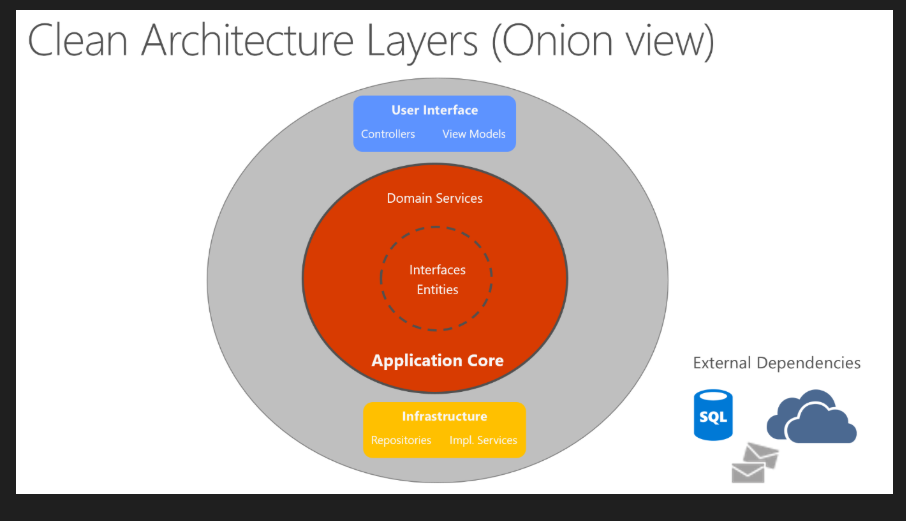
Dependency Inversion: Components interact through “contracts” rather than hard-coded links. This makes the system easier to test, swap, and extend as requirements change.
Data and Middleware
Entity Framework Core 10: Simplifies data access with native support for vector search and JSON, allowing you to integrate AI capabilities directly into your existing SQL workflows.
Middleware Pipeline: A customizable “assembly line” for web requests. You can easily plug in global rules for security, logging, and performance (rate limiting) that automatically apply to the entire app.
As a result, organizations can build their enterprise systems using ASP.NET Core to achieve faster, more predictable scaling while maintaining a secure foundation.
What CTOs Should Evaluate in 2026
As part of their technology strategy for 2026, CTOs should assess:
Architecture: Moving toward Clean Architecture and microservice models will make applications more scalable and maintainable.
Cloud-ready: Applications should be ready for multi-cloud deployment, as they can be built with a containerized architecture, using DevOps practices, and being “cloud-ready.”
AI adoption: CTOs need to assess the potential benefits of agent-based systems and machine learning pipelines to drive insights and automation.
While .NET 10 offers the architecture to lead the market, the challenge for many CTOs remains finding the specialized talent to execute these complex AI and cloud-native migrations. To bridge this gap without the overhead of long recruitment cycles, many enterprise leaders choose to hire .NET developers who are already experts in the latest Microsoft ecosystem, ensuring these trends are turned into functional business assets.
Conclusion
In 2026, .NET 10 development trends will evolve into an ecosystem that bridges the gap between enterprise stability and cutting-edge innovation. By unifying agentic AI workflows through the Microsoft Agent Framework, enabling high-performance web development with ASP.NET Core, and leveraging NativeAOT for cloud-native efficiency, the platform allows CTOs to slash technical debt while rapidly deploying intelligent, scalable solutions.
Ultimately, .NET 10 provides a future-proof foundation, with performance optimizations and secure architectures ensuring your business remains relevant and leads in a market driven by AI and digital-first customers.