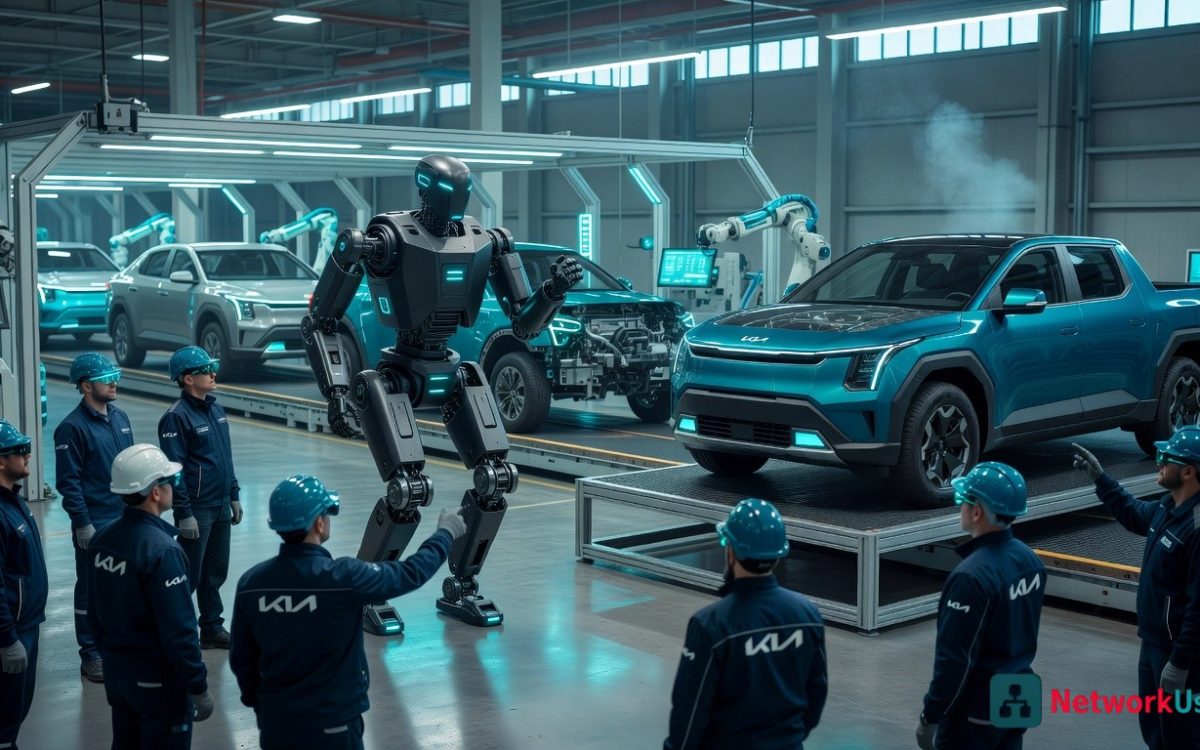
Kia, a leading automaker under the Hyundai Motor Group, recently announced a significant pivot in its electrification strategy by reducing its electric vehicle (EV) production targets, while confirming development of an electric pickup truck and integrating Boston Dynamics’ Atlas humanoid robots into its Georgia manufacturing facilities. This move reflects broader industry challenges in EV adoption amid slowing demand and supply chain hurdles.
Kia’s Revised EV Targets and Market Pressures
Hyundai Motor Group, which includes Kia, originally aimed to produce 1.73 million EVs annually by 2030, but executives now project a more modest 1.4 million units, citing weaker-than-expected sales growth. According to a report from S&P Global Mobility, global EV sales rose only 35% in 2023, down from 65% the previous year, pressuring automakers to adjust ambitions.
Reasons Behind the Cut
The decision stems from high interest rates, subsidy reductions in key markets like the U.S. and Europe, and intense competition from Tesla and Chinese rivals. Kia’s CEO Ho Sung Song stated in an earnings call that the company will prioritize profitability over aggressive expansion, focusing on hybrid models as a bridge technology.
Industry analyst Sam Abuelsamid from Navigant Research notes,
“Kia’s recalibration aligns with a maturing EV market where infrastructure lags behind hype, potentially delaying full electrification by years.”
This shift could impact investor confidence, as Kia’s stock dipped 2% following the announcement.
Confirmation of Kia’s Electric Pickup Truck
Amid the EV target reduction, Kia reaffirmed plans for its first electric pickup, slated for production at its West Point, Georgia plant. The vehicle, part of the PV5 platform under the Purpose Vehicle (PV) series, promises a towing capacity of up to 7,700 pounds and a range exceeding 300 miles, leveraging an 800-volt architecture for faster charging.
Technical Specifications and Innovations
The pickup will feature advanced machine learning algorithms for adaptive suspension and over-the-air updates via a dedicated protocol framework. With a battery throughput optimized for minimal latency in power delivery, it aims to compete directly with the Ford F-150 Lightning and Rivian R1T. Kia’s engineering team highlights the use of cloud computing integration for real-time performance monitoring.
As of April 2026, prototypes have undergone rigorous testing, with full production expected to boost Kia’s U.S. market share in the burgeoning electric truck segment, projected to reach 20% of light-duty sales by 2030 per BloombergNEF.
Atlas Robots Deployment in Georgia Factories
Kia plans to deploy Atlas humanoid robots from Boston Dynamics—acquired by Hyundai in 2021—across its $7.6 billion Metaplant America in Georgia, starting with pilot programs in assembly lines. These robots, capable of complex tasks like part handling, will enhance automation efficiency.
Robot Architecture and Factory Integration
Atlas features a sophisticated processor-driven control system with high bandwidth for sensor data processing, enabling low-latency responses in dynamic environments. The deployment follows a modular architecture that integrates with existing factory encryption protocols for secure data exchange.
- Expected throughput increase: 25% in welding and painting operations, per Hyundai’s internal simulations.
- Cost savings: Up to $500 million annually through reduced labor dependencies, as estimated by McKinsey & Company.
This initiative draws parallels to automation advancements in heavy industry, showcasing how artificial intelligence is reshaping manufacturing.
Historical Evolution of Kia’s Electrification Efforts
Kia’s EV journey began with the Soul EV in 2014, evolving to the award-winning EV6 in 2021, which set benchmarks for fast-charging tech. The group’s investment in Boston Dynamics has accelerated robotics integration, building on Hyundai’s $1.1 billion acquisition to pioneer humanoid applications in auto production.
Expert Views and Industry Comparisons
While some praise Kia’s pragmatic approach, others warn of lost momentum. Ford’s EV sales grew 86% in 2023, outpacing Kia’s 64%, highlighting the need for agile strategies. For insights into AI-driven innovations, see how project management tools leverage machine learning.
| Aspect | Kia EV Pickup | Tesla Cybertruck |
|---|---|---|
| Range | 300+ miles | 340 miles |
| Price | $45,000 est. | $60,000+ |
| Automation | Atlas robots | Optimus pilots |
Comparisons reveal Kia’s edge in affordability, though Tesla leads in throughput for autonomous features.
Future Trends and Implications
Looking ahead, Kia’s moves signal a hybrid-robotics era in automotive manufacturing, with humanoid robots potentially reducing defects by 40%, according to a MIT study on automation. Challenges include ethical concerns over job displacement and high initial costs for robot frameworks.
Pros: Enhanced precision and scalability. Cons: Dependency on AI reliability and regulatory hurdles. Real-world examples include BMW’s use of similar bots, cutting assembly time by 30%.
In related tech ethics discussions, explore data usage in AI training. For broader user engagement in SEO Auckland strategies, Kia’s consumer-focused EV design offers lessons.
Key Takeaways and Outlook
Kia’s adjustments underscore the need for balanced innovation in EVs and automation. Tech enthusiasts should watch for the electric pickup’s launch and Atlas integration, which could redefine factory efficiency. Stay informed on evolving cybersecurity measures in robotic systems to mitigate risks. sourcing insulation installers
