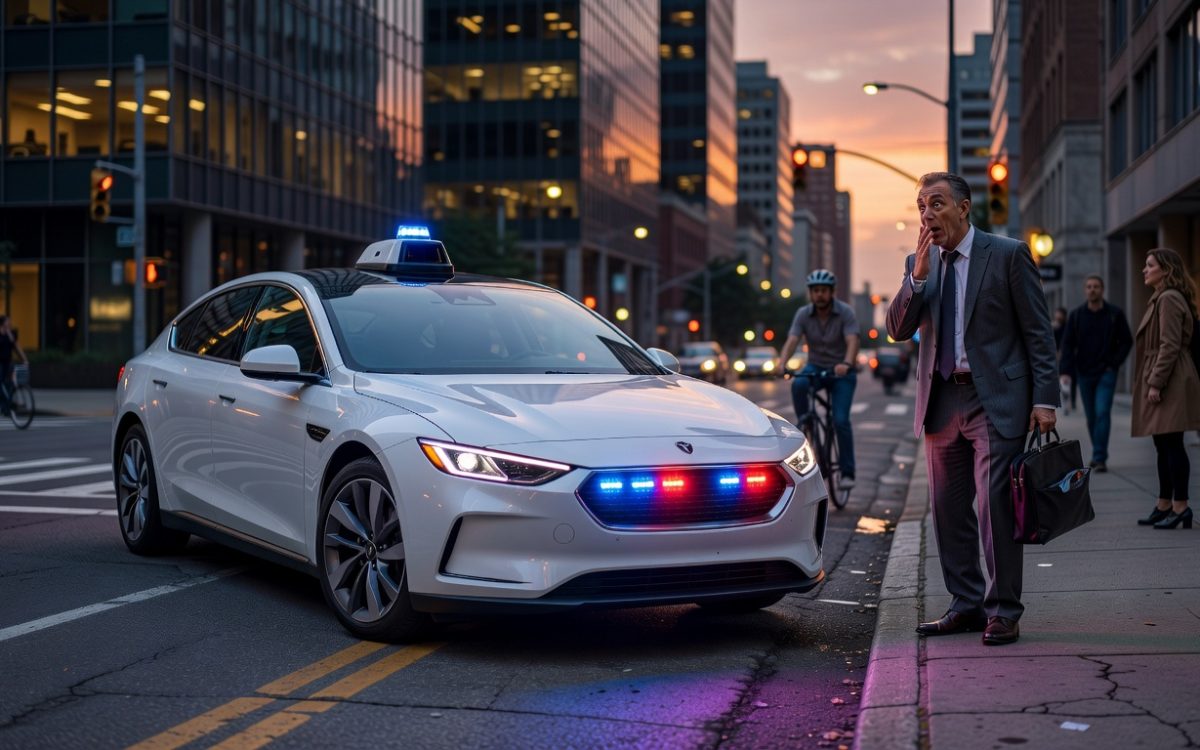
Lead: Waymo Robotaxi Calls 911 in Emergency
SAN FRANCISCO — A Waymo autonomous vehicle summoned emergency services on its own last Wednesday after detecting a passenger suffering a medical emergency, marking one of the first instances of a robotaxi independently contacting 911 in a real-world scenario.
Incident Details
The incident occurred around 7:45 p.m. on October 15, 2026, in San Francisco’s Mission District. According to the San Francisco Police Department, the Waymo One robotaxi, a modified Jaguar I-PACE, was en route from the Castro District to the Financial District with a single passenger, identified as 42-year-old software engineer Maria Gonzalez.
Waymo’s safety systems detected irregular vital signs through the vehicle’s integrated health monitoring features, including heart rate variability from seat sensors and passenger movement patterns via cabin cameras. The vehicle pulled over safely at the intersection of 16th and Valencia Streets and automatically initiated a 911 call, relaying the passenger’s location, vehicle identification number, and a synthesized description of the situation: “Medical emergency detected; passenger unresponsive.”
Emergency responders arrived within six minutes, transporting Gonzalez to San Francisco General Hospital, where she was treated for a suspected cardiac event and stabilized. No injuries were reported from the vehicle’s operation, and the robotaxi remained stationary until authorities cleared the scene.
Waymo spokesperson Elena Vasquez confirmed the details in a statement to NetworkUstad: “Our vehicles are equipped with advanced safety protocols, including the ability to interface directly with emergency services when human intervention is not possible. This event underscores the potential of autonomous technology to enhance public safety.”
Background on Robotaxi Safety Protocols
Autonomous ride-hailing services like Waymo have operated in San Francisco since 2021, following regulatory approvals from the California Public Utilities Commission. The technology integrates AI-driven decision-making with redundant safety measures, including remote human oversight via teleoperation centers.
Calling 911 autonomously builds on earlier developments, such as Tesla’s 2023 software update allowing vehicles to alert emergency contacts. Waymo’s system, rolled out in pilot testing earlier this year, uses natural language processing to communicate with dispatchers and complies with FCC guidelines for automated calls. This capability addresses a key concern in the industry: ensuring rapid response in scenarios where drivers—human or otherwise—are unavailable.
Prior incidents, including a 2024 Cruise robotaxi collision in Phoenix that required manual emergency intervention, have highlighted vulnerabilities. The National Highway Traffic Safety Administration (NHTSA) has investigated over 200 autonomous vehicle reports since 2020, emphasizing the need for seamless emergency integration.
Expert Perspectives
Bryant Walker Smith, a professor of law and engineering at the University of South Carolina and an advisor to NHTSA, described the event as a “milestone in accountable automation.” In an interview with NetworkUstad, Smith noted, “This isn’t just about calling for help; it’s about the vehicle providing actionable data that could save lives. However, it raises thorny questions about data privacy and who bears liability if the AI misinterprets a situation.”
Similarly, Robin Chase, founder of Zipcar and author on mobility innovation, praised the response time. “Robotaxis could transform emergency response in urban areas, potentially reducing fatalities by 20-30% through faster alerts,” Chase said via email. She cautioned that widespread adoption requires standardized protocols across providers like Uber and Zoox.
Implications and Future Developments
The incident has prompted discussions on regulatory frameworks for AI-mediated emergencies. California’s Department of Motor Vehicles announced plans to review Waymo’s protocols, potentially influencing national standards under the Biden administration’s 2026 autonomous vehicle roadmap.
For consumers, this event bolsters confidence in robotaxis, which logged over 50 million miles in U.S. cities last year with a safety record 85% better than human-driven taxis, per Waymo data. Yet, it also spotlights challenges: Gonzalez’s family has filed a query with Waymo regarding sensor accuracy, though no lawsuit is pending.
Looking ahead, Waymo intends to expand the feature to its fleet of 1,500 vehicles in San Francisco and Los Angeles by early 2027. Industry analysts predict similar integrations from competitors, potentially integrating with wearable health devices for proactive alerts. As robotaxis proliferate—projected to comprise 15% of urban rides by 2030—this case illustrates their evolving role beyond transportation into lifesaving infrastructure.