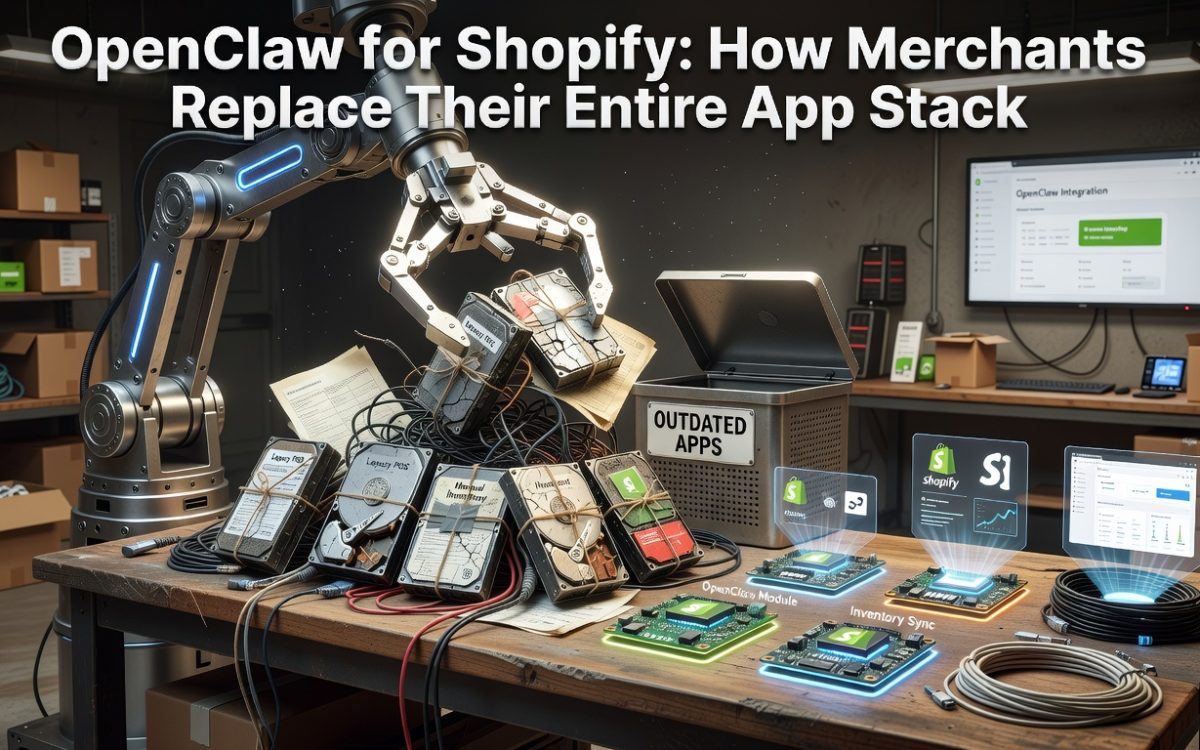
Most Shopify stores end up with a mess of apps that do not really talk to each other. You have got one tool handling support tickets, another watching inventory, a third trying to do upsells, and maybe a fourth managing returns. Each one was a good idea at the time but together they create chaos. Data lives in different places and automations step on each other.
If you have been through this, you already know how frustrating it gets. The patchwork approach works fine when your store is doing a few thousand dollars a month. But once you are processing 200 or 300 orders a week, the cracks show fast. Missed inventory updates, duplicate customer replies, shipping delays that cost you reviews. According to a 2025 Statista report, global eCommerce sales are projected to surpass $7.4 trillion by 2026. Merchants competing at that scale cannot afford operational chaos.
This article explains how OpenClaw for Shopify lets merchants swap out that bloated app stack for a single managed system of AI agents, and why that change matters more than most people realize.
Why the Shopify App Stack Gets Out of Control
There is a pattern that plays out in pretty much every growing Shopify store. You start lean, add tools as problems come up, and one day you realize your tech stack looks like a junk drawer with a monthly subscription attached to every item in it.
The One More App Trap
It starts innocently enough. You install an inventory tracker after you oversell during a flash sale. Then you grab a support chatbot because tickets pile up over weekends. Before long, you have got separate apps for email campaigns, order routing, shipping rate calculation, and low-stock alerts.
Each one solves a narrow problem. But none of them talk to each other, and that is the real issue. Your inventory app does not know your marketing app just launched a 40% off campaign. Your chatbot cannot check real-time shipping status. They are all doing their own thing in their own little corner, and the coordination falls on your team.
What It Actually Costs You
Forget the subscription fees for a second. The real cost is the friction. When a customer asks where my order is and your support person has to open three different tabs to piece together an answer, that is four to six minutes per ticket instead of thirty seconds.
Multiply that across 50 tickets a day. You are burning three to four hours of labor on something that should be instant and automatic. And that is just one workflow. The compounding effect across inventory, marketing, and fulfillment is genuinely massive once you sit down and add it up.
The Data Silo Problem
Every app stores its own slice of your business. Your email platform knows purchase history. Your inventory tool knows stock levels. Your shipping app knows delivery timelines. But no single system sees the full picture at once.
So when you want to answer a simple question like which products should we restock before our next email goes out, you end up pulling three different reports and stitching them together in a spreadsheet. That is how most mid-size Shopify merchants still operate. Not because they want to, but because their tools were never designed to work as a team.
How OpenClaw for Shopify Changes the Math
OpenClaw is not another app you bolt onto your store. It is an open-source AI agent framework, and through a
OpenClaw is not another app you bolt onto your store. It is an open-source AI agent framework, and through a professional OpenClaw setup for eCommerce, merchants get it deployed, configured, and managed on their own infrastructure. That last part matters more than it might sound.
Five Agents, One System
Instead of twelve disconnected apps, OpenClaw runs five purpose-built AI agents: Order Processing, Inventory Management, Customer Support, Marketing Campaigns, and an Orchestrator that keeps all four of them working in sync.
The Orchestrator is the piece that changes everything. When your Marketing agent launches a promotion, the Inventory agent already knows before a single order comes in. When a customer reaches out about a delayed shipment, the Support agent pulls live data from the Order Processing agent without anyone switching tabs or copying order numbers between dashboards. It runs as one thing, not five things pretending to be one.
Your Data Stays on Your Machine
Most SaaS apps send your store data to their own servers. Every customer email, purchase history, and API key lives on infrastructure you do not control. With OpenClaw, everything runs on your own server. Your data never leaves your environment. If you ever want to move providers or bring management in-house, nothing is holding your data hostage.
For merchants in regulated niches like supplements or health products, or anyone processing a high volume of orders daily, that level of control is not optional. It is a baseline requirement.
No Vendor Lock-In
OpenClaw is MIT licensed and fully open-source. You have complete SSH access to your deployment. If you want to modify an agent, swap a component, or move everything to different infrastructure, you can. That is genuinely different from a typical Shopify app where changing providers means starting from scratch with your data trapped inside someone else’s platform.
What the Day to Day Actually Looks Like
Forget the theory for a moment. Here is what actually changes on a regular Tuesday morning when OpenClaw is running instead of a pile of disconnected apps.
Inventory That Thinks Ahead
The Inventory Management agent does not just track what is in stock. It watches actual sales velocity and flags products that are trending toward zero before you are scrambling to reorder. If your bestselling item usually moves 120 units a week and suddenly jumps to 180 because the Marketing agent just pushed a campaign, you get an alert before the shortage hits, not after the one-star reviews start coming in.
No more finding out you are out of stock from an angry customer message. That is a scenario most merchants have lived through at least once, and it is the kind of thing that sticks with you.
Customer Support Across Every Channel
The Support agent handles inquiries across WhatsApp, Slack, and Telegram, not just your store’s built-in chat widget. It can pull live order status, start a return, and run sentiment analysis on incoming messages to catch frustrated customers before they escalate.
A customer messages at 11 PM asking about a refund. The agent checks their order history, confirms the return policy applies, and walks them through the process. Your team reviews the interaction the next morning. That is a very different experience from the standard we will get back to you in 24 hours auto-reply that most stores still send.
Shipping Without the Back and Forth
With Shiprocket integration built into the deployment, fulfillment connects directly to your carrier network. The Order Processing agent handles label generation, tracking updates, and delivery confirmations without anyone logging into a separate shipping dashboard.
For a store shipping 100 to 200 packages a day, this saves two to three hours of repetitive manual work every single day. That time compounds fast over a month.
Why Managed Deployment Beats Doing It Yourself
You could technically set up an OpenClaw deployment on your own. Plenty of people have done it. But most merchants who have looked into it choose a managed deployment instead, and the reason is not about technical skill.
The 3 AM Problem
Self-hosted infrastructure needs watching. Agents need updates. Security patches need applying. When something breaks at 3 AM during your biggest sales weekend, someone has to fix it fast. With a managed deployment, that is handled around the clock. Updates, security, uptime monitoring, all of it. You focus on your store. Someone else keeps the system running.
Configuration That Actually Fits How You Work
A managed setup does not just drop the software on a server and leave you to figure it out. The agents get configured for your specific Shopify setup, your product catalog, your shipping zones, and the way your customers actually reach out to you. The difference between a generic install and one tuned to your store is significant, and you feel it within the first week.
Everything Visible in One Place
You get monitoring dashboards from day one. Order volume, agent response times, inventory alerts, campaign performance, all of it visible in one view. Building that kind of operational visibility yourself takes weeks of setup work on top of the deployment itself. Most merchants would rather spend that time running their store.
Making the Switch Without Breaking Anything
Replacing your whole app stack sounds like a big project. In practice, it is less disruptive than most merchants expect.
Start With Your Biggest Problem
You do not have to migrate everything at once. Most merchants start with the workflow that causes them the most daily pain, usually customer support or inventory management. Once that is running well, which typically takes a few days rather than weeks, you move to the next piece.
Keep What Is Actually Working
If you have a Shopify app that does its job well and does not overlap with what OpenClaw handles, there is no reason to remove it. This is not about clearing your app list on principle. It is about replacing the tools that create data silos, conflicting automations, and costs that do not justify themselves anymore.
Measure Before and After
Track your response times, stockout incidents, and monthly app spending before you make any changes. Then look at the numbers again at 30 days and 60 days. The comparison tends to be the thing that convinces merchants to stay with the setup, because the before numbers are usually worse than they expected.
The Bigger Picture for Shopify Merchants
The Shopify ecosystem is maturing fast. Merchants who built their operations on a stack of single-purpose apps are running into a ceiling, and most of them can feel it even if they have not identified the exact cause yet. Slower response times, opportunities missed, costs climbing without a matching increase in revenue.
OpenClaw for Shopify is not about chasing an AI trend. It is about running a cleaner operation on infrastructure you actually control, one that scales without adding another monthly subscription every time a new problem surfaces.
The merchants who make this shift early will not just save money. They will operate faster, make fewer mistakes, and have teams that spend their time on work that actually moves the business forward. In eCommerce, that operational edge is the kind that compounds quietly and then becomes very hard to close.