Bentley Continental GT Speed Review: Supreme Grand Touring Poise
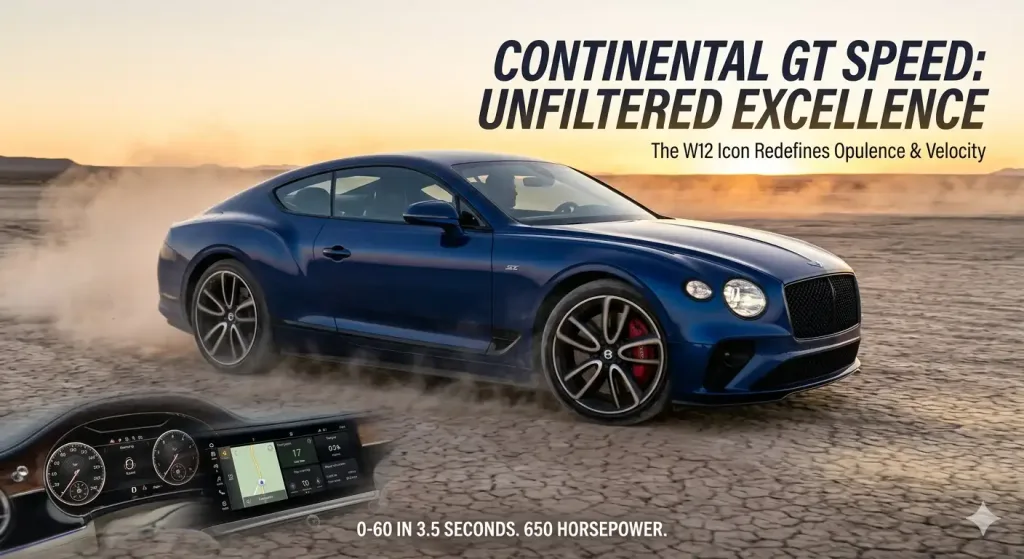
The Bentley Continental GT Speed reinvents the grand tourer with a 771-hp plug-in hybrid V8 that delivers supercar acceleration alongside near-silent electric cruising. Its towering price and weighty 5,400-pound curb figure are the main compromises, but for affluent buyers who want a single car that does everything, it has few rivals. See how it stacks up against other flagships in our luxury vehicle reviews.
For two decades, the Continental GT Speed was defined by its 6.0-liter twin-turbo W12. That engine was retired in 2024, and in its place Bentley fitted the Ultra Performance Hybrid system. The switch is more than an efficiency play — the new setup produces 771 hp, making this the most powerful road-going Bentley ever built, according to Bentley’s official specifications. Enthusiasts mourning the twelve-cylinder soundtrack will find the V8 delivers a genuinely cultured bellow rather than a synthesized substitute.
Performance and the Hybrid Advantage
The electric motor’s real trick is torque-fill: it delivers an instant shove the moment you touch the throttle, erasing turbo lag entirely. The result is startling in a car this size. Bentley claims 3.1 seconds to 60 mph, but independent testing by Forbes recorded just 2.8 seconds, with the electric assistance credited for the launch ferocity. Top speed remains a colossal 208 mph. Crucially, the battery also allows up to 39 miles of pure-electric driving at speeds up to 87 mph, so short commutes can be completed in near silence.
Chassis, Weight, and Handling
There is no hiding that this is a heavy car — curb weight sits around 5,400 pounds, roughly 500 pounds more than the outgoing model. Yet the engineering does remarkable work to disguise it. The 48-volt active anti-roll system keeps body movement tightly controlled, while standard all-wheel steering shrinks the car’s footprint at low speeds. The rear-biased 49:51 weight distribution, achieved by placing the battery behind the rear axle, gives the coupe a playful balance that belies its mass. Given the poundage, the optional carbon-ceramic brakes are a sensible box to tick.
Efficiency, Practicality, and Everyday Use
Government ratings land at 52 MPGe combined and 19 mpg on premium gasoline alone — a night-and-day improvement over the W12 it replaces. The trade-off is packaging: mounting that battery under the trunk floor shrinks cargo space significantly, a compromise buyers should weigh against the performance and efficiency gains. For daily luxury travel, though, the cabin remains the star, with vault-like quietness in electric mode and the reassuring thud of properly engineered doors.
Verdict
The Bentley Continental GT Speed successfully bridges two worlds that rarely meet — supercar acceleration and serene, zero-emission luxury cruising. It is heavier and pricier than ever, and the smaller trunk is a real compromise, but no direct rival packages this breadth of ability so convincingly. For the wealthy buyer who wants one car to conquer both the city and the continent, it is close to definitive.
Rating: 4.6 / 5 — A technological triumph that reinvents the grand tourer without losing Bentley’s soul.
Frequently Asked Questions
How much does the Bentley Continental GT Speed cost?
How powerful is the new Continental GT Speed?
Is the Bentley Continental GT Speed a hybrid?
What happened to the W12 engine?
How fast is the Continental GT Speed 0-60 mph?
What is the top speed of the Continental GT Speed?
How much does the Continental GT Speed weigh?
Is the Continental GT Speed good value?
+Pros
- Explosive, lag-free acceleration that outpaces the factory 0-60 claim
- Genuine electric-only running for silent, emission-free city trips
- Sharply improved efficiency versus the retired W12
- Sumptuous, meticulously crafted cabin with bespoke personalization
- Active anti-roll suspension hides the considerable weight impressively
−Cons
- Very high starting price that escalates quickly with options
- Heavy 5,400-pound curb weight demands strong braking hardware
- Cargo space is compromised by the rear-mounted battery
- Carbon-ceramic brakes are a near-essential $20,000 option