Enterprises are seeing rapid growth in IoT devices — from smart manufacturing and supply chain monitoring to building management and equipment tracking. This generates significant data volumes and supports advanced automation. Weak network infrastructure results in lost data, security vulnerabilities, and operational downtime. A strong, well-designed network is therefore the essential base for any enterprise IoT deployment — never just an optional extra. This usually starts with expert IoT consulting to build a clear strategy for device connectivity, data handling, and infrastructure alignment.
Why Standard Networks Fail for IoT
Traditional corporate networks were engineered for human-generated data traffic from computers and phones. This traffic is relatively predictable. IoT fundamentally changes the requirements. The new demands are:
- Much higher scale and density — thousands to millions of endpoints.
- Burst-heavy M2M traffic patterns, not steady user-driven streams.
- Wide variety of device protocols, power sources, and computing abilities.
- Robust operation in harsh, remote, or physically challenging settings.
If the architecture doesn’t address these unique needs, you end up with congested networks, increased latency, and real-time data that fails to provide meaningful value. Working with a partner that offers IoT consulting services allows for a proper evaluation of your requirements so the network is designed around your actual business objectives, not a standard off-the-shelf approach.
Core Principles of a Robust IoT Network Architecture
IoT network design follows key principles. Prioritize stability, security, and scalability above high bandwidth alone.
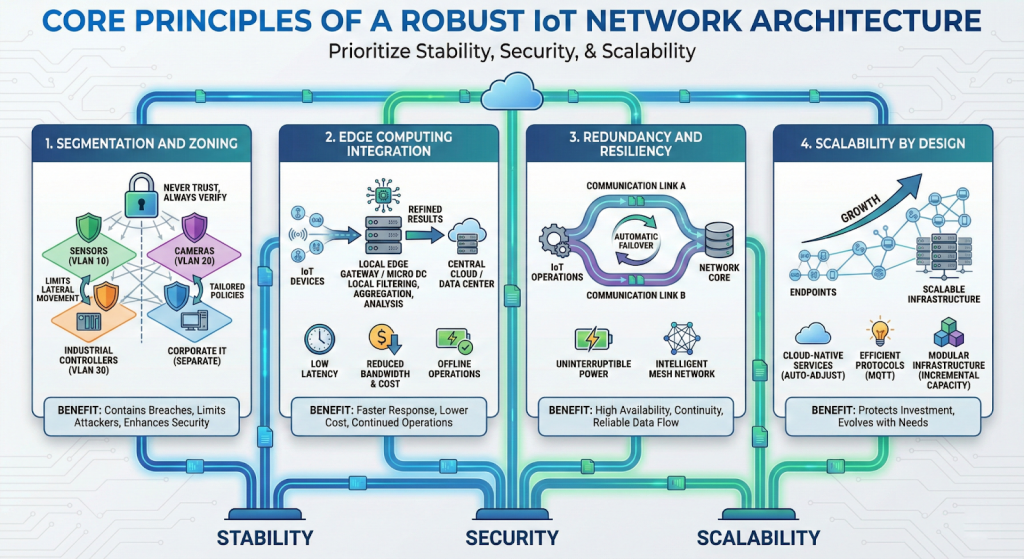
1. Segmentation and Zoning
“Never trust, always verify” is a core requirement for IoT environments. Given the weak security found in most IoT devices, they must be kept separate from the corporate IT network segment.
Achieve this through segmentation: VLANs provide a straightforward and widely used method, SDN offers dynamic policy enforcement, and in high-risk scenarios, physical network separation remains an option. Assign dedicated segments to different device classes — sensors, cameras, industrial controllers, and so on.
Benefit: Contains potential breaches, limits lateral movement for attackers, and allows for tailored security policies.
2. Edge Computing Integration
Edge computing integration is a core IoT requirement—process data at the edge. Install edge gateways or micro data centers for local data filtering, aggregation, and analysis before transmitting refined results upstream.
Benefit: Drastically reduces latency for time-sensitive operations, minimizes bandwidth consumption and cost, and enables operations to continue during central network outages.
3. Redundancy and Resiliency
If your IoT operations are mission-critical, resilience isn’t optional—it’s what keeps the lights on. Guard against expensive outages by incorporating redundant communication links, automatic failover, uninterruptible power, and intelligent mesh networks that find new routes around failures.
Benefit: Ensures high availability and continuity of service, maintaining data flow even under adverse conditions.
4. Scalability by Design
An IoT network must be designed for growth. It needs to handle a surge in endpoints and the accompanying data deluge without performance loss.
Achieve this by using inherently scalable components. Use cloud-native services that adjust resources automatically. Implement efficient protocols like MQTT designed for massive device counts. Choose a modular infrastructure that allows you to add capacity incrementally without major re-engineering.
Benefit: Protects the initial investment and allows the IoT deployment to evolve in lockstep with business needs.
Architectural Models and Protocol Choices
Selecting the right combination of connectivity and protocols is a technical decision with long-term strategic impact.
| Model/Layer | Options | Best For | Considerations |
| Connectivity | LTE-M/NB-IoT, 5G, LoRaWAN, Wi-Fi 6, Ethernet | Coverage, Power, Bandwidth needs | LTE-M/NB-IoT for wide-area, low-power; 5G for ultra-low latency/high bandwidth; LoRaWAN for very long-range, low-data. |
| Protocol | MQTT, CoAP, AMQP, HTTP/HTTPS | Device constraints & data pattern | MQTT is the de facto standard for lightweight pub/sub; CoAP for very constrained devices; AMQP for robust enterprise messaging. |
| Topology | Star, Mesh, Hybrid | Reliability vs. Cost | Star is simple; Mesh is resilient but complex; Hybrid balances both for large-scale IIoT deployments. |
For manufacturing, energy, or logistics enterprises, demands are considerably higher. Industrial IoT (IIoT) requires exceptional reliability, real-time control, and full OT system integration. Success depends on a strong knowledge of networking combined with industrial protocols.
Security: The Non-Negotiable Layer
The entire IoT network demands security designed in at every stage, never as a retrofit. Implement secure boot on devices along with hardware trust anchors such as TPM, and assign each one a unique cryptographic identity.
Mandate TLS or DTLS encryption for all data moving across the network and prohibit the use of default passwords. Deploy dedicated IoT security solutions for ongoing monitoring that can catch anomalies — for example, a sensor starting to scan ports or connect in ways it shouldn’t.
Security must govern a device’s full lifecycle. Enforce strict procedures for three phases: secure provisioning, authenticated firmware updates, and controlled decommissioning with data erasure. Documentation ensures consistent control.
The Implementation Roadmap
A phased rollout minimizes risk and ensures successful IoT deployment.
- Define Requirements & Outcomes: Specify the business objective (predictive maintenance, asset tracking, quality control, etc.). It defines technical needs.
- Assess & Plan: Evaluate existing infrastructure, note deficiencies, and plan the future architecture. Expert IoT consulting prevents typical issues.
- Pilot & Validate: Test a small-scale POC. Measure performance, security, and manageability.
- Scale & Integrate: Roll out incrementally, integrate with existing ERP, CRM, analytics tools.
- Manage & Optimize: Monitor regularly, patch systems, optimize for real-world demands.
Conclusion
A strong enterprise IoT network is not optional. It is a complex, mandatory foundation. This requires a major shift from how most companies think about connectivity. You are not just adding Wi-Fi. You must build a new type of architecture—one that is segmented by design, pushes intelligence to the edge, has built-in backup paths, and can grow on demand.
Your choices for communication protocols and network layouts must be driven by concrete use cases, not by what’s trendy. Security cannot be an afterthought. It must be the first layer applied, and it must protect every device from activation to retirement.
For the majority of businesses, doing this in-house is a significant and avoidable risk. The technical hurdles are substantial.
Professional IoT consulting brings a clear benefit at this stage. It creates a direct path to an operational system, minimizes the chance of major setbacks, and converts the network from a risk into a trustworthy platform. Capital put toward a strong architecture isn’t an optional outlay.
It’s the essential precondition for a secure, stable, and genuinely useful IoT deployment that endures.