A staggering 78 million tons of solar panel waste could accumulate globally by 2050. This prediction raises serious concerns about recycling these panels. The clean energy revolution hides a dirty secret. Solar installations have grown 22% annually throughout the United States. Yet a mounting challenge looms ahead.
These panels serve their purpose for 25-30 years, but their disposal creates significant issues. The United States and European Union currently recycle less than 10% of decommissioned panels. This situation presents both a challenge and a chance for innovation. Modern recycling technologies can recover up to 95% of semiconductor materials and 90% of glass from end-of-life panels.
Recycled materials could supply more than 50% of the silver needed for new panels by 2035. They could also provide 30% of the aluminum, silicon, and glass requirements. Solar panels can definitely be recycled. The biggest problems lie in the methods and economics. Recycling costs range from $20 to $30 USD per panel, which poses a significant hurdle. The environmental benefits, however, justify these costs.
This piece outlines practical steps to store and recycle your used solar panels. You’ll find guidance on whether you need to dispose of home system panels or want to partner with reputable companies like Solar Recycling.
We can transform this waste challenge into an eco-friendly solution.
Why Responsible Solar Panel Disposal Matters
The solar industry’s explosive growth has created an unexpected challenge. A pressing question emerges as solar installations reach the end of their useful life: what happens to all those panels?
The Growing Volume Of Solar Waste
Solar installations are booming all across America. Most systems are still relatively new, with 70% of today’s operating solar energy systems installed after 2019. This youth masks a looming waste management crisis.
The United States will face about one million total tons of solar panel waste by 2030. Looking further ahead, the numbers become more alarming. Experts expect the U.S. to have the second-largest volume of end-of-life panels globally by 2050, reaching 10 million tons.
To name just one example, see the panels that will cover around 3,000 American football fields retiring by 2030. A typical solar panel works well for 25-35 years before performance drops enough to need replacement. Weather damage and installation errors can force panels into early retirement even if they still function.
“My panels were only eight years old when hail damaged three of them beyond repair,” says Michael Torres, a Colorado homeowner. “I had no idea what to do with them.”
Environmental Risks Of Improper Disposal
Retired solar panels pose significant risks. Lab tests reveal that different panel varieties contain various metals in their semiconductors and solder.
Some of these metals include:
- Lead and cadmium, which can be harmful at high concentrations
- Selenium compounds that may leach into groundwater
- Silver and copper that become environmental contaminants when improperly disposed
- Silicon materials encased in plastic that degrade into microplastics over decades
Broken or degraded panels in landfills can leak these substances into surrounding soil.
While not all panels qualify as hazardous waste, those failing the toxicity characteristic leaching procedure (TCLP) test require special handling under federal regulations.
The environmental damage goes beyond contamination. Heavy metals reduce soil fertility and prevent healthy plant growth. Toxic substances accumulate in fish and other organisms, damaging entire ecosystems. Mishandling can release silica dust and chemical fumes into the air.
The recycling rate for decommissioned panels remains nowhere near adequate – less than 10% in the United States and the European Union. Most panels end up in landfills, creating long-term environmental risks.
The Chance For A Circular Economy
What may seem like a disposal challenge can actually become a meaningful opportunity. When handled responsibly, Solar Recycling solar panels support a circular approach where retired panels are processed and recovered for future use.
Instead of ending up as waste, these materials can re-enter the supply chain, helping organizations reduce environmental impact while maximizing long-term value.
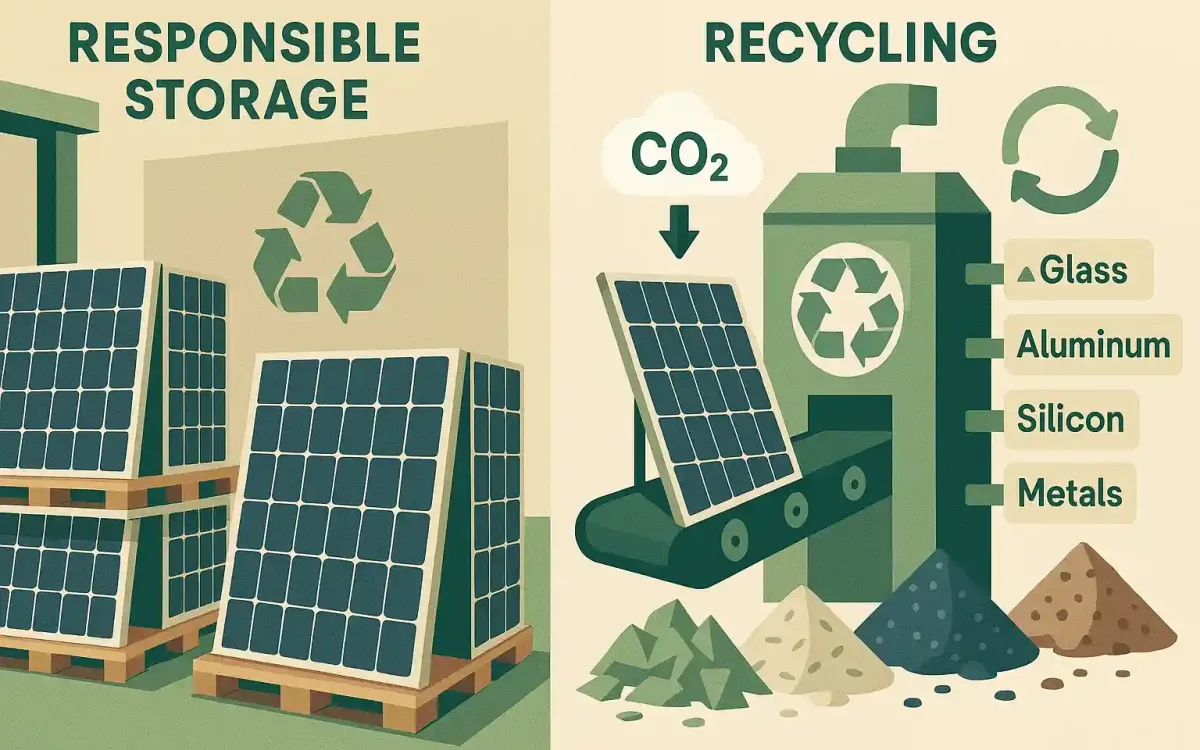
Modern recycling technologies can recover up to 95% of semiconductor materials and 90% of glass from end-of-life panels. This recovery cuts about 1,200 pounds of carbon dioxide emissions per recycled ton compared to making panels from raw materials.
The economic rewards could be huge. Recovered materials from solar panels might be worth more than $15 USD billion globally by 2050. A standard panel contains about 80% glass, 10% polymer, 5% aluminum, 4% silicon, and smaller amounts of copper, silver, and other metals. Each ton of recycled silicon solar panels yields up to 90 pounds of aluminum and 686 pounds of glass.
Reclaimed resources reduce new mining needs, cut manufacturing costs, and create specialized green jobs. The solar panel recycling market shows promising growth – valued at $250 USD million in 2022, experts project it to reach $1.29 USD billion by 2028.
All the same, big hurdles remain. Recycling a solar panel costs $20-$30 USD, while landfill disposal costs just $1-$5 USD. This price gap often leads to improper disposal or stockpiling, especially where enforcement lacks teeth.
Understanding the Lifecycle of a Solar Panel
Solar panels don’t last forever. Like any technology, they go through different stages from their best performance to retirement. Understanding this helps homeowners make better decisions about upkeep, replacement, and recycling.
Typical Lifespan And Degradation
Solar panels last a long time. The average operational lifespan has improved by a lot – from about 20 years in 2007 to 25-35 years in 2025. Most manufacturers now back their products with 25-year warranties, which shows how much they trust their panels will last.
The panels won’t stay at peak efficiency forever. Their energy production slowly drops – we call this degradation. Tests show most panels lose between 0.5% and 1.3% of their efficiency each year. They typically lose 2-3% in the first year because of light-induced degradation (LID). After that, the yearly drop usually stays around 0.7%.
Weather plays a vital role in how fast panels wear down. Panels work better in cooler places, losing about 0.48% per year, while those in hot areas lose 0.88%. This means after 25 years, most panels still work at 80-90% of their original power.
Several things affect how quickly panels wear out:
- UV rays and harsh weather
- Temperature changes that make panels expand and contract
- Material and manufacturing quality
- How well they’re installed and mounted
When Panels Become Unusable
Panels don’t just stop working when their warranty runs out. Their efficiency drops slowly until it makes sense to replace them. Manufacturers say a panel’s useful life ends when it produces less than 80% of its original power. The lower energy output makes it worth getting new, better panels.
“My 30-year-old panels were still working, just not well enough to power everything they once did,” says Robert Chen, who recently got new panels. “They weren’t dead, just tired.”
Some of the oldest solar systems have lasted surprisingly well. A system in Italy ran non-stop from 1982 to 2017. Another homeowner tested his 40-year-old panel from 1980 and found it had only lost 8% of its power.
You might need new panels if you see discoloration, burn marks, constant low performance, or physical damage. Panels need replacement when keeping them costs more than getting new ones.
Early Retirement Due To Damage Or Upgrades
Not every panel makes it to old age. Many things can force early replacement. We don’t know all the reasons yet since about 70% of today’s solar systems were installed after 2019. But some common patterns show up.
Bad weather often kills panels early. Hail, falling branches, and big temperature swings can break glass and internal wiring. Strong winds and built-up debris can also wreck panels.
Poor installation causes many problems too. Bad wiring, wrong mounting, or cheap parts can make panels fail faster. Manufacturing defects happen rarely – about 1 in 5,000 panels – but they can cause unexpected failures.
Many people choose to replace working panels early – they call it repowering. New technology often drives this decision. Someone with 15-20 year old panels might find that new models make twice the power in the same space. This makes upgrading worth it even if the old panels still work.
If you want to replace your panels early, companies that specialize in Solar Recycling can help you do it responsibly.
Options for Storing and Disposing of Used Panels
What’s next for your solar panels when they stop working well? Many homeowners ask this question but can’t find good answers. The right way to handle old panels saves resources and protects the environment.
Short-Term Storage Tips For Used Panels
Your decommissioned solar panels need careful storage. Keep them dry and safe from harsh weather. Water damage can harm internal parts and make hazardous materials leak over time.
Store panels vertically instead of stacking them if they need assessment. This method protects the glass and reduces cracks. Place them on pallets to avoid ground contact and water damage.
Each panel needs a label showing its removal date, model number, and condition details. These records help you decide between recycling and reuse later. Safety comes first – cover any exposed wires with electrical tape and wear gloves to protect yourself from sharp edges.
“I kept my old panels in the garage for six months before finding a recycler,” says Jamie Wilson, a homeowner in Arizona. “Having them properly stored meant they qualified for the secondary market rather than just scrap.”
When To Think Over Reuse Or Resale
Not every old solar panel needs recycling right away. Panels that work at lower efficiency still have value for other uses. A hardware check helps you choose the best option.
Reuse or resale works best when:
- Panels work with minor efficiency loss
- They’ll last another 10-12 years (especially if they’re under 5 years old)
- They lose only 0.5-1.9% efficiency each year
- No major damage exists like broken glass or peeling backsheets
The market for used solar equipment keeps growing. Companies like EnergyBin help connect sellers with buyers. Panels that can’t connect to the power grid still work well for charging electric bikes or powering remote locations.
“Used panels that maintain 80% of their original capacity often find homes in off-grid cabins or recreational vehicles,” explains solar resale specialist Diane Hernandez.
How To Dispose Of Solar Panels Safely
Proper disposal becomes essential when panels can’t serve another purpose. Sadly, about 90% of old solar panels end up in landfills. This wastes both environmental and economic chances.
Start by looking up local recycling options. These organizations help with solar panel recycling:
- Earth911 (searchable database of recyclers)
- Solar Energy Industries Association (SEIA)
- Department of Energy’s Solar Energy Technologies Office
- Regional programs like Alberta Recycling Management Authority (ARMA)
Specialist recyclers like Solar Recycling solar panels, SOLARCYCLE, and Sunset Renewables offer dedicated services. These experts recover up to 95% of panel materials, including valuable aluminum, silver, copper, and glass.
Recycling makes more economic sense now. The raw materials from old panels worldwide will be worth about $450 USD million by 2030. That equals the materials needed for 60 million new panels.
“I contacted a local recycler who actually paid me for my old panels,” reports Michael Chen of San Diego. “The aluminum frames alone had significant scrap value.”
Note that panels with hazardous materials need special handling. Panels that fail the toxicity characteristic leaching procedure (TCLP) test must follow federal hazardous waste rules. Always get proof of proper disposal, including destruction certificates from your recycler.
Conclusion
Solar panel waste creates an environmental challenge that could turn into an economic opportunity. The pile of decommissioned panels will grow in the coming decades. Yet proper handling can turn this potential problem into a valuable resource stream.
Numbers tell the story clearly. Modern recycling technologies recover nearly 95% of semiconductor materials and 90% of glass from old panels.
These recovered resources cut down the need for new raw materials. Your choice to recycle instead of throwing away makes a real difference.
FAQs
Why is responsible disposal of solar panels important?
With global solar waste projected at 78 million tons by 2050 and US at 10 million tons, improper landfilling risks leaching hazardous metals like lead and cadmium into soil and water, harming ecosystems. Recycling recovers 95% of semiconductors and 90% of glass, supporting a circular economy, reducing CO2 by 1,200 lbs per ton, and creating $15 billion in material value by 2050.
What is the typical lifespan of solar panels?
Solar panels last 25-35 years with warranties up to 25 years, degrading 0.5-1.3% annually after initial 2-3% light-induced degradation. Factors like UV exposure, temperature, and installation quality affect longevity; cooler climates see slower 0.48% yearly loss. Panels remain 80-90% efficient after 25 years but are often replaced below 80% output for upgrades.
How should used solar panels be stored short-term?
Store panels vertically on pallets in a dry, protected area like a garage to prevent breakage or moisture damage. Label with details like date, model, and condition; cover exposed wires and use gloves for safety. This preserves value for potential resale or recycling, as seen in cases where panels were stored for months before being reused in off-grid systems.
What are the options for recycling solar panels?
Partner with recyclers like Solar Recycling, SOLARCYCLE, or Sunset Renewables, which recover up to 95% materials. Costs $20-30 per panel versus $1-5 for landfilling. Check databases like Earth911 or SEIA for local facilities; hazardous panels need TCLP testing and certificates. Recycling supports reuse of glass, aluminum, silicon, copper, and silver in new panels.
When can used solar panels be reused or resold?
Reuse if panels retain over 80% efficiency, are under 5 years old with minor degradation, and have no major damage from weather or defects. Markets like EnergyBin facilitate resale for off-grid applications. Early retirement from upgrades or damage (e.g., hail) provides opportunities, extending life by 10-12 years and reducing waste in the growing solar industry.