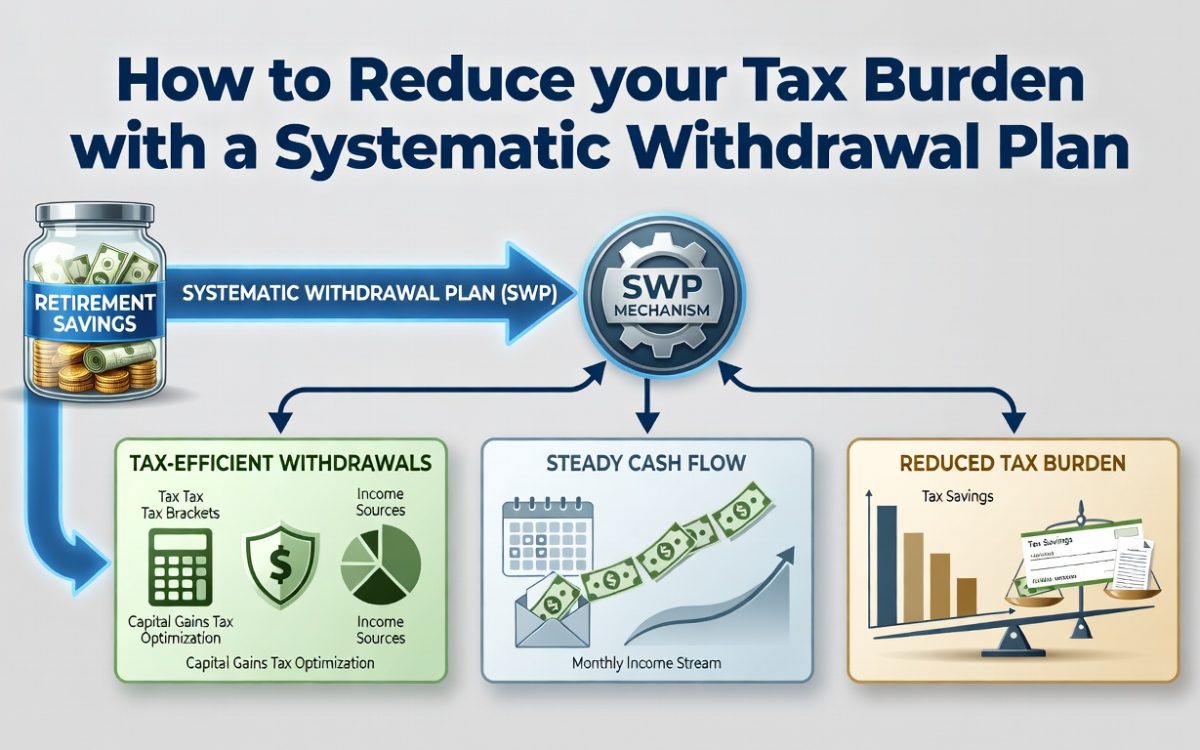
Most people view taxes as an inevitable seasonal storm, something to be endured every March with a stack of receipts and a sense of resignation. Yet, in the pursuit of wealth, what you keep often matters more than what you earn.
There is a quiet brilliance in the way the Indian tax code treats redemptions versus interest income, and for the discerning investor, a Systematic Withdrawal Plan (SWP) is the ultimate tool for navigating these waters.
It is the financial equivalent of choosing a scenic, toll-free highway over a congested road with high tariffs. Why pay more to the taxman simply because you chose the wrong exit strategy?
The Dividend Myth and the Interest Trap
Traditional income streams are often surprisingly inefficient. Consider the classic bank fixed deposit or even the dividend option in mutual funds. Both are essentially “loud” cash flows. The money hits your account, and the tax department immediately takes its cut based on your peak income tax slab. If you are in the 30 percent bracket, nearly a third of your gain vanishes before you can even spend it. It is a blunt instrument.
An SWP operates differently. It is “quiet.” When you withdraw through an SWP, you aren’t just receiving a payout; you are redeeming units of an investment. This is a critical distinction. Each withdrawal is composed of two parts: the principal amount you originally invested and the capital gain. The tax department only cares about the gain. The principal portion comes back to you tax-free because, well, it was already your money. By shifting the perspective from “earning income” to “reclaiming capital,” the effective tax rate plummets.
Understanding the Geometry of Capital Gains
Wealth creation in India has a favourable bias toward those who wait. Under current regulations, Equity-Oriented Mutual Funds held for more than twelve months qualify for Long-Term Capital Gains (LTCG) tax. The beauty of the SWP lies in its timing. By delaying withdrawals until after that one-year mark, an investor transitions from the higher Short-Term Capital Gains (STCG) rate to a much leaner 12.5 percent LTCG rate on gains exceeding 1.25 lakh rupees in a financial year.
Imagine a scenario where an investor needs a monthly cash flow. Instead of relying on a high-yield savings account or a bond that pays interest taxable at 30 percent, they use an SWP from an equity-balanced fund. The first 1.25 lakh of profit every year is essentially a “tax holiday.” By harvesting gains systematically, you are effectively resetting your cost basis while keeping your tax liability at a minimum. It is tactical. It is deliberate. It is about using the law of the land to ensure your corpus lasts five to ten years longer than it otherwise would.
The Illusion of Double Taxation
Sometimes the fear of “paying twice” keeps people away from mutual funds. There is a lingering worry that if the fund pays taxes internally, and then the investor pays on withdrawal, the math won’t add up. This is rarely the case. In fact, the SWP structure provides a level of control that no pension or annuity can match. You decide the amount. You decide the frequency. If you have a year where your other income is lower, you can theoretically increase your SWP to soak up more of those lower tax brackets.
Think of your portfolio as a giant block of ice. A lump sum withdrawal is like smashing the block with a hammer; shards fly everywhere, and much of it melts away in the heat of immediate taxation. An SWP is more like a controlled melt. You channel the water exactly where you need it, when you need it, ensuring that none of it is wasted. This level of granular control over one’s tax destiny is perhaps the most underrated feature of modern mutual fund investing.
Strategy Over Instinct
Successful investing is often about fighting the urge to do the “obvious” thing. The obvious thing is to chase the highest gross return. The sophisticated thing is to chase the highest net-of-tax return. An SWP might not have the flashy headlines of a multibagger stock, but its ability to shield a portfolio from the compounding erosion of high taxes is a superpower in its own right.
Ultimately, wealth is a game of inches. Reducing your tax burden by 10 or 15 percent every year through a smart withdrawal strategy creates a massive delta over a twenty-year retirement. It is the difference between outliving your money and having your money outlive you. It requires a bit of math, a bit of patience, and a total shift in how we perceive “income.” After all, the best way to earn more money is to stop losing the money you already have.
Disclaimer: Investments in the securities market are subject to market risk, read all related documents carefully before investing. NetworkUstad is not liable for any decisions made based on this content.