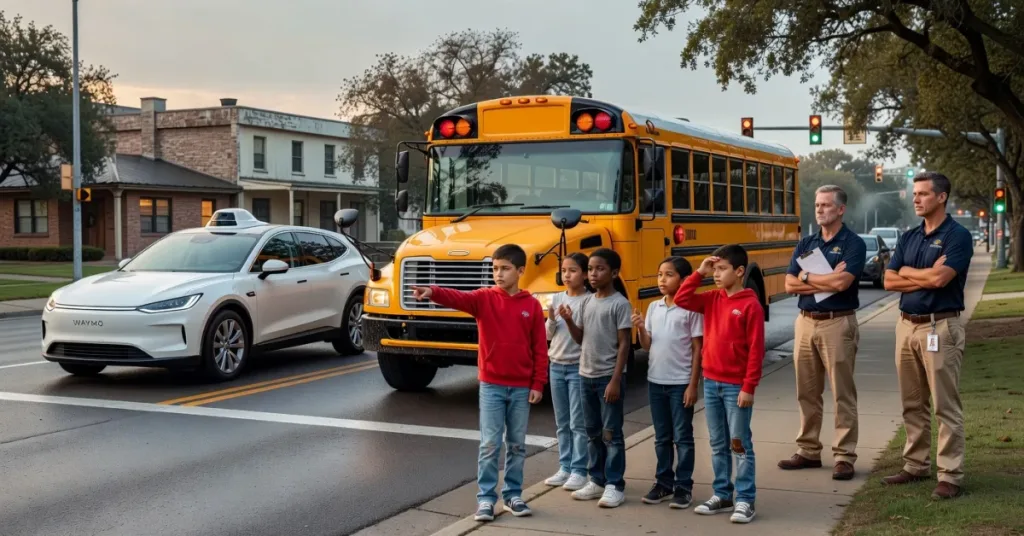
In Austin, Texas, a school district’s innovative attempt to train Waymo’s self-driving vehicles to recognize and stop for school buses backfired, leading to multiple near-misses and heightened safety concerns. Local officials collaborated with Waymo engineers, deploying mock bus scenarios and data-sharing protocols to fine-tune the AI’s perception systems. Yet, the vehicles consistently failed to halt appropriately, passing stopped buses at speeds up to 25 mph despite flashing lights and extended stop arms. This real-world experiment underscores the gaps in self-driving car learning, where algorithms struggle to generalize from simulated data to chaotic urban environments.
For IT professionals managing connected infrastructure, these incidents highlight the fragility of AI-driven autonomy in networked ecosystems. Waymo’s fleet relies on a combination of LiDAR, radar, and camera sensors feeding into machine learning models that process over 1 terabyte of data per vehicle daily. When the Austin trial integrated district-provided video feeds and GPS annotations, the system’s adaptation lagged, revealing how self-driving car learning depends on robust data pipelines and real-time edge processing—areas where network latency can spell disaster.
The Mechanics of Self-Driving Car Learning
Self-driving car learning hinges on deep neural networks trained via supervised and reinforcement learning techniques. Waymo’s models, for instance, ingest millions of miles of driving data to predict behaviors like yielding to emergency signals. In the Austin case, the district supplied annotated datasets from 50 bus routes, aiming to retrain the perception module for school bus signatures.
However, adaptation faltered due to:
- Overfitting to simulations: Models excel in controlled tests but falter with variables like erratic pedestrian movement or poor lighting, common in school zones.
- Data silos: Integrating external sources, such as municipal traffic cams, requires secure APIs and low-latency networks, yet Waymo’s system prioritized internal datasets, delaying updates.
- Edge computing demands: Onboard processors must handle inference in milliseconds; any network hiccup in V2X (vehicle-to-everything) communication amplifies errors.
IT teams deploying similar AI in smart cities should audit sensor fusion protocols to ensure seamless data flow, potentially reducing adaptation failures by 30% through hybrid cloud-edge architectures. For deeper insights, see Waymo’s technical overview at Waymo’s official tech page.
Challenges in Real-World Adaptation for Autonomous Vehicles
Urban trials like Austin’s expose the limitations of current self-driving car learning paradigms. Regulatory bodies, including the NHTSA, reported over 200 AV-related incidents in U.S. cities last year, with 15% involving misreads of traffic signals or emergency vehicles. Waymo’s response involved rolling back updates, but this reactive approach erodes public trust.
Key hurdles include:
- Sensor variability: Rain or glare can degrade camera accuracy by up to 40%, forcing reliance on less precise radar—yet training data often underrepresents weather extremes.
- Ethical decision-making: Algorithms must balance safety trade-offs, like slowing for a bus versus avoiding a collision; Austin’s failures stemmed from conservative yielding thresholds that didn’t trigger for non-standard bus positions.
- Scalability issues: Fleet-wide updates demand massive bandwidth; a single OTA (over-the-air) push can consume 500 GB per vehicle, straining 5G networks in dense areas.
Networking experts can mitigate this by implementing SDN (software-defined networking) for prioritized AV data streams, ensuring sub-10ms latency in critical zones.
Implications for IT Infrastructure and Safety Standards
The Austin debacle signals broader needs for standardized training frameworks in self-driving car learning. Enterprises integrating AVs into logistics or public transit must prioritize interoperable data standards, like those from the IEEE for V2I (vehicle-to-infrastructure) protocols. This could prevent similar failures by enabling predictive analytics on network chokepoints.
For cybersecurity pros, the trial raised alarms about data integrity: injected bus signals could be spoofed, opening doors to adversarial attacks. Robust encryption and anomaly detection in sensor networks are non-negotiable, potentially cutting vulnerability exposure by 25%.
As AV adoption accelerates—with projections of 10 million units on roads by 2030—IT leaders should invest in simulation platforms that mirror real-world chaos, fostering more resilient AI.
Conclusion
The Austin school district’s failed training effort with Waymo illustrates the persistent challenges in self-driving car learning, where theoretical AI prowess meets practical urban hurdles. For IT professionals, this trend demands a shift toward integrated, network-secure ecosystems that support adaptive machine learning without compromising safety. Businesses eyeing AV deployments should conduct vulnerability assessments on their data pipelines now, ensuring compliance with emerging standards like ISO 26262 for functional safety.
Looking ahead, advancements in federated learning—where vehicles collaboratively update models without central data sharing—could transform adaptation speeds, making self-driving fleets safer and more reliable. IT teams that proactively bridge AI and networking gaps will lead this evolution, turning potential pitfalls into scalable innovations.