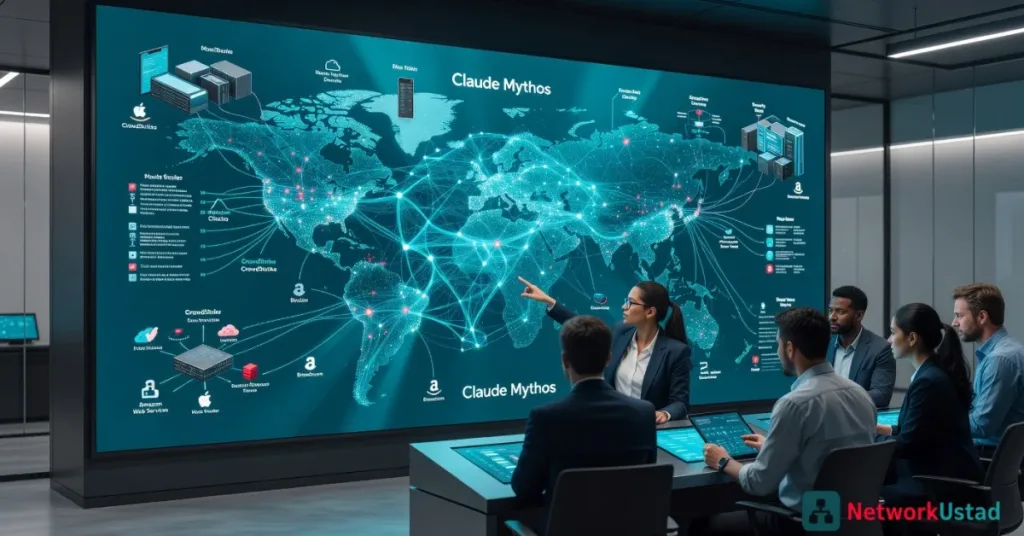
Anthropic’s latest push into cybersecurity leverages its advanced AI model, Claude Mythos, to uncover thousands of zero-day vulnerabilities across critical infrastructure. This initiative, dubbed Project Glasswing, deploys a preview version of the model to scan complex systems for flaws that traditional tools often miss. Early results show it identifying exploits in software stacks used by giants like Amazon Web Services, Apple, Broadcom, Cisco, and CrowdStrike—highlighting how machine learning can outpace human-led audits in detecting latent threats.
Zero-day flaws, by definition, exploit unpatched weaknesses before vendors can respond, posing risks to encryption protocols and network architectures. In one instance, Claude Mythos pinpointed irregularities in firmware handling that could allow unauthorized access to processor-level operations, potentially compromising data throughput in high-bandwidth environments. This isn’t just theoretical; the model’s ability to simulate attack vectors on diverse frameworks like cloud-native APIs has already flagged issues in real-world deployments, emphasizing the urgency for IT teams to integrate AI-driven scanning into their vulnerability management pipelines.
Project Glasswing Overview
Project Glasswing represents a collaborative effort where a select group of organizations gains early access to Claude Mythos for proactive security hunting. Unlike conventional scanners that rely on signature-based detection, this AI employs reinforcement learning to probe system behaviors under stress, revealing flaws in areas like latency-sensitive routing protocols. For instance, it has exposed weaknesses in how edge devices manage bandwidth allocation during failover, which could lead to denial-of-service in enterprise networks.
The initiative focuses on major systems, including those underpinning cloud computing infrastructures. By analyzing codebases and runtime environments, Claude Mythos simulates adversarial conditions to identify zero-days that evade standard tools like static analysis engines. This approach builds on Anthropic’s frontier model capabilities, trained on vast datasets of historical breaches, to predict and mitigate risks before exploitation.
For more on zero-day definitions and impacts, see the Wikipedia entry on zero-day vulnerabilities.
The Innovation Behind Claude Mythos
At its core, Claude Mythos innovates by combining natural language processing with symbolic execution, allowing it to “reason” about code in ways that mimic expert red-team exercises. This enables detection of subtle issues, such as race conditions in multi-threaded processors that affect throughput in distributed systems. Traditional methods, like fuzzing, often overlook context-specific flaws, but Mythos integrates domain knowledge of protocols like TLS for encryption integrity checks.
The model’s preview version processes petabytes of telemetry data, achieving what would take human analysts months in days. Partners like Cisco have used it to audit router firmware, uncovering zero-days in BGP implementations that could reroute traffic undetected. This shift toward AI-augmented security frameworks promises to reduce the mean time to detection (MTTD) for novel threats.
Market Impact on Cybersecurity
The rollout of Project Glasswing disrupts the $200 billion cybersecurity market by democratizing access to elite vulnerability research. Organizations like AWS and Apple, early adopters, report enhanced resilience in their architectures, potentially lowering breach costs that average $4.45 million per incident globally. For IT professionals, this means reevaluating tools like Nessus or Qualys, integrating AI layers to handle the explosion of IoT and 5G-connected devices.
Vendors such as Broadcom and CrowdStrike stand to benefit, using Mythos insights to patch silicon-level flaws before public disclosure. However, it raises questions about AI reliability—false positives could strain bandwidth in scanning operations. Enterprises must now prioritize hybrid models, blending AI with human oversight to maintain low latency in threat response. For guidance on integrating such tools, refer to NIST’s Cybersecurity Framework.
Future Implications for IT Leaders
Looking ahead, Claude Mythos could evolve into a standard for zero-day hunting, influencing standards bodies like IETF to incorporate AI validation in protocol designs. By 2026, widespread adoption might cut undiscovered vulnerabilities by significant margins, but it demands robust governance to prevent AI biases from missing edge cases in diverse frameworks.
IT teams should audit their exposure to partner ecosystems, simulating Mythos-like scans on custom APIs. This proactive stance will be crucial as quantum threats loom, challenging current encryption paradigms.
Our Take
Claude Mythos via Project Glasswing marks a pivotal advancement, empowering a handful of tech leaders to fortify against thousands of zero-days that lurk in modern systems. For cybersecurity professionals, the key takeaway is to pilot AI tools now, focusing on integration with existing SIEM platforms to boost detection efficacy without overwhelming resources.
Forward, expect this to spur industry-wide AI security alliances, reducing the asymmetry between attackers and defenders. Network engineers, prioritize throughput optimizations in AI scans to avoid performance hits—start by benchmarking your architecture against open-source analogs like those from Hugging Face.