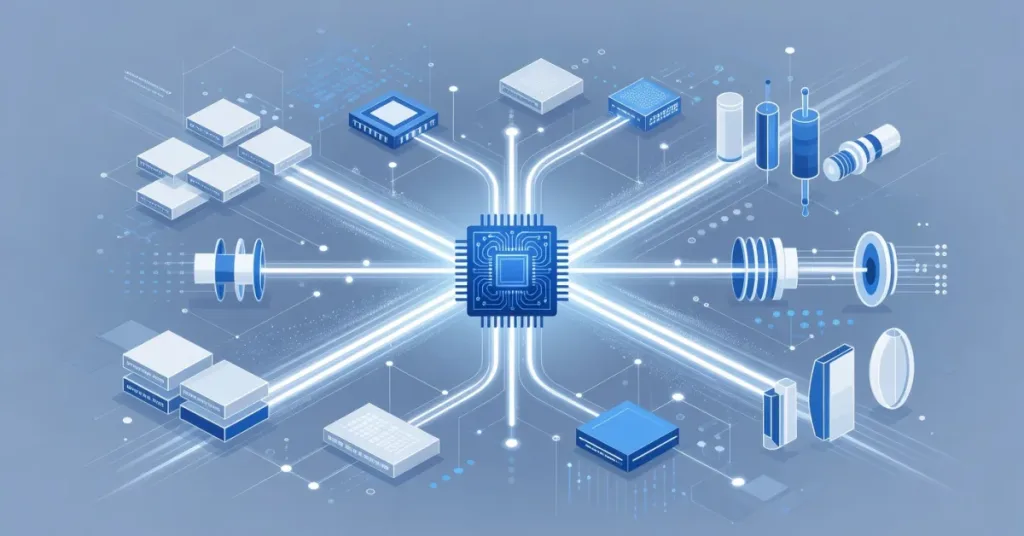
Cisco recently unveiled expansions to its Silicon One processor family, pushing Ethernet switching capacities to 51.2 Tbps per chip—more than double the previous generation’s 25.6 Tbps. This upgrade directly addresses the surging demands of AI data centers, where training large language models requires handling petabytes of data with minimal latency. For network engineers grappling with AI infrastructure, this means scalable solutions that can support hyperscale environments without overhauling existing setups.
🔑 Key Takeaways
- Cisco recently unveiled expansions to its Silicon One processor family, pushing Ethernet switching capacities to 51
- In a move timed with the AI boom, Cisco's announcements include new routing systems and optics designed for high-density AI clusters
- High-density ports: Up to 64x800G interfaces for massive parallelism in AI computations
📋 Table of Contents
In a move timed with the AI boom, Cisco’s announcements include new routing systems and optics designed for high-density AI clusters. Data from industry reports shows AI networking traffic growing at 40% annually, straining traditional networks. IT pros and business leaders now face the challenge of integrating these technologies to future-proof their operations, ensuring seamless data flow for machine learning workloads.
Silicon One Lineup Expansions
Cisco’s Silicon One G202 and G200 processors headline the updates, optimized for AI networking with enhanced programmability and efficiency. The G202, aimed at spine switches, delivers 51.2 Tbps bandwidth, enabling 800G Ethernet ports crucial for AI training farms.
- Programmable architecture: Supports custom forwarding behaviors for AI-specific traffic patterns.
- Power efficiency gains: Reduces consumption by up to 40% compared to prior models, vital for sustainable data centers.
- Backward compatibility: Integrates with existing Cisco hardware, minimizing migration costs.
These features empower network engineers to build resilient AI networking fabrics, as seen in deployments at major cloud providers.
New Systems for AI-Driven Networks
Complementing the chips, Cisco introduced the 8100 and 8200 series routers, tailored for AI networking at the edge and core. The 8200 series boasts 25.6 Tbps capacity in a compact form factor, ideal for space-constrained environments.
Key benefits include:
- High-density ports: Up to 64x800G interfaces for massive parallelism in AI computations.
- Integrated security: Built-in encryption for protecting sensitive AI data in transit.
- Automation tools: Leverages AI for predictive analytics, reducing downtime by 30%.
For IT leaders, these systems align with trends like those in Versa’s SASE upgrades, enhancing data protection in AI ecosystems.
Optics Innovations for AI Connectivity
Cisco’s new Qualified Optics line, including 800G transceivers, tackles the optical challenges of AI networking. These modules support extended reach up to 2km, essential for interconnecting AI servers across data halls.
- Low-latency design: Achieves sub-10ns jitter, critical for real-time AI inference.
- Cost reductions: 25% lower per-port expenses through silicon photonics integration.
- Interoperability: Compatible with multi-vendor setups, as detailed in Cisco’s optics whitepaper.
This positions optics as a cornerstone for scalable AI networking, echoing advancements in NetBox Labs’ AI copilot for network management.
Deployment Strategies and Ecosystem Integration
To maximize these technologies, enterprises should prioritize hybrid AI networking models. Cisco’s Nexus Dashboard integrates with the new lineup, offering unified visibility. Metrics indicate a 50% faster deployment time when combining Silicon One with AI-optimized optics.
Professionals can explore synergies with emerging threats, like those in the Bloody Wolf campaign, by embedding robust defenses.
The Bottom Line
Cisco’s Silicon One expansions and new systems redefine AI networking, providing the bandwidth and efficiency needed for explosive AI growth. Network engineers gain tools to handle 10x more traffic without proportional cost increases, while business leaders can accelerate AI initiatives with reduced risk.
We recommend assessing your current infrastructure against these benchmarks—start with a Cisco AI readiness audit to identify upgrade paths. Looking ahead, as AI networking evolves, expect further convergence with edge computing, potentially slashing latency to under 1ms by 2025. Staying informed via resources like our weekly recaps will keep you ahead.