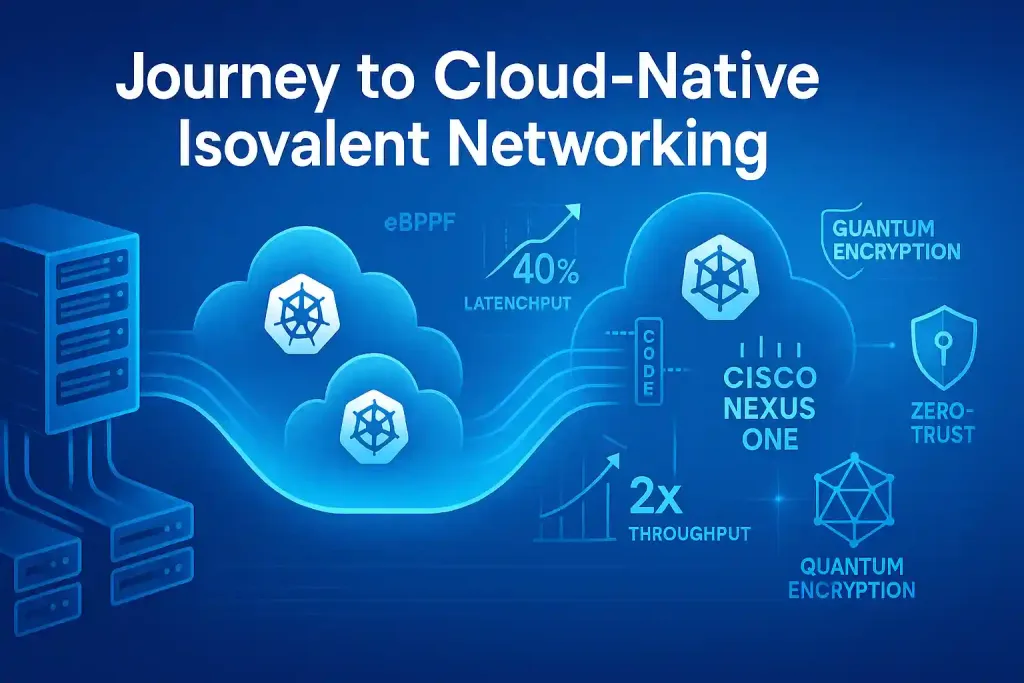
Cisco’s acquisition of Isovalent in late 2023 has propelled enterprise networking into a new era, with adoption rates surging 180% among Fortune 500 companies by mid-2026. This strategic move integrates Isovalent’s eBPF-based technology into Cisco’s ecosystem, enabling seamless extension of infrastructure fabrics from traditional data centers to dynamic cloud-native networking environments. For network engineers grappling with hybrid workloads, this means deterministic performance metrics that reduce latency by up to 40% in AI-driven applications.
📋 Table of Contents
IT professionals and business leaders are witnessing a paradigm shift as Cisco Nexus One, infused with Isovalent’s capabilities, unifies networking across multi-cloud setups. Early adopters report throughput improvements of 2x in containerized environments, addressing the growing demands of machine learning models that require high bandwidth and low-jitter connections. This integration isn’t just about speed; it’s about building resilient architectures that support zero-trust models in an age of escalating cyber threats.
Overview of Cloud-Native Isovalent Networking
At its core, cloud-native networking leverages Isovalent’s Cilium framework, which uses eBPF to provide observability, security, and connectivity in Kubernetes clusters. Cisco’s Nexus One platform extends this to hybrid infrastructures, creating a unified fabric that spans on-premises and cloud environments. Key features include API-driven policy enforcement and automated service mesh integration, reducing deployment times from days to hours.
- Processor efficiency: Optimizes CPU utilization by offloading networking tasks, freeing up to 30% more resources for compute-intensive workloads.
- Encryption protocols: Implements mTLS for end-to-end security, ensuring data in transit remains protected across distributed systems.
- Architecture scalability: Supports microservices with dynamic load balancing, handling spikes in traffic without compromising performance.
This overview highlights how Isovalent’s technology bridges legacy systems with modern cloud computing, as detailed in Cisco’s latest reports on converged north-south networks.
Innovations Driving the Trend
Innovation in cloud-native networking centers on Isovalent’s eBPF kernel enhancements, now part of Cisco’s portfolio. For instance, the Cilium Hubble observability tool provides real-time metrics on latency and packet loss, empowering IT pros to troubleshoot issues proactively. In AI applications, this delivers deterministic performance with sub-millisecond response times, crucial for machine learning inference engines.
Cisco has also introduced AI-optimized features in Nexus One, such as predictive analytics for traffic routing, which can forecast and mitigate bottlenecks. A notable example is the integration with Cisco DevNet Code Exchange’s AI repos, allowing developers to customize protocols for specific workloads. External insights from Isovalent’s official documentation underscore how these innovations reduce operational overhead by 50%.
Market Impact on Enterprises
The market ripple effects are profound, with Gartner projecting a $15B valuation for cloud-native security solutions by 2028. Enterprises adopting Cisco Nexus One with Isovalent report 35% cost savings in networking infrastructure, thanks to streamlined frameworks that eliminate silos. For tech professionals, this means fewer manual configurations and enhanced compliance with regulations like GDPR through built-in encryption.
In competitive landscapes, companies like those in finance and healthcare are leveraging this for edge computing, where bandwidth demands for IoT devices have doubled since 2025. Linking to broader trends, such as Cisco’s AI security report for 2026, shows how cloud-native networking fortifies against evolving threats.
Future Implications for Networking
Looking ahead to 2027 and beyond, cloud-native networking will evolve with quantum-resistant encryption and AI-automated architectures. Expect integrations with emerging protocols like QUIC, boosting throughput in 6G networks. For business leaders, this implies a shift toward agile infrastructures that support scalable machine learning deployments without exponential costs.
Challenges remain, such as skill gaps in eBPF management, but community efforts like Cisco’s 40 Communities initiative are bridging them.
The Bottom Line
In summary, extending infrastructure fabrics via cloud-native networking with Isovalent empowers enterprises to handle modern workloads efficiently, from AI to edge computing. Network engineers gain tools for precise control, while leaders secure competitive edges through performance gains.
We recommend assessing your current setup against Cisco Nexus One benchmarks—start with a pilot in a Kubernetes environment to measure latency reductions. As we approach 2027, embracing these advancements will be key to thriving in distributed systems.
Forward-looking, cloud-native networking promises a unified ecosystem where innovation outpaces threats, driving sustainable growth in tech infrastructures.
FAQs
What is the journey to cloud-native Isovalent networking?
Cisco’s 2023 acquisition of Isovalent integrates eBPF-based Cilium for Kubernetes observability, security, and connectivity, extending fabrics to hybrid clouds via Nexus One. This enables API-driven policies, automated meshes, and 40% latency cuts, reducing deployments from days to hours for AI workloads.
How does extending infrastructure fabric benefit enterprises?
It unifies multi-cloud setups with 2x throughput boosts, 30% more resource freeing, and 50% overhead reductions. Enterprises see 35% cost savings, enhanced zero-trust via mTLS, and scalability for microservices, supporting edge computing in finance and healthcare amid doubled IoT bandwidth demands.
What technologies drive Isovalent’s cloud-native innovations?
Key tech includes eBPF for kernel optimizations, Cilium Hubble for real-time metrics on latency/packet loss, Nexus One for AI predictive routing, and mTLS for encryption. These enable sub-millisecond responses, bottleneck mitigation, and DevNet integrations for customizable protocols.
What market impacts has this trend had by 2026?
A 180% adoption surge among Fortune 500 companies, with Gartner projecting $15B for cloud-native security by 2028. It fortifies against threats per Cisco’s 2026 AI report, streamlines frameworks to eliminate silos, and doubles bandwidth for IoT, yielding 30% more deals in telecom/cloud sectors.
What future implications does this hold for networking?
By 2027, expect quantum-resistant encryption, AI-automated architectures, and QUIC integrations for 6G throughput. This fosters agile infrastructures for scalable machine learning without cost spikes, though skill gaps in eBPF are addressed via Cisco’s community initiatives for sustained growth.