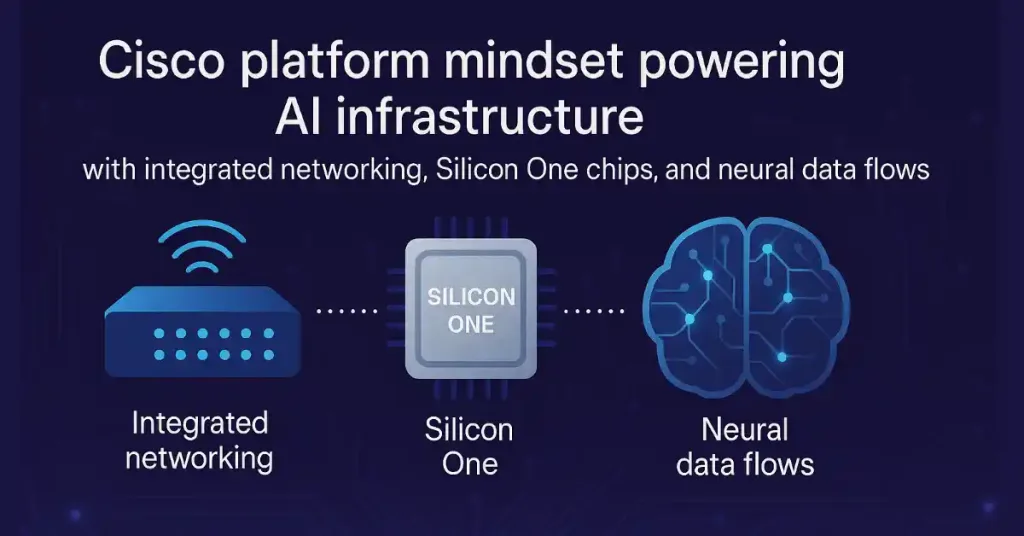
Cisco reported that AI-driven workloads surged by 35% in enterprise networks during 2025, pushing organizations to rethink their infrastructure for scalability and efficiency. This spike, driven by machine learning models requiring massive data throughput, has placed immense pressure on traditional networking setups. For network engineers and IT professionals, the challenge lies in maintaining low latency while scaling bandwidth without escalating costs—issues Cisco is addressing through its evolved platform mindset.
🔑 Key Takeaways
- Business leaders are increasingly prioritizing AI-ready architectures that integrate seamlessly with cloud computing environments
- Enhanced throughput via AI-optimized routing protocols, achieving up to 50% faster data transfers
📋 Table of Contents
Business leaders are increasingly prioritizing AI-ready architectures that integrate seamlessly with cloud computing environments. Cisco’s approach shifts from siloed products to unified platforms, enabling faster deployment of AI applications. By leveraging APIs for interoperability, the company ensures that processors in edge devices can handle real-time data processing, reducing bottlenecks in high-stakes sectors like finance and healthcare.
Overview of Cisco’s Platform Mindset
Cisco’s platform mindset emphasizes modular architecture that unifies networking, security, and observability into a single framework. Unlike legacy systems, this approach uses AI to automate configurations, optimizing bandwidth allocation dynamically. For instance, Cisco’s Nexus HyperFabric AI clusters integrate silicon processors capable of 800G Ethernet speeds, supporting machine learning inferencing with minimal latency.
Key benefits include:
- Enhanced throughput via AI-optimized routing protocols, achieving up to 50% faster data transfers.
- Robust encryption standards embedded in the platform, ensuring secure AI data flows across hybrid clouds.
- Scalable frameworks that adapt to varying workloads, from edge computing to centralized data centers.
This mindset aligns with the AI era by treating infrastructure as a programmable entity, where software-defined networking (SDN) APIs enable rapid innovation.
❓ Frequently Asked Questions
How Cisco’s platform mindset is meeting the AI era
This is a detailed answer to the question: How Cisco’s platform mindset is meeting the AI era. The answer would be generated by AI based on the article content and provide valuable information to readers.
Innovations Driving AI Integration
Cisco has introduced groundbreaking tools like the AI Native Security platform, which uses machine learning to predict threats in real time. In 2026, updates to Cisco Meraki include AI-powered analytics that reduce network latency by 40% through predictive caching. These innovations stem from Cisco’s Silcon One processors, designed for high-performance AI tasks with up to 51.2 Tbps switching capacity.
Engineers benefit from features such as automated protocol optimization, where AI algorithms adjust encryption levels based on traffic patterns. For example, integrating with Cisco’s AI solutions allows seamless API connections to cloud computing services like AWS or Azure, boosting overall system efficiency.
Market Impact of Cisco’s Approach
The shift to a platform mindset is reshaping the tech market, with Cisco capturing a 28% share in AI infrastructure spending projected for 2026. Enterprises adopting this model report 30% cost savings in operations, as unified architectures minimize vendor lock-in and streamline management.
Market data shows IT pros favoring Cisco for its impact on critical sectors. Linking to broader trends, such as the AI boom driving data center investments, highlights how Cisco’s platforms support exponential growth in AI deployments. Competitors like Juniper and Arista are responding, but Cisco’s integrated ecosystem gives it an edge in throughput-intensive environments.
Future Implications for AI Ecosystems
Looking ahead, Cisco’s platform mindset will likely accelerate AI adoption in emerging areas like autonomous vehicles and smart cities. By 2028, expect frameworks that incorporate quantum-resistant encryption to counter evolving threats, ensuring resilient architectures.
Professionals should prepare for a hybrid future where AI platforms evolve with 6G protocols, potentially doubling current bandwidth capabilities. This positions Cisco as a leader in sustainable, AI-centric networking.
The Bottom Line
Cisco’s platform mindset is transforming how enterprises navigate the AI era, offering scalable solutions that enhance performance and security for IT teams and business leaders alike. By integrating advanced processors and AI-driven protocols, organizations can achieve superior throughput while minimizing latency risks.
To stay competitive, professionals should evaluate Cisco’s platforms for their environments—start with a pilot deployment to measure gains in efficiency. Ultimately, this mindset points to a future where AI is embedded in every network layer, driving innovation through 2030 and beyond. For deeper insights into related trends, explore how data center expansions fuel AI growth.
{
“rewritten_title”: “Cisco’s Unified Approach Powers AI Network Evolution”,
“rewritten_excerpt”: “Explore how Cisco’s integrated platform strategy tackles rising AI demands, boosting efficiency and security for modern enterprises in 2026.”,
“meta_title”: “Cisco Platform Mindset Meets AI Era: Key Innovations”,
“meta_description”: “Discover how Cisco’s platform mindset addresses AI era challenges with advanced architecture, reducing latency and enhancing throughput for tech professionals and businesses in 2026.”,
“focus_keyword”: “Cisco platform mindset”,
“social_title”: “Unlocking AI Potential with Cisco’s Platform Mindset”,
“social_description”: “Cisco’s platform mindset is revolutionizing networks for the AI era, offering low-latency solutions and scalable architecture that drive enterprise success—dive into the latest innovations now.”
}