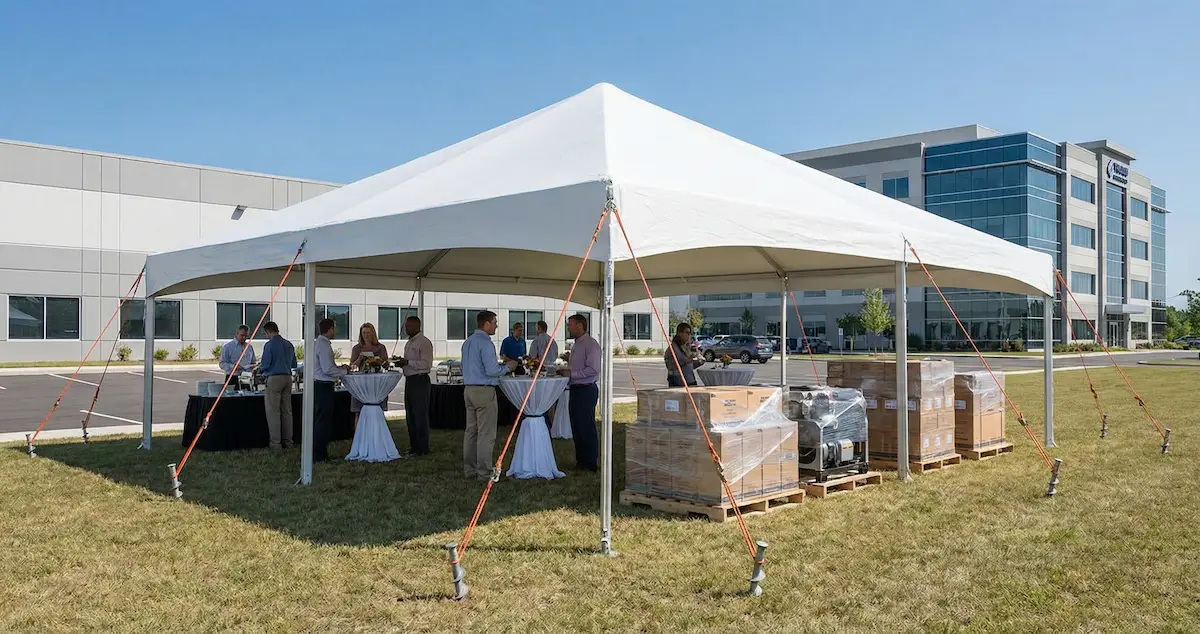
Industrial operations, corporate facilities, and logistical hubs often require adaptable outdoor space for a variety of functions. Whether for hosting employee events, creating a temporary covered work or storage area, or providing shelter for equipment during maintenance, permanent structures are not always practical or necessary. A large, freestanding temporary shelter offers a versatile solution. A 20’ x 20’ Heavy Duty Outdoor Party Tent represents a category of structure designed to provide substantial covered area quickly and without permanent installation.
Technical Overview and Structural Design
This type of shelter typically consists of a powder-coated steel or aluminium frame that supports a durable fabric cover, often made from polyethylene tarpaulin (PE) or similar material. The frame is designed for easy assembly and disassembly, while the cover provides protection from sun and rain. The “heavy duty” designation usually refers to reinforced frame joints and a thicker, more resilient fabric.
Adapting Temporary Shelters for Industrial and Corporate Applications
While marketed for social events, these shelters have several practical applications in a business context:
- Providing covered outdoor space for company picnics, team-building events, or seasonal celebrations for staff.
- Creating a temporary weather-protected area for equipment staging, outdoor repair work, or material sorting.
- Offering shade and shelter for outdoor break areas or smoking shelters for employees.
- Serving as a covered checkpoint or registration area for visitor parking or large deliveries.
- Protecting goods or materials temporarily stored outdoors from sudden rain or direct sun exposure.
The Importance of Operational Flexibility and Employee Engagement
The ability to quickly deploy a large covered space adds significant flexibility to facility management. It allows businesses to create functional outdoor areas that support both operational needs (like protected work zones) and human resource goals (like fostering community through sanctioned events). This can enhance employee morale, provide practical solutions for outdoor tasks, and demonstrate a responsive approach to changing site requirements without capital investment in permanent construction.
Technical Fundamentals and Site Considerations
Successful and safe use of a large temporary shelter requires careful planning based on its specifications and the intended site.
- Dimensions and Clearance: The 20′ x 20′ footprint and 10′ peak ceiling define the covered area and headroom. Adequate space must be allocated, considering guy ropes and overall stability.
- Frame Strength and Fabric Quality: The frame must be robust enough to withstand wind loads. Heavy-duty PE tarpaulin fabric should be UV-resistant, waterproof, and tear-resistant for repeated use.
- Anchoring and Stability: Proper anchoring is the most critical safety factor. The shelter must be securely staked to the ground using appropriate stakes for the soil type (e.g., steel auger stakes for grass, concrete blocks for pavement). In high-wind areas, additional ballast or anchoring is mandatory.
- Site Selection: Choose a level, well-drained area free of overhead hazards like power lines or tree branches. Consider water runoff during rain.
Factors Affecting Stability, Safety, and Longevity
The shelter’s performance is almost entirely dependent on correct installation and environmental conditions. Inadequate anchoring is the primary cause of failure, leading to collapse in wind. The fabric cover will degrade over time with UV exposure. Proper tensioning during setup prevents fabric flapping and stress on the frame. The shelter is designed for temporary use in fair to moderate weather; it is not a substitute for a engineered structure in severe storms or for heavy snow loads.
Safety Considerations and Mandatory Best Practices
Large temporary shelters can become hazards if not managed correctly. Adherence to strict safety protocols is essential.
- Always follow the manufacturer’s assembly instructions precisely. Do not skip steps or use substitute parts.
- Never erect the shelter in high winds, and always monitor weather forecasts. Be prepared to lower or dismantle it if severe weather is forecast.
- Use all provided anchoring components and ensure they are driven securely into the ground at the correct angle and distance.
- Do not attach signage, lights, or other items to the frame in a way that creates undue sail area or stress, unless the structure is specifically designed for it.
- Keep all flames, grills, or heat sources a safe distance away from the fabric walls and roof.
Equipment Types and System Components
The primary product is the shelter kit. Key components include the frame sections (legs, trusses, connectors), the fabric cover, a carry bag, and the anchoring kit (stakes, ropes). Variations exist in size, frame material, fabric type (polyethylene, vinyl), and roof style (peak, pagoda).
Advantages and Practical Limitations
A clear understanding of the shelter’s purpose ensures it is used effectively and safely.
- Advantages: Provides a large amount of covered space quickly and portably. Cost-effective for temporary needs. Offers flexibility for various uses. Easy to store when not in use. Provides good protection from sun and light rain.
- Limitations: Not a permanent or all-weather structure. Requires diligent attention to anchoring and weather conditions. Fabric has a finite lifespan and is vulnerable to high winds if not secured. Offers no insulation or climate control. May require a permit for use on commercial property, depending on local bylaws.
Real-World Application Example
A manufacturing plant is hosting its annual summer family day in the employee parking lot. To provide a central gathering point with shade and rain protection, the facilities team erects a 20′ x 20′ heavy-duty tent. It serves as the main food and seating area. Later in the season, the same tent is used to create a covered outdoor staging area for a large equipment delivery, protecting the components from an unexpected rain shower. This demonstrates the shelter’s dual utility for both community and operational purposes.
Conclusion and Industry Outlook
For facility and operations managers, a large temporary shelter is a valuable asset in the toolkit for managing outdoor space. Its core value lies in its adaptability and rapid deployment capability for both operational and social functions. The trend is toward more robust and user-friendly designs, with quicker assembly mechanisms and improved anchoring systems. When selected for appropriate applications, installed with rigorous attention to safety—especially anchoring—and maintained properly, such a shelter can significantly enhance a site’s functionality and responsiveness to temporary needs, supporting both logistical efficiency and workplace culture.