Day: August 29, 2019
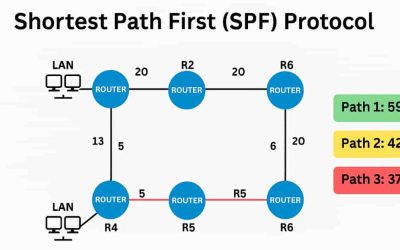
Understanding the Shortest Path First (SPF) Protocol: Link-State Routing with Dijkstra’s Algorithm
In networking, efficient routing is crucial for data transmission across complex topologies. The Shortest Path First (SPF) Protocol, also known as Link-State Routing, uses Edsger Dijkstra’s SPF Algorithm to determine the optimal path for packets. Protocols like Open Shortest Path First (OSPF) and Intermediate System-to-Intermediate System (IS-IS) are prime examples of link-state routing protocols. These...
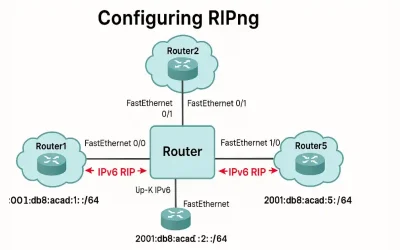
How to Advertise IPv6 Networks in RIPng
IPv6 Routing Information Protocol (RIP), also known as RIPng (RIP Next Generation), supports IPv6 addresses. It is a Distance Vector routing protocol that uses a hop count as a routing metric. After enabling IPv6 RIP, we also need to configure the advertisement of IPv6 RIP routes. We can display IPv6 RIP settings to verify the...
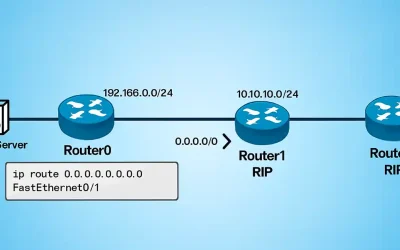
Propagating a Default Route in RIP: Step-by-Step Cisco Configuration Guide (Updated 2025)
Propagating a default route in RIP is a key feature of the Routing Information Protocol (RIP), a distance-vector routing protocol commonly used in small networks. It uses hop count as its metric and is suitable for CCNA-level studies, where understanding basic dynamic routing is key. A default route (0.0.0.0/0), also known as the gateway of...