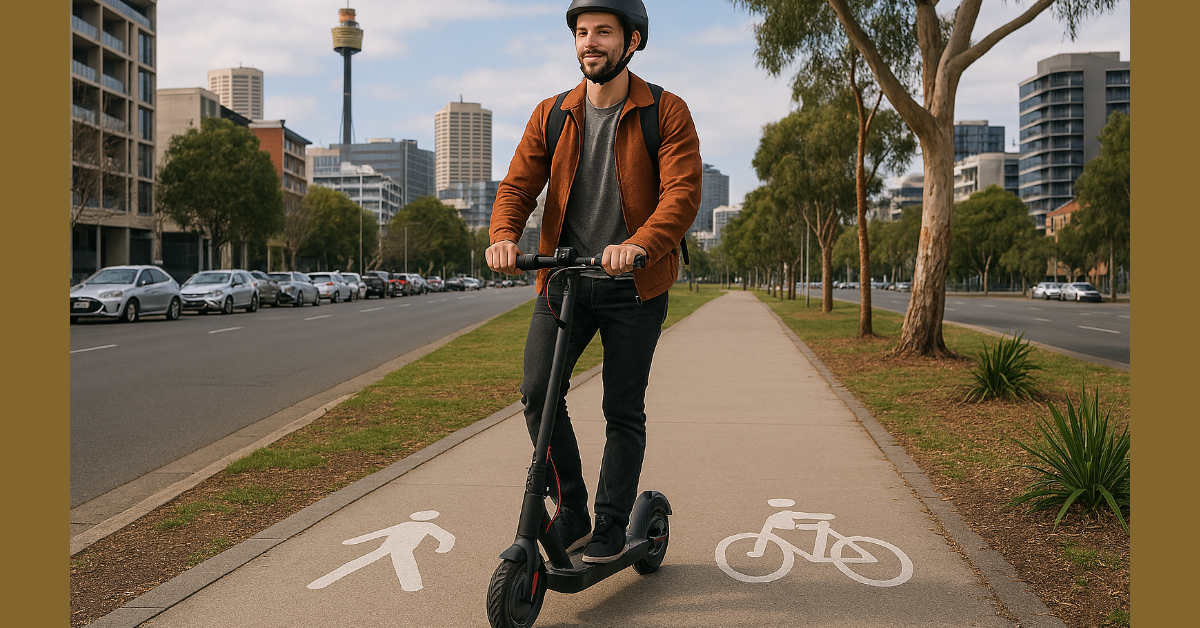
Electric scooters are subject to the same drug driving offenses as motor vehicle drivers, and severe penalties apply if riders are caught drinking or drug riding. Individuals must also be over 16 years old to use the shared scheme e-scooters and not exceed 10 km/h on shared paths.
The trial is expected to last 12 months and will be evaluated and monitored by the NSW Government. However, it could pave the way for more electric scooter freedom in New South Wales should it be successful.
Updating for 2025, NSW continues its restrictive stance on private e-scooters, which remain illegal on public roads and paths and are limited to private property. However, shared e-scooter trials have expanded to more areas like Sydney, Newcastle, and Wollongong, with speed limits increased to 20 km/h in trial zones (up from 10 km/h on shared paths). The minimum age stays at 16, and helmets are mandatory. The CBD areas prohibit riding on footpaths. Enforcement has tightened with fines up to AUD 1,000 for violations, amid a 25% rise in e-scooter usage in urban areas. Riders should check Transport for NSW for trial site maps. This evolution reflects growing acceptance, but full legalization for private scooters is pending review in 2026.
To expand safely, consider NSW’s focus on pedestrian priority: always yield, and use bells for warnings. Case studies from 2025 trials show reduced accidents through geo-fencing tech that auto-slows scooters in high-traffic zones, promoting harmonious urban sharing.
Electric Scooter Laws in Queensland
In Queensland, electric scooters are considered personal mobility devices. Therefore, when riding an electric scooter in Australia, you must wear a helmet approved by the Australian Standards (AS). This item may be either an approved bicycle or a motorbike helmet.
The age restrictions for riding an electric scooter in Queensland are 16 years of age or 12 years and supervised by an adult while riding the device. Children under 12 years of age must not ride electric scooters in Queensland.
When riding adult electric scooters, riders must have an effective stopping system controlled by using brakes, gears, or motor control, as well as a working bell, horn, or similar warning device (if the device has handlebars).
When riding electric scooters in Queensland, you must always stay on the left and give way to pedestrians. The speed limits vary depending on where you are riding. On footpaths and shared paths, the maximum speed is 12 km/h unless otherwise signed. Separate paths and bicycle paths have a 25 km/h speed limit.
When riding in a bike lane on roads with a speed limit of 50 km/h or less, the maximum speed is 25 km/h, and any other lower speed limits must be obeyed. Likewise, on physically separated on-road bike lanes, the maximum speed is 25 km/h, and any other lower speed limit must also be obeyed.
You cannot ride past a ‘personal mobility devices prohibited’ sign. In addition, your local council or landowners may prohibit personal mobility devices in certain areas such as malls, esplanades, or jetties.
In 2025, Queensland remains one of the most permissive states, with e-scooters fully legal as personal mobility devices. Updates include new battery safety standards to prevent fires, requiring UL-certified batteries for all devices. Speed limits hold: 12 km/h on footpaths/shared paths and 25 km/h on bike lanes/roads ≤50 km/h. Age: 12 with supervision, 16 unsupervised. Helmets, bells, and lights are essential, with no passengers or mobile use. Fines for non-compliance can reach AUD 500. With e-scooter rides surpassing 5 million in Brisbane alone (2025 data), councils have added more dedicated paths. Tips: Opt for models under 500W for compliance; always scan for prohibited signs via apps like Neuron.
Expansion includes environmental perks: E-scooters reduce urban emissions by 20% per trip compared to cars (CSIRO estimates), making QLD’s laws supportive of green transport.
Electric Scooter Laws in South Australia
Electric scooters are considered motorized wheeled recreational devices. In South Australia, electric scooter riders must be at least 16 years of age, hold a current driver’s license, and wear an approved helmet. They must also stay within 25 km/h, and electric scooters cannot be used on roads or road-related areas such as footpaths, bike/pedestrian tracks, or vehicle parking areas.
Electric scooters can only be used on private property. Failing to abide by this law could result in hefty fines for driving unregistered or uninsured vehicles or even for failing to hold the appropriate driver’s license.
Under South Australian legislation, electric scooters are considered motor vehicles and thus require a driver’s license, registration, and compulsory third-party insurance. These devices do not meet safety standards under the Australian Design Rules (ADR), so they are not eligible for registration.
For 2025, South Australia has relaxed some restrictions, making e-scooters fully legal if they meet requirements. Riders 16+ need no license now, but helmets are mandatory. Speed: 10 km/h on footpaths/shared paths, 25 km/h on bike lanes/roads, and ≤50 km/h without bike lanes. No footpaths in busy areas. The speed limit is under review for a potential increase to 15 km/h on paths. Private use on property is still allowed, but public riding requires compliance. Penalties include AUD 300 fines for speeding. With market growth, SA has seen a 30% uptick in e-scooter registrations, prompting more infrastructure like charging stations in Adelaide.
Electric Scooter Laws in Tasmania
In Tasmania, electric scooters—or Personal Mobility Devices (PMDs)—are a popular way to get around. But before you hop on one, it’s important to understand the laws that govern their use.
To be considered a PMD, an off-road electric scooter must have at least one wheel and measure no more than 125 cm long, 70 cm wide, and 135 cm high. It must also not exceed 45 kg in weight and not be capable of travelling faster than 25 km/h on level ground.
Anything bigger or that can travel faster must meet licensing and registration requirements for motor vehicles. So before you take to the streets, ensure your e-scooter complies with the laws.
As of 2025, Tasmania keeps e-scooters legal as PMDs with the same dimensions. Riders 16+ must carry ID, wear helmets, and fit bells/lights. Speeds: 15 km/h on footpaths, 25 km/h on shared paths/bike lanes/roads. Allowed on footpaths with caution. No major changes, but enforcement emphasizes yielding to pedestrians. With Tasmania’s scenic paths, e-scooter tourism has grown 40%, per 2025 tourism data. Tips: Check for weather-resistant models; fines up to AUD 400 for non-compliance.
Electric Scooter Laws in Victoria
If you own a privately owned e-scooter, you can only ride it on private property. As long as your electric motor has a power output of 200 watts or less and a speed capability of 10 km/h or less, you are in compliance. Don’t get caught breaking the laws—enjoy your e-scooter ride on private property and avoid public roads, footpaths, shared or cycle paths, and public parks.
In Victoria, electric scooters may be used for commercial hire in certain areas. These e-scooters provide a sustainable and convenient mode of transport for short journeys. However, users are automatically speed-limited to 20 km/h and must adhere to certain laws when using the scooter.
Riders must be at least 18 years old and are not allowed to carry passengers. When using commercial hire e-scooters, riders must not ride on footpaths and must always wear a bicycle helmet. Additionally, electric scooters may only be used on bicycle lanes, shared paths, and roads with a speed limit of less than 50 km/h.
Furthermore, riders must not use a mobile phone while riding, must be below 0.05 BAC, and must have zero presence of prescribed drugs when using the scooter.
In 2025, Victoria has advanced to full legality for devices meeting requirements (500W limit). Private e-scooters are now allowed publicly. Age: 16+. Speeds are 20 km/h on shared paths, bike lanes, and roads with a maximum speed of 60 km/h; they are updated to 25 km/h on bike paths. There are no footpaths available outside of shared zones. Helmets are mandatory. Melbourne’s shared schemes logged over 10 million rides in 2025, boosting the economy by AUD 50 million. Updates include stricter power limits to curb modifications.
Electric Scooter Laws in Western Australia
Electric scooters in the state of Victoria are considered ‘eRideables.’ An electric rideable, commonly referred to as an eRideable, is a small device with at least one wheel that is not more than 125 cm long, 70 cm wide, and 135 cm high and weighs no more than 25 kg. It also cannot travel faster than 25 km/h on level ground.
Electric scooters can generally be ridden on footpaths, bicycle paths, and shared paths. They may also be used on local roads without center lines and with a speed limit of 50 km/h or less. However, when using these local roads, riders must not exceed 10 km/h and give way to any pedestrians at pedestrian crossings. Additionally, electric scooter riders are no longer required to dismount when crossing a pedestrian if they enter the crossing from the connected path rather than the road.
Riders must be at least 16 years of age to use electric scooters. Special provisions allow children under this age to ride low-powered electric scooters that have a maximum motor power of 200 watts and a speed limit of 10 km/h.
If you have an electric scooter that exceeds the dimensions of 125 cm long, 70 cm wide, 135 cm high, and 25 kg and can travel more than 25 km/h, it may not be legally ridden on roads and paths in Western Australia.
For 2025, WA classifies e-scooters as eRideables with the same specs. Fully legal. Age: 16+. Speeds: 10 km/h on footpaths, 25 km/h on shared paths/bike lanes/roads without lines, and ≤50 km/h. Helmets required. Rental schemes expanded to regional areas like the outskirts of Perth. 2025 updates: No dismount at crossings from paths.
With WA’s vast spaces, e-scooters aid last-mile transport, reducing emissions by 15% per user (WA Dept of Transport).
Electric Scooter Laws in the Australian Capital Territory
Electric scooter riders in the Australian Capital Territory must obey some laws to ensure their safety and that of pedestrians.
To stay compliant, scooterists must:
- Wear a high-quality, approved helmet
- Stick to the bicycle side of separated paths, footpaths, shared paths, or bike paths, and always keep to the left when riding on roads.
- Speed limits must be adhered to, with 25 km/h on bike paths, 15 km/h on footpaths, and 10 km/h at crossings.
- Under the influence of drugs or alcohol or using mobile devices while riding is prohibited.
- Passengers aren’t allowed
- For children aged 12 and under, electric scooters can only be ridden under adult supervision.
Knowing these electric scooter laws is essential for staying safe on your ride.
In 2025, ACT remains progressive. Fully legal. Age: 12+. Speeds: 15 km/h on footpaths, 25 km/h on bike paths; roads limited unless there are no alternatives. Helmets and bells are required. No passengers, mobiles, or intoxicants. Canberra’s usage surged 35% with integrated public transport apps.
Tips: Use reflective strips; 2025 sees more bike path extensions.
Electric Scooter Laws in Northern Territory
When riding an electric scooter, also known as an e-scooter in Northern Territory, you don’t need a driver’s license or learner permit. But it pays to be aware of the rules so you know what’s allowed and what isn’t—otherwise, you might come face-to-face with hefty fines or points on your license.
If you hire a Neuron e-scooter, you must be at least 18 years old and wear an approved helmet that is securely fitted. You can only use them in public places and keep them to the left, giving way to pedestrians.
You also can’t carry passengers, use a mobile phone, or have a BAC of 0.05 or more. As for speed, the scooters are limited to 15 km/h and must have lights operating at night.
For your own e-scooter, it’s a different story—you can only ride it on private property, not roads, footpaths, or other public spaces.
For 2025, NT restricts private e-scooters to property; hired ones are encouraged. Age: 18+. Speeds: 15 km/h on footpaths/shared/bike lanes, 25 km/h on roads; limited road use for obstructions. Helmets for under 16s. Darwin’s climate necessitates the implementation of new heat safety recommendations. Usage is low but growing 20%.
Will the law change on electric scooters?
Electric scooters are becoming increasingly popular in Australia, and the laws surrounding them are also evolving. Currently, the laws regarding motorized scooters for adults vary from state to state. However, the government is considering the legalization of electric scooters, potentially resulting in modifications to their usage and riding locations.
TfL has already announced plans to procure operators for a trial period beyond September 2023 with the potential to make these laws permanent after May 2024, when the national trial period ends. This is exciting news for anyone looking forward to getting around on an electric scooter, as it provides greater access, making this mode of transportation more accessible for all.
In 2025, changes have occurred: National discussions via NTC aim for uniformity by 2027, with states like NSW and WA expanding trials. The federal government is pushing for the use of UL batteries and the implementation of geo-fencing.
Summary
Electric scooter laws in Australia vary by state, so riders should be aware of the specific regulations in their location. Awareness of these regulations is essential for staying safe and compliant when riding a motorized scooter for adults.
Before riding electric scooters, it is important to ensure you are familiar with the rules and regulations in your state or local area. It is also important for riders to ensure that their e-scooter meets all the necessary safety requirements, such as having a reliable braking system and visibility lights for nighttime rides.
Furthermore, electric scooter riders should be aware of potential hazards, such as pedestrians and other road users, which can pose an increased risk when riding at higher speeds.
Finally, it is advised that electric scooter riders wear protective gear—including a helmet—when riding an electric scooter to protect themselves from any potential injury or harm.
Keep you and those around you safe—follow electric scooter laws for a smooth ride!
Conclusion: Navigating Electric Scooter Laws in Australia for 2025 and Beyond
As electric scooters surge in popularity—with the market projected to triple by 2033—staying informed on state-specific laws is crucial for safe, legal riding. From NSW’s expanded trials to QLD’s permissive paths, 2025 updates emphasize safety, sustainability, and accessibility. Respect pedestrian rights, speed limits, and helmet laws when traveling or exploring to avoid penalties. Looking ahead, potential national standardization could unify rules, boosting eco-friendly transport. For the latest on “electric scooter laws in Australia 2025,” consult official transport sites and ride responsibly to enjoy this growing mobility revolution.
FAQs
What are the electric scooter speed limits in NSW for 2025?
In NSW, private e-scooters are restricted to private property, but shared schemes in trial zones like Sydney allow 20 km/h. Helmets are mandatory for riders 16+, and there are no footpaths in CBDs. Fines up to AUD 1,000 apply for violations, with geo-fencing tech reducing accidents by 25%.
At what age can you ride an electric scooter in Queensland in 2025?
Riders must be 16+ unsupervised or 12+ with adult supervision in QLD. Speeds: 12 km/h on footpaths, 25 km/h on bike lanes/roads, and ≤50 km/h. New 2025 battery safety standards require UL-certified models. Helmets, bells, and no passenger or mobile use are enforced.
Are electric scooters legal on footpaths in Victoria in 2025?
In Victoria, e-scooters are legal, but no riding on footpaths except in shared zones. Speeds: 20 km/h generally, 25 km/h on bike paths. Riders 16+ must wear helmets. 2025 updates include 500W power limits, with over 10 million rides in Melbourne boosting the local economy.
What helmet rules apply for e-scooters in ACT 2025?
ACT requires high-quality approved helmets for all riders 12+. Speeds: 15 km/h on footpaths, 25 km/h on bike paths. There should be no passengers, mobile phones, or intoxicants present. 2025 sees 35% usage growth in Canberra, with apps integrating public transport for seamless commutes.
Can you ride electric scooters on roads in WA in 2025?
Indeed, in Western Australia, the speed limit on roads without dividing lines is between 50 km/h and 25 km/h. Footpaths: 10 km/h. Riders aged 16+ need helmets. 2025 expansions include regional rentals. Under-16s will have access to low-powered (200W) options. According to state data, e-scooters reduce emissions by 15% for each user.
Disclaimer: This article provides general information on electric scooter laws in Australia as of December 26, 2025, based on publicly available sources. Laws can change, and this is not legal advice. Consult official state transport authorities or a legal professional for personalized guidance. The author and publisher disclaim liability for any actions taken based on this content. Always verify current regulations before riding.