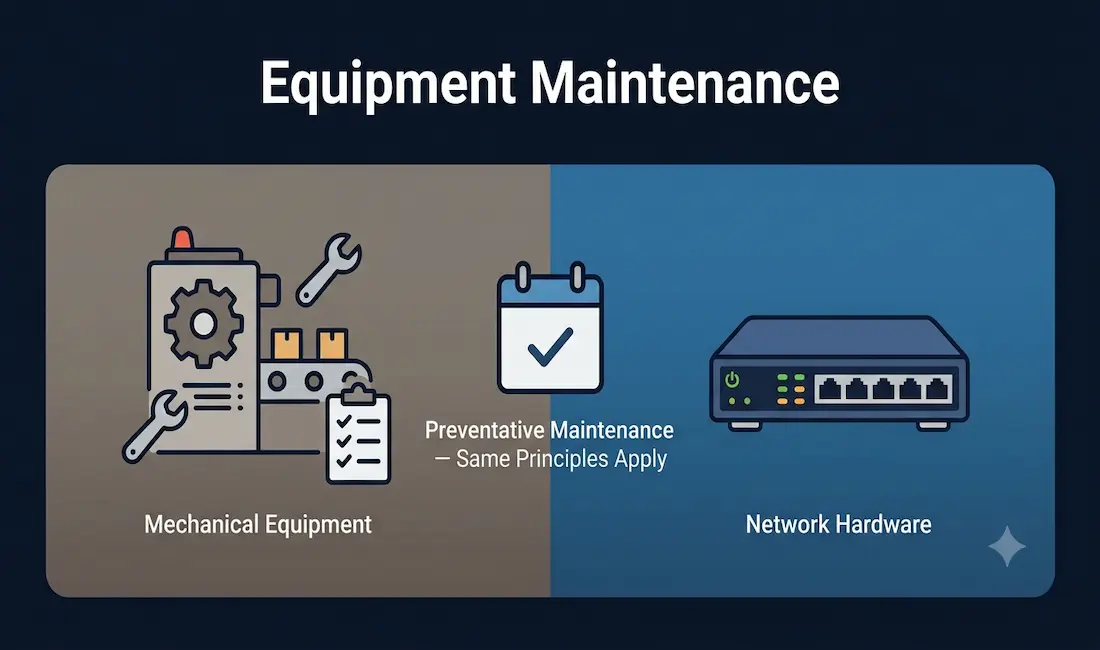
Wear and tear of machines and equipment is a normal occurrence, since physical assets degrade over time due to general use, corrosion, friction, and environmental exposure. This applies just as much to industrial machinery as it does to the network hardware, switches, routers, and cabling, that keeps a modern facility connected. Taking proper care of equipment and following a consistent maintenance routine can meaningfully slow this degradation, extend service life, and reduce the far higher cost of unplanned downtime and emergency repairs.
Unplanned equipment downtime is a genuinely expensive problem across industries: studies in manufacturing and industrial operations consistently place the cost of unplanned downtime in the thousands of dollars per hour once lost production, labour, and expedited repair costs are factored in, making preventative maintenance one of the highest-return activities a facility or IT operations team can invest time in.
This article covers five practical ways to protect your equipment and extend its usable lifetime, with a closing section on how these same principles apply directly to networking hardware.
Tip #1: Read the User Manual
It may sound obvious, but reading and actually following the manufacturer’s user manual is one of the most effective, lowest-cost ways to protect equipment from unnecessary wear. Every piece of equipment or machinery is engineered differently and requires care specific to its design, materials, and intended operating conditions.
The manufacturer is the single best source for how a given piece of equipment should be operated, cleaned, and maintained, including specific lubricant types, torque specifications, recommended operating temperature and humidity ranges, and the manufacturer’s own recommended maintenance interval. Deviating from these specifications, even with good intentions, is one of the most common causes of premature equipment failure.
Tip #2: Use the Right Equipment for the Job
Using the wrong type, size, or rated capacity of equipment for a given task creates unnecessary stress and accelerates wear, since the equipment is being operated outside the conditions it was actually engineered for. This applies broadly: using an undersized tool for a heavy task, running a motor or pump beyond its rated duty cycle, or connecting a device to a power source outside its rated voltage or current range.
Confirm that the equipment you’re using is correctly rated and sized for the specific task at hand, not just capable of technically completing it. Correctly matched equipment not only reduces wear but typically completes the task faster and more reliably, since it isn’t operating near or beyond its design limits.
Tip #3: Inspect Regularly
Regular inspection catches small issues before they become expensive failures, and maintains equipment functionality and output quality over time. Depending on the complexity and risk profile of the equipment, this may require a qualified engineer or technician; for simpler equipment, a trained operator performing routine visual and functional checks is often sufficient.
A useful regular inspection checklist covers: unusual noise or vibration, abnormal operating temperature, visible corrosion or wear on moving parts, fluid leaks, loose fasteners or connections, and any deviation from normal performance metrics. Catching any of these early, before they cascade into a larger failure, is consistently far cheaper than the repair or replacement that follows a missed early warning sign.
For electronic and networking equipment specifically, status indicator LEDs serve exactly this early-warning inspection function, giving a fast, at-a-glance signal of link, activity, or fault conditions well before a problem shows up in monitoring software. See our guide to Ethernet and network device status LEDs for a full breakdown of what different LED colours and patterns actually indicate.
Tip #4: Perform Regular Preventative Maintenance
Beyond inspection, setting a defined preventative maintenance schedule and following it consistently is what actually slows the underlying deterioration rate, rather than just catching problems after they start. This includes scheduled lubrication, filter changes, cleaning, calibration checks, and component replacement on a defined interval, rather than only reactive repair after something visibly fails.
Consistent preventative maintenance does mean planning around brief production or operational interruptions for the maintenance window itself, but with proper scheduling, this cost is consistently far lower than the cost of an unplanned failure and the emergency repair, expedited parts shipping, and lost output that typically follow it. A maintained log of completed and pending maintenance work also helps identify recurring issues on specific equipment, informing whether repair or replacement is the more cost-effective long-term choice.
Increasingly, condition-based and predictive maintenance approaches, using vibration sensors, thermal monitoring, or connected IoT sensors reporting into a central monitoring system, are supplementing or replacing purely calendar-based maintenance schedules, allowing maintenance to be triggered by actual equipment condition rather than a fixed time interval alone.
Tip #5: Store the Right Way
Proper storage is easy to overlook but genuinely important for protecting equipment not currently in active use. Poor storage conditions, exposure to moisture, extreme temperature swings, dust, or direct sunlight, can cause meaningful degradation even on equipment that isn’t being operated at all.
Store equipment according to the manufacturer’s specified environmental conditions where possible: a controlled temperature and humidity range, protection from dust and direct sunlight, and, for equipment with batteries or fluids, storage orientation and charge-state guidance specific to that equipment type. Even equipment designed to tolerate a wide range of conditions during active use often has narrower recommended storage parameters, since it isn’t actively generating heat or being monitored during storage the way it would be in operation.
How This Applies to Networking Equipment
The same wear-and-tear principles covered above apply directly to network hardware, and IT teams benefit from treating switches, routers, wireless access points, and structured cabling with the same preventative-maintenance mindset used for industrial equipment.
Environmental conditions matter for network gear too. Excess heat, dust accumulation in ventilation paths, and humidity all shorten the service life of switches and routers, exactly as they do for mechanical equipment. Server rooms and network closets should maintain manufacturer-recommended temperature and humidity ranges, with adequate airflow and regular dust cleaning around ventilation intakes.
Regular inspection applies to cabling and connectors, not just electronics. Physical cabling is subject to genuine mechanical wear and tear: connector wear from repeated insertion/removal cycles, cable jacket degradation from UV exposure or flexing, and connector corrosion in humid environments. A loose or degraded physical connection is also one of the most common root causes behind the kind of intermittent link issues covered in our basic Cisco router configuration guide, underscoring why physical-layer inspection remains a genuinely valuable first troubleshooting step even in an era of largely software-defined network management.
Preventative maintenance extends to firmware and configuration hygiene, not just physical hardware, keeping device firmware current, reviewing configurations periodically, and maintaining accurate documentation of what’s deployed where all serve the same underlying purpose as a mechanical maintenance schedule: catching and addressing small issues on a routine basis before they compound into a larger, more disruptive failure.
Conclusion
Protecting equipment from wear and tear, whether industrial machinery or network hardware, comes down to five consistent principles: follow the manufacturer’s guidance, use correctly rated equipment for the task, inspect regularly and specifically, maintain on a defined preventative schedule, and store equipment properly when not in active use. These principles apply just as directly to the switches, routers, and cabling running a network as they do to any mechanical equipment, and a maintenance mindset applied consistently across both is one of the most reliable ways to protect the return on a capital equipment investment over its full service life.
Frequently Asked Questions
How much does unplanned equipment downtime typically cost?
Industry studies across manufacturing and industrial operations consistently show unplanned downtime costing organizations thousands of dollars per hour once lost production output, idle labour, and expedited emergency repair costs are all factored in together. This is why preventative maintenance, though it requires planned time and some upfront cost, is generally far cheaper over an equipment’s lifetime than a purely reactive, repair-after-failure approach.
What is the difference between preventative and predictive maintenance?
Preventative maintenance follows a fixed schedule, performing tasks like lubrication, filter changes, or inspections at defined time or usage intervals regardless of the equipment’s actual current condition. Predictive maintenance instead uses condition monitoring, vibration sensors, thermal imaging, or connected IoT sensors reporting into a monitoring platform, to trigger maintenance based on the equipment’s actual measured condition, allowing maintenance to happen closer to when it’s genuinely needed rather than on a fixed calendar regardless of real wear. Many organizations use a hybrid of both approaches, depending on the criticality and monitoring feasibility of specific equipment.
Do network switches and routers really need the same wear-and-tear attention as mechanical equipment?
Yes, though the specific failure modes differ. Network hardware doesn’t wear the way a mechanical bearing does, but it is genuinely affected by heat, dust accumulation, humidity, and power quality issues over time, all of which shorten component lifespan and increase failure risk. Physical cabling and connectors also experience real mechanical wear from repeated handling, flexing, and environmental exposure. Treating server room environmental conditions, cable management, and firmware currency with the same preventative-maintenance discipline used for industrial equipment meaningfully reduces unplanned network downtime.
What should a basic regular equipment inspection actually check for?
A solid baseline inspection checklist covers unusual noise or vibration, abnormal operating temperature, visible corrosion or wear on moving or connected parts, fluid leaks where applicable, loose fasteners or physical connections, and any deviation from the equipment’s normal performance metrics. For electronic and networking equipment specifically, status indicator LEDs provide a fast, low-effort equivalent, an at-a-glance signal of link, activity, or fault conditions that can flag a developing problem well before it would otherwise be noticed through monitoring software or a support ticket.
How often should preventative maintenance actually be performed?
The correct interval depends entirely on the specific equipment, its manufacturer’s guidance, its operating environment, and how heavily it’s used, so there’s no single universal answer. The manufacturer’s user manual is the authoritative starting point for a recommended baseline interval; from there, actual field experience, whether inspections are consistently finding issues before or after the scheduled maintenance point, should be used to adjust the interval up or down over time. Equipment operating in harsher environments (high dust, heat, humidity, or usage intensity) generally warrants more frequent maintenance than the same equipment operating under ideal conditions.