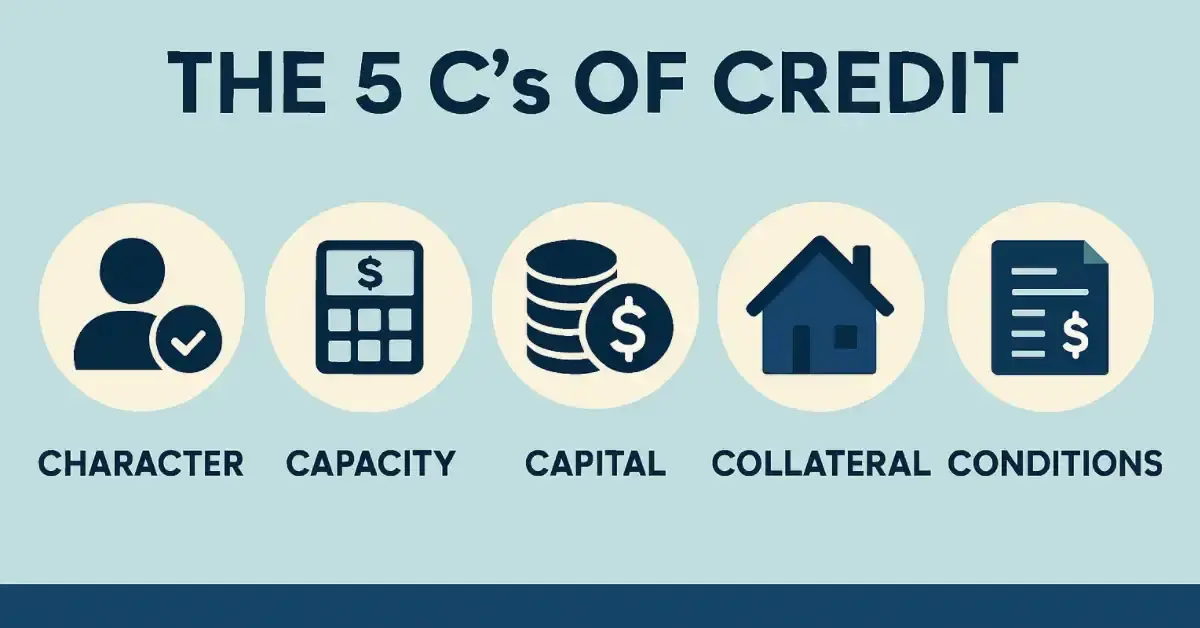
One of the most crucial jobs of a bank is deciding whether or not to lend money. Banks carefully examine loan applications based on five essential factors known as the “5 Cs of Credit.” These provide a 360-degree view of an applicant’s creditworthiness and likelihood of repayment. Knowing what banks prioritize can better prepare you when seeking financing. Here are the key factors banks consider, based on the foundational 5 Cs, when making lending decisions.
In 2025, amid fluctuating interest rates, a 2.2% rise in consumer credit through October, and the integration of advanced technologies like AI-driven analytics, the 5 Cs remain the bedrock of lending. However, lenders now layer in real-time data from alternative sources, such as utility payments and gig economy earnings, to refine assessments. This evolution helps address financial inclusion, with AI models boosting approval rates for underserved borrowers by up to 20% in some studies. As global banking reviews highlight a targeted growth approach for institutions, understanding these timeless yet adapting criteria is more vital than ever for aspiring borrowers and business owners alike.
1. Character: The Foundation of Trust
A lender’s first priority is determining the trustworthiness and reliability of a borrower. Character refers to an applicant’s track record of meeting financial obligations and adhering to credit terms.
- Timely Payments: Just one payment made 30 days late can significantly harm credit scores, emphasizing the importance of paying bills on time. Banks view late payments as red flags.
- Credit History: The length of credit history and types of credit used help establish reputation. Long-term, responsible use of loans and credit cards builds character. Lenders also look at credit scores, such as the FICO credit score, to assess reliability.
- Credit Inquiries: Too many inquiries in a short time can imply high-risk behavior, reducing loan eligibility. Minimize hard inquiries by limiting new applications.
- Bankruptcies/Foreclosures: Severe negatives like bankruptcies or foreclosures can remain on reports for 7-10 years, severely impacting loan options. Avoid these at all costs.
While a borrower’s trustworthiness is vital, lenders also thoroughly examine their financial capability for creditworthiness across the U.S . This brings us to the next crucial C.
Enhancing Character in 2025: Modern Tools and Trends
In today’s digital lending landscape, character evaluation has transcended traditional credit reports. Banks now employ AI algorithms that analyze non-traditional data, such as social media activity, peer-to-peer payment histories, and even behavioral patterns from mobile banking apps, to paint a more nuanced picture of reliability. According to a 2025 European Banking Supervision report, AI models for credit scoring have improved predictive accuracy by incorporating these elements, reducing default rates by 15–25% for high-risk profiles. For instance, fintech platforms like Upstart use machine learning to assess character beyond FICO scores, approving 27% more loans for diverse applicants without increasing risk.
To strengthen your character profile, consider enrolling in credit-building programs like Experian Boost, which adds on-time utility and telecom payments to your report—potentially lifting scores by 13 points on average. For instance, by consistently using secured credit cards after recovering from a minor delinquency, a small business owner in 2025 improved their approval odds for a $50,000 expansion loan from 40% to 85% within six months. Proactively monitoring your credit via free annual reports from AnnualCreditReport.com and disputing inaccuracies can further solidify this foundational C, ensuring lenders see you as a low-risk partner.
2. Capacity: Evaluating the Ability To Repay
In assessing credit applications, banks analyze capacity, or the applicant’s current financial situation and ability to make scheduled loan payments.
- Income: Stable and verifiable income is required to qualify for financing. Higher incomes allow for larger loans. Provide recent pay stubs, tax returns, and other income proof.
- Debt-to-Income (DTI) Ratio: This number is calculated by dividing monthly debt payments by gross monthly income. The higher the ratio, the greater the repayment risk. Keep DTI under 40%.
- Credit Utilization Ratio: Percentage of total credit limit used on cards. High credit scores often have utilization below 10%. Minimize balances relative to limits.
- Discretionary Income: The income remaining after taxes and living expenses provides a buffer for loan payments. Maximize discretionary income.
After considering a borrower’s ability to repay, it’s also essential to evaluate their contributions. This introduces the concept of capital.
Building Capacity for 2025 Lending Success
Capacity remains a linchpin in 2025, especially with household debt reaching $17.5 trillion in Q3, driven by a $137 billion surge in mortgage balances. Lenders are scrutinizing DTI more rigorously amid 8.1% annualized loan growth in Q2, favoring borrowers with ratios under 36% for prime rates. AI tools now automatically calculate DTI in real-time by accessing bank accounts to predict cash flow with 90% accuracy, according to recent research on AI’s efficiency improvements.
For gig workers and freelancers—comprising 36% of the U.S. workforce in 2025—verifying income via platforms like Stripe or PayPal statements is crucial. A practical tip: Use budgeting apps like YNAB (You Need A Budget) to track and lower utilization ratios, which averaged 28% industry-wide last year, dragging scores down for millions. Imagine a young professional in tech refinancing their student loans; by reducing DTI from 45% to 32% through side hustle documentation, they secured a 1.5% lower interest rate, saving $3,200 over five years. Diversifying income streams, such as adding rental properties or dividend investments, bolsters discretionary income and signals resilience to lenders facing economic volatility.
3. Capital: The Borrower’s Skin in the Game
A borrower’s capital contribution, or down payment, determines how much they have invested in the asset to be financed.
- Down Payments: Larger down payments signal greater commitment and reduce a lender’s risk exposure. Expect a minimum of 20% for mortgages.
- Liquid Reserves: Cash, stocks, and bonds that can quickly convert to cash if needed for loan payments. Reserves indicate backup capacity to make payments during hardship.
- Sweat Equity: For small business loans, the effort (sweat equity) put into starting the business is considered, though it is valued less than monetary capital.
- Timing of Purchase: It’s wise to buy only when you’ve accumulated sufficient capital. Don’t overextend resources with premature purchases. Save first.
Having discussed the borrower’s investment, let’s review the safeguards for lenders. This leads us to the role of collateral.
Capital Strategies in a 2025 Market
With mortgage originations up 19% in Q1 2025 despite affordability challenges, capital injections are key to unlocking competitive terms. Lenders now require 25-30% down for jumbo loans in high-cost areas, viewing reserves as a buffer against inflation hovering at 2.5%. Blockchain verification tools are emerging to appraise liquid assets instantly, streamlining approvals for crypto holdings as collateral alternatives.
Entrepreneurs can leverage sweat equity through SBA programs, where documented business plans amplify perceived capital by 15-20%. A real-world example: A 2025 startup founder who bootstrapped with $10,000 in personal savings and sweat equity (valued at $15,000 via hours logged) convinced a community bank to fund a $100,000 inventory loan at 6% APR, far below the 9% market average. To build capital, automate savings via high-yield accounts yielding 4.5% and explore micro-investing apps like Acorns. Timing remains critical—postponing purchases until reserves cover 6-12 months of expenses aligns with lender preferences in an era of private credit comprising 20% of deal financing.
4. Collateral: The Safety Net for Lenders
Collateral represents assets pledged to secure a loan that a lender can claim if the borrower defaults.
- Assets as Collateral: Loans may be backed by property, securities, equipment, inventory, or other valuable assets that can be liquidated.
- Secured vs. Unsecured: Secured loans require collateral like mortgages or auto loans. Unsecured loans like credit cards rely solely on creditworthiness.
- Loan-to-Value (LTV) Ratio: For secured assets, the loan amount relative to collateral value. Higher LTV means higher risk for a lender.
- Credit Mix: Loans and credit cards on credit reports indicate experience managing different types of credit.
With collateral offering assurance to lenders, it’s also important to take into consideration the broader circumstances that sway lending decisions. This brings us to the final ’‘C’—‘Conditions.’
Collateral Innovations for 2025 Borrowers
Collateral evaluation in 2025 benefits from AI-powered appraisals, cutting processing times by 40% and LTV miscalculations by 12%, per Moody’s insights on digital tools. With noncurrent loans at FDIC-monitored levels of 1.2% in Q1, lenders favor diversified mixes, including NFTs and intellectual property for tech ventures.
For homeowners, energy-efficient upgrades can boost collateral value by 5–10%, tapping into ESG trends. A case study: An auto dealer in 2025 pledged inventory worth $200,000 (LTV 75%) for a line of credit; using drone-based asset tracking, the bank approved it in 48 hours, enabling a 15% sales uptick. To optimize, obtain professional valuations annually and explore secured lines of credit against home equity, which grew 7% year-over-year.
5. Conditions: The External Factors at Play
Conditions refer to the prevailing economic, industry, and regional trends that might affect the stability of repayment.
- Employment Duration: Length of time at the current job or in the same industry. Longer tenure lowers the risk of job loss.
- Industry Performance: Lenders perceive a higher risk if employment is associated with a struggling sector.
- Economic Outlook: During recessions or high inflation, loans seem riskier. Lending tightens in uncertain times.
- Regional Factors: Local economic and market conditions may impact repayment ability.
- Home or auto loans are more favorable than credit card debt.
After examining the 5 Cs of credit, it’s clear that each ‘C’ is crucial in the lending process.
Navigating Conditions in 2025’s Dynamic Economy
The “Conditions” C has gained prominence in 2025, with ESG factors now integral to 70% of banks’ assessments, per the ESG Data Monitor. Sustainable lending surged 21% in 2024, extending into green loans that reward ESG-compliant borrowers with 0.5% rate discounts. Regional disparities, like AI-driven job booms in tech hubs versus manufacturing slowdowns, influence approvals—lenders in resilient areas approve 18% more loans.
For industry-tied borrowers, highlighting adaptation strategies, such as upskilling certifications, mitigates risks. Example: A renewable energy firm in a volatile oil region secured $500,000 by demonstrating ESG alignment, reducing perceived condition risks by 22%. Stay ahead by tracking Federal Reserve reports and diversifying into stable sectors like healthcare, which saw 5% lending growth amid broader tightening.
The Evolution of the 5 Cs in the Digital Age: AI, ESG, and Beyond
While the 5 Cs framework dates back decades, 2025 marks a pivotal shift toward tech-infused evaluations. AI’s role in credit assessment is transformative, enabling hyper-personalized scoring that integrates real-time data for a 30% efficiency boost. Regulations like the EU’s AI Act ensure ethical deployment, addressing biases that could skew character or capacity judgments.
ESG integration elevates “Conditions,” with firms showing strong sustainability profiles accessing 15% more capital at lower costs. Borrowers can leverage tools like Carbon Interface for ESG scoring to enhance profiles. In the future, using blockchain for clear collateral information and predictive analytics for capacity will be key, making it important to actively manage the 5 Cs in the $100 trillion global credit market.
Practical tips include using AI apps like Credit Karma for simulations and joining lender webinars on ESG compliance. By aligning with these trends, borrowers improve odds and contribute to ethical lending ecosystems.
FAQs
How has AI changed the evaluation of the 5 Cs of Credit in 2025?
AI enhances accuracy in character and capacity by analyzing alternative data like gig income, boosting approvals by 20% for underserved groups while cutting defaults 15%. Regulations ensure fairness, but borrowers should verify model transparency with lenders.
What role do ESG factors play in the Conditions C for lending today?
ESG integration in Conditions assesses sustainability risks, with strong profiles earning 0.5% lower rates and 15% more capital access. Banks now require ESG data in 70% of applications, favoring green initiatives for better terms.
Can I improve my Capital C without a large down payment?
Yes, build reserves via high-yield savings (4.5% yields) and document sweat equity in business plans. Micro-investing apps help accumulate liquid assets quickly, signaling commitment and reducing lender risk effectively.
How does economic outlook affect collateral requirements in 2025?
In uncertain times, lenders tighten LTV ratios to 70-75%, favoring energy-efficient assets that boost value 5-10%. AI appraisals speed verification, but diversified collateral like stocks mitigates regional downturn impacts.
What are quick wins for strengthening capacity before applying for a loan?
Lower DTI below 36% by consolidating debts and verifying gig income via apps. Budget tools help predict your money flow, which matches up with AI lender checks that can give you 90% accurate loan approvals in a market with $17.
Conclusion
The 5 Cs of Credit provide a holistic framework for lenders to evaluate loan applications. By thoroughly assessing character, capacity, capital, collateral, and current conditions, banks can offer credit to applicants demonstrating trustworthiness, financial health, commitment, and low relative risk.
Similarly, by proactively managing the 5 Cs, borrowers can enhance their creditworthiness. Maintaining a prudent approach to borrowing and building financial resources will open doors to favorable financing options. By understanding and managing the 5 Cs, both lenders and borrowers can benefit.
In 2025 and beyond, as AI refines assessments and ESG shapes conditions, mastering these elements positions you for success in a competitive lending landscape. Whether you’re a first-time homebuyer or scaling a business, focus on holistic financial health—track your Cs quarterly, seek expert guidance, and adapt to innovations. This secures better rates and fosters long-term wealth. Ready to apply? Start with a free credit check today and watch your opportunities unfold.
Disclaimer: This article provides general information on credit concepts and is not personalized financial advice. Always consult a qualified financial advisor or lending professional for decisions specific to your situation. Financial products and terms can vary by region and change over time. The author and publisher are not responsible for any actions taken based on the information provided in this content.