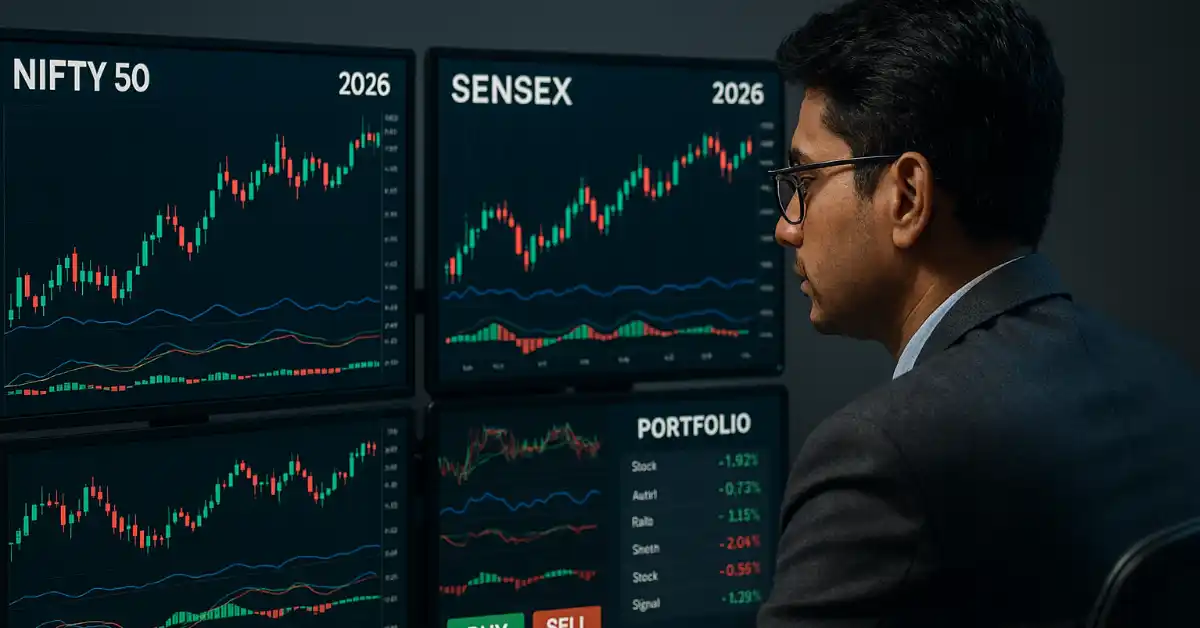
Stock trading in the Indian market is a dynamic and complex venture requiring knowledge, strategy, and discipline. Whether you’re a seasoned investor or a beginner, navigating the twists and turns of the stock market demands a thoughtful approach. This article explores six indispensable tips to help you navigate the Indian stock market successfully.
The Indian Stock Market in 2026: Setting the Stage
Before diving into the essential tips, understanding the current market environment is crucial. As of January 2026, India’s equity markets have entered the new year with renewed optimism and firm footing. The BSE Sensex reached an all-time high of 85,762 points on January 2, 2026, gaining 0.67% and demonstrating strong investor confidence. The Nifty 50 closed at 26,328.55, up 0.70%, with both indices showcasing resilience despite global headwinds.
The Indian stock market demonstrated remarkable performance in 2025, with the Nifty finishing the year with a 10.5% gain, making it India’s top-performing major index. Market capitalization reached unprecedented levels, with robust primary market activity raising ₹1.75 lakh crore through mainboard IPOs—the highest ever for India’s equity markets.
For 2026, analysts project Nifty 50 to reach approximately 29,120 by December, assuming a P/E of 20.0x on FY28E EPS of ₹1,456, representing significant upside potential. Earnings are projected to grow 17.6% in FY27E and 14.8% in FY28E, driven by financials, discretionary spending, telecom, non-ferrous metals, IT, and staples sectors.
Educate Yourself: The Foundation of Successful Trading
One of the fundamental aspects of successful stock trading in the Indian market is a commitment to continuous education. Before diving into the market with a free Demat account, take the time to understand the basics of stock trading, market dynamics, and economic indicators. Familiarize yourself with financial statements, company reports, and macroeconomic factors influencing the market.
a. Stay Informed:
Keep abreast of market news, company announcements, and economic developments. Regularly read financial publications, follow market analysts, and leverage online resources to stay informed about the latest trends and events impacting the Indian stock market.
In 2026, staying informed means understanding critical market drivers:
Domestic Institutional Investors (DIIs): DIIs have become crucial market stabilizers, cushioning persistent Foreign Portfolio Investor (FPI) outflows. In 2025, DIIs absorbed FPI net sales of ₹1.66 lakh crore, reinforcing confidence in India’s equity markets. This trend continues in 2026, with DIIs providing net buying support.
Foreign Institutional Investor Activity: FIIs sold ₹7,608 crore worth of Indian equities in the first two trading sessions of 2026, continuing 2025’s pattern. However, experts anticipate a turnaround as improved fundamentals and GDP growth attract net FII inflows later in the year. A potential moderation in US Federal Reserve rate hikes and cooling of the AI trade could redirect global capital toward Indian equities.
Economic Fundamentals: India maintains strong economic fundamentals with projected GDP growth of 6.5-7.2% for FY26. Benign inflation, improving macro indicators, and stronger Q2 GDP growth underpin positive market sentiment. Government initiatives including tax cuts, GST reforms, and interest rate reductions are expected to revive consumption and support market growth.
Sectoral Rotation: Different sectors are exhibiting varying momentum. In early 2026, power stocks led gains (NTPC +4.67%), banking showed resilience (SBI +2.1%), and metals benefited from infrastructure spending. Conversely, FMCG faced pressure as ITC tumbled 3.78% on new cigarette tax concerns, while globally sensitive sectors experienced volatility.
b. Risk Management:
Understanding the concept of risk is crucial. Diversify your investment portfolio to spread risk across different sectors and asset classes. Additionally, establish and adhere to a risk tolerance level. This ensures that you don’t expose yourself to unnecessary financial vulnerabilities.
Modern Risk Management in 2026:
Sectoral Diversification: Don’t concentrate holdings in single sectors. Balance exposure across financials (which dominate indices at 35-38%), IT (12-15%), consumer goods (10-12%), energy, healthcare, and emerging sectors like renewables and digital infrastructure.
Market Cap Allocation: The 2025 experience showed large-caps leading gains while mid-caps and small-caps lagged. BofA Securities warns of potential sharp corrections in small and mid-cap stocks if downside risks materialize. Consider a balanced allocation: 60-70% large-caps for stability, 20-30% mid-caps for growth, and 10-20% small-caps for aggressive opportunities.
Asset Class Diversification: Beyond equities, maintain exposure to:
- Debt instruments for stability (15-25% of portfolio)
- Gold and silver for hedging (5-10% allocation)
- International equities for geographic diversification (5-15%)
- Alternative investments like REITs for income generation
Volatility Management: Markets in 2026 are expected to be range-bound in the first half due to global headwinds, with potential rally in the second half. Understanding this cyclical nature helps manage expectations and avoid panic selling during temporary corrections.
Develop a Solid Trading Plan: Setting the Course for Success
A well-thought-out trading plan is the cornerstone of successful stock trading in the Indian market. Your plan should encompass your financial goals, risk tolerance, and the strategies you’ll employ. Consider the following elements when crafting your trading plan:
a. Define Objectives:
Clearly outline your financial objectives, whether capital appreciation, income generation, or a combination. Your objectives will shape your trading strategy and guide your decision-making process.
Objective-Based Strategy Framework for 2026:
For Capital Appreciation (Growth Focus):
- Target: 15-20% annual returns
- Portfolio composition: 70% large-cap growth stocks, 20% mid-caps, 10% small-caps
- Sectors: Focus on chemicals, infrastructure, manufacturing, and capital goods with strong order books
- Holding period: 3-5 years minimum
- Review frequency: Quarterly rebalancing
For Income Generation (Dividend Focus):
- Target: 8-12% total returns with 4-6% dividend yield
- Portfolio composition: 80% dividend-paying large-caps, 20% REITs and InvITs
- Sectors: Financials, utilities, PSU stocks with stable cash flows
- Holding period: Long-term (5+ years)
- Review frequency: Semi-annual
For Balanced Growth and Income:
- Target: 12-15% total returns
- Portfolio composition: 50% growth stocks, 30% dividend payers, 20% fixed income
- Diversified across 8-10 sectors
- Holding period: 3-7 years
- Review frequency: Quarterly
b. Set Entry and Exit Points:
Establish specific criteria for entering and exiting trades. Considering technical and fundamental analysis indicators, define the conditions that trigger a buy or sell decision. This helps you stay disciplined and avoid emotional trading.
2026 Entry Point Considerations:
Valuation Metrics: The Nifty’s forward P/E ratio has normalized from 23-25x in early 2025 to approximately 19-22x, creating a healthier and more reasonable starting point for 2026 investments. Look for stocks trading below their historical average P/E multiples with strong fundamentals.
Technical Indicators for Entry:
- Price above 50-day and 200-day moving averages indicates uptrend
- RSI (Relative Strength Index) between 40-60 suggests balanced momentum
- MACD showing bullish convergence
- Volume confirming price movements
- Support at key levels (Nifty: 26,000-26,050; Sensex: 85,000)
Fundamental Triggers for Entry:
- Earnings upgrades or strong quarterly results
- Positive management commentary on outlook
- Sector-specific catalysts (policy changes, capacity additions)
- Improving return ratios (ROE, ROCE)
- Debt reduction and balance sheet improvement
Exit Point Discipline:
- Predetermined profit targets (20-30% for growth stocks)
- Stop-loss levels (7-10% below entry for active trades)
- Trailing stop-loss for protecting profits
- Exit on fundamental deterioration (earnings downgrades, governance issues)
- Rebalancing triggers when holdings exceed allocation limits
Understand Market Trends: Riding the Waves of Success
Successful stock trading in the Indian market involves recognizing and capitalizing on market trends. Trends can be classified as bullish (upward), bearish (downward), or sideways (range-bound). Technical analysis tools like moving averages, trendlines, and chart patterns can help you identify and follow market trends.
a. Technical Analysis:
Utilize technical analysis to identify trend reversals, support and resistance levels, and potential entry or exit points. Tools like trendlines and moving averages can provide valuable insights into the market’s direction, helping you make informed decisions.
Technical Outlook for 2026:
Nifty 50 Technical Levels:
- Resistance Zones: Immediate resistance at 26,200-26,300, major resistance at 26,336-26,386 (near all-time high), breakout target at 26,500+
- Support Zones: Immediate support at 26,000-26,050 (aligned with 20-day EMA), strong support at 25,800-26,000 (demand zone), critical support at 25,600
- Momentum: MACD showing early bullish convergence, price respecting higher supports, intraday bias neutral to mildly positive
- Strategy: Buy-on-dips approach recommended as long as Nifty holds above 26,000
Sensex Technical Levels:
- Resistance: Testing all-time highs around 85,800-86,000
- Support: Key support at 85,000, strong support band at 84,000-84,500
- Trend: Closed at lifetime high with consolidation within defined range
- Caution: Shows signs of fatigue near upper Bollinger band despite bullish setup
Market Breadth Indicators:
- 73% of Nifty 50 stocks trading above their 50-day EMA, indicating expanding participation
- Positive market breadth supports ongoing rally sustainability
- Divergence between large-caps and mid/small-caps suggests selective opportunities
b. Fundamental Analysis:
In addition to technical analysis, incorporate fundamental analysis into your decision-making process. Evaluate a company’s financial health, earnings potential, and industry trends. This comprehensive approach ensures a well-rounded understanding of the stocks in your portfolio.
2026 Fundamental Focus Areas:
Earnings Growth Trajectory: Corporate earnings outlook has strengthened significantly. After collapsing from over 20% CAGR (2020-2024) to just 5-6% in 2025, earnings are projected to rebound to 17.6% growth in FY27E. Companies meeting or exceeding earnings estimates will outperform those disappointing on results.
Balance Sheet Quality: In uncertain times, prioritize companies with:
- Strong balance sheets and low debt-to-equity ratios
- Predictable and positive cash flows
- High return on equity (ROE >15%)
- Improving working capital management
- Prudent capital allocation policies
Sectoral Fundamentals Analysis:
Financials (35-38% index weight): Expected to remain core holdings with focus shifting from loan growth to underwriting discipline and asset quality. PSU banks may lead the financial sector given attractive valuations and improving asset quality.
IT Services (12-15%): After weak 2025, modest recovery expected in 2026 as global IT demand stabilizes. However, AI adoption may create 8-10% negative revenue impact as clients deploy AI tools. Focus on companies with strong digital capabilities and AI integration services.
Consumer Discretionary: Quick commerce penetration stories like Blinkit and Swiggy Instamart growing at 100%+ rates. Similarly, organized retail players like Titan gaining share from unorganized sector present compelling opportunities.
Capital Goods & Infrastructure: Strong order books and public capex supporting growth. Companies linked to domestic investment and manufacturing showing promise.
Automobiles: Policy support and festive demand driving performance. However, monitor for demand saturation and inventory build-up risks.
Power & Renewables: Capacity expansion and renewable energy focus creating opportunities. NTPC’s +4.67% gain in early 2026 reflects sector momentum.
Quality Metrics to Evaluate:
- Consistent revenue growth over 3-5 years
- Expanding or stable operating margins
- Return on capital employed (ROCE) >15%
- Competitive moats (brand, network effects, switching costs)
- Management track record and corporate governance
Understanding modern business IT management becomes crucial as digital transformation shapes company competitiveness and operational efficiency, directly impacting investment decisions.
Practice Risk Management: Safeguarding Your Capital
Effectively managing risk is key to long-term success in the Indian stock market. While the profit potential is enticing, protecting your capital from significant losses is essential. Implement the following risk management strategies:
a. Set Stop-Loss Orders:
Define specific price levels at which you will automatically sell a stock to limit potential losses. Stop-loss orders help you adhere to your predetermined risk tolerance and prevent emotional decision-making during market fluctuations.
Advanced Stop-Loss Strategies for 2026:
Fixed Percentage Stop-Loss: Set stops at 7-10% below purchase price for active traders, 15-20% for long-term investors. This protects against catastrophic losses while allowing room for normal volatility.
Trailing Stop-Loss: As stock price rises, adjust stop-loss upward to lock in profits. For example, if stock bought at ₹100 rises to ₹130, move stop-loss from ₹90 to ₹117 (10% trailing stop), securing ₹17 profit minimum.
Support-Based Stop-Loss: Place stops slightly below key technical support levels identified through technical analysis. This allows temporary fluctuations while exiting if support breaks.
Time-Based Stop-Loss: Exit positions if investment thesis doesn’t play out within predetermined timeframe (e.g., 6-12 months), even if price hasn’t hit stop-loss level.
Volatility-Adjusted Stop-Loss: In volatile markets (like expected H1 2026), widen stops to accommodate increased fluctuations. Use Average True Range (ATR) indicator to set dynamic stops.
b. Position Sizing:
Determine the size of each position in your portfolio based on your risk tolerance and the specific risks associated with each trade. Avoid concentrating too much capital on a single stock, exposing you to unnecessary risk.
Position Sizing Framework:
The 5-10 Rule: No single stock should exceed 10% of portfolio value. Most positions should be 5-7% to ensure adequate diversification across 12-20 holdings.
Risk-Based Sizing: Calculate position size based on distance to stop-loss. If willing to risk ₹10,000 per trade and stop-loss is 10% below entry, position size should be ₹1,00,000 regardless of stock price.
Correlation-Adjusted Sizing: Reduce position sizes in highly correlated stocks (multiple banks, multiple IT companies) to avoid hidden concentration risk. If holding 3 private sector banks, each should be smaller than if holding one bank, one pharma, and one auto stock.
Volatility-Based Sizing: Allocate smaller positions to volatile small-caps (3-5% each) and larger positions to stable large-caps (7-10% each) based on risk-adjusted returns.
Portfolio Construction Example (₹10 Lakh Portfolio):
- 5 large-cap positions: ₹70,000 each (7% each) = ₹3.5 lakh
- 4 mid-cap positions: ₹50,000 each (5% each) = ₹2 lakh
- 3 small-cap positions: ₹30,000 each (3% each) = ₹90,000
- Index funds/ETFs: ₹2 lakh (20%)
- Debt/Gold: ₹1.6 lakh (16%)
Embrace Discipline and Patience: Keys to Long-Term Success
Discipline and patience are virtues that every successful stock trader in the Indian market needs for online share trading. The stock market is unpredictable, and knee-jerk reactions can lead to poor decision-making. Develop the discipline to stick to your trading plan and exercise patience in the face of market volatility.
a. Avoid Emotional Trading:
Fear and greed can cloud judgment and lead to impulsive actions. Adhering to your trading plan and staying disciplined can avoid emotional trading and allow you to make decisions based on logic and analysis.
Behavioral Finance Insights for 2026:
Recency Bias: Don’t extrapolate recent performance indefinitely. The 2025 underperformance versus global markets doesn’t mean 2026 will be similar. Analysts expect mean reversion as earnings recover and valuations normalize.
Herd Mentality: Resist the urge to chase hot stocks or sectors simply because everyone else is buying. The ITC drop of 3.78% in January 2026 triggered panic FMCG selling, but fundamentally strong companies often recover from such events.
Loss Aversion: Investors feel losses more acutely than equivalent gains, leading to holding losing positions too long (hoping to break even) while selling winners too quickly. Follow predetermined exit rules regardless of emotional attachment.
Anchoring: Don’t anchor to previous high prices when making buy/sell decisions. Evaluate current fundamentals and future prospects, not past prices. A stock that was ₹500 and is now ₹300 isn’t necessarily cheap if fundamentals have deteriorated.
Confirmation Bias: Seek information that challenges your investment thesis, not just confirms it. Follow analysts with contrarian views and devil’s advocate perspectives.
Practical Discipline Techniques:
- Write down investment thesis before buying
- Maintain trading journal documenting entry/exit reasons
- Take mandatory 24-48 hour cooling period before emotional trades
- Use automated alerts and orders to remove emotion from execution
- Review decisions monthly to learn from both successes and failures
b. Long-Term Perspective:
Stock trading is not a get-rich-quick endeavor. Adopt a long-term perspective and resist the urge to chase short-term gains. Successful investors in the Indian market understand the importance of patience in waiting for their investment theses to unfold.
The Power of Long-Term Compounding:
Historical Performance: Over rolling 10-year periods, Indian equity markets have delivered 10-13% annualized returns, significantly outperforming inflation (4-6%) and fixed deposits (6-8%). A ₹1 lakh investment at 12% compounds to ₹3.1 lakh in 10 years, ₹9.6 lakh in 20 years.
2026 Long-Term Outlook: Despite expected range-bound trading in H1 2026, structural India growth story remains intact. Factors supporting long-term bull case include:
- Demographic dividend with 65% population under 35 years
- Rising per capita income and consumption
- Financialization of savings (only 10% of household financial savings in equities currently)
- Manufacturing renaissance through PLI schemes and “Make in India”
- Infrastructure investment cycle spanning decades
- Digital transformation across sectors
Time Horizon Recommendations:
- Traders (intraday to 3 months): High skill required, 80-90% fail long-term, not recommended for beginners
- Short-term investors (3-12 months): Moderate risk, requires active monitoring, suitable for experienced investors
- Medium-term investors (1-3 years): Balanced approach, captures earnings cycles, good for working professionals
- Long-term investors (3+ years): Lowest stress, highest success rate, recommended for majority
Patience Payoff Example: If you’d invested ₹10 lakh in Nifty 50 index fund in January 2016 and held through multiple corrections (2016 demonetization, 2018 IL&FS crisis, 2020 COVID crash, 2022 Russia-Ukraine war), your investment would be worth approximately ₹26-28 lakh by January 2026, despite numerous panic-inducing events.
Continuous Evaluation and Adaptation: Staying Ahead of the Curve
The Indian stock market is dynamic and influenced by domestic and international factors. To remain successful, traders must continuously evaluate their strategies, adapt to changing market conditions, and stay ahead of the curve.
a. Regular Portfolio Review:
Periodically review your portfolio to assess the performance of individual stocks and the overall strategy. If necessary, rebalance it, considering changes in market trends, economic conditions, or company fundamentals.
2026 Portfolio Review Framework:
Quarterly Reviews (Every 3 Months):
- Compare portfolio returns against benchmarks (Nifty 50, Sensex)
- Check if sector allocations match targets (rebalance if deviation >5%)
- Review individual stock performance and news
- Assess whether original investment thesis remains valid
- Identify winners to book partial profits and losers to cut
- Adjust position sizes based on conviction and market conditions
Event-Driven Reviews (As Needed):
- Corporate earnings announcements
- Major management changes or governance issues
- Regulatory changes affecting holdings
- Sector-specific disruptions
- Merger & acquisition activity
- Stock reaching predetermined profit targets or stop-losses
Annual Strategic Review:
- Comprehensive evaluation of investment strategy effectiveness
- Tax-loss harvesting opportunities before financial year-end
- Rebalancing across asset classes (equity, debt, gold)
- Updating risk tolerance based on life changes
- Portfolio stress-testing against various scenarios
Performance Metrics to Track:
- Absolute returns (total portfolio value change)
- Relative returns (vs. Nifty 50, Sensex benchmarks)
- Risk-adjusted returns (Sharpe ratio, volatility)
- Win rate (percentage of profitable trades)
- Maximum drawdown (largest peak-to-trough decline)
- Sector and stock concentration levels
b. Stay Updated on Market Developments:
Be informed about regulatory changes, economic policies, and global events that may impact the Indian stock market. Awareness of these factors allows you to adjust your strategy and make well-informed decisions.
Critical 2026 Market Developments to Monitor:
Domestic Policy Watch:
- Union Budget announcements (typically in February)
- Monetary policy decisions by Reserve Bank of India
- GST Council meetings and tax reforms
- Industry-specific policy changes (PLI schemes, sector subsidies)
- Regulatory changes by SEBI affecting market structure
- State and general election outcomes influencing policy direction
Global Factors:
- US Federal Reserve interest rate trajectory
- China economic recovery pace and implications
- Geopolitical tensions affecting commodity prices
- Global recession risks and spillover effects
- Dollar strength impacting FII flows and import costs
- International trade policies and tariff changes
Sectoral Regulatory Updates:
- Banking sector: NPA provisioning norms, capital requirements
- Insurance: FDI limits, product regulations
- Pharmaceuticals: drug price controls, patent expirations
- Telecommunications: spectrum auctions, tariff regulations
- Real estate: RERA implementations, property tax changes
- Automobiles: emission norms, EV incentives
Technology Disruptions:
- AI adoption impact across sectors
- Fintech innovations changing financial services
- E-commerce and quick commerce evolution
- Digital payments and UPI growth
- Blockchain and crypto regulatory developments
As network protocols become critical to financial data security, understanding technological infrastructure supporting trading platforms becomes increasingly important for informed investment decisions.
The Current Indian Market Landscape in 2026
Market Structure and Participation
Retail Investor Surge: The NSE now has over 11 crore (110 million) unique registered investors as of January 2025, representing unprecedented retail participation. This democratization has been facilitated by digital payment platforms, mobile trading apps, and financial literacy initiatives.
Systematic Investment Plans (SIPs): Robust SIP flows continue supporting market stability, with monthly inflows providing consistent buying pressure. This retail-driven demand has helped cushion FII outflows and reduced market volatility.
Primary Market Activity: 2025 witnessed record IPO activity with mainboard offerings raising ₹1.75 lakh crore and 267 SME companies raising ₹11,429 crore. This robust activity continues into 2026, with anticipated IPOs from marquee companies including Reliance Jio, NSE, and PhonePe.
Market Valuation Context
P/E Normalization: The Nifty 50’s forward P/E ratio normalized from elevated 23-25x levels to more reasonable 19-22x by end of 2025, making valuations more attractive. This creates healthier entry points compared to overvalued 2021-22 period.
Relative Valuations: While Indian markets trade at premium to other emerging markets, this reflects superior growth prospects, political stability, and improving corporate governance. The premium has moderated, making Indian equities more attractive on relative basis.
Sector-Specific Valuations: Pockets of expensive valuations exist, particularly in momentum sectors and some small/mid-caps. BofA Securities warns of potential sharp corrections in richly valued SMID (Small and Mid-cap) segments if risks materialize. Selectivity and avoiding overvalued stocks is crucial.
Expert Predictions for 2026
Base Case Scenario: Most analysts project Nifty reaching 29,000-29,500 by December 2026, representing approximately 10-12% upside from January 2026 levels. This assumes steady earnings growth, stable macroeconomic conditions, and gradual FII return.
Bull Case Scenario: If earnings surprise positively, FII flows return strongly, and global AI trade moderates (benefiting India), Nifty could reach 31,000-32,000 (15-20% upside). Kotak Securities’ bull case targets 32,032 assuming 22.0x P/E multiple.
Bear Case Scenario: Prolonged global volatility, earnings disappointments, or sharp correction in overvalued segments could push Nifty to 24,500-25,500 (5-7% downside from January 2026 levels). However, most experts believe downside risks are already priced in.
Consensus View: Range-bound market in H1 2026 due to global headwinds, with potential rally in H2 2026 as FII flows return and earnings visibility improves. Focus shifts from index levels to stock selection and quality over momentum.
Advanced Trading Strategies for Modern Markets
Strategy 1: Sectoral Rotation
Concept: Actively shift portfolio allocation toward sectors showing strong momentum while reducing exposure to laggards. In 2026, this means increasing weight in sectors like power, capital goods, and financials while being cautious in globally sensitive sectors.
Implementation:
- Monitor sectoral indices performance weekly
- Identify 2-3 sectors outperforming Nifty consistently
- Allocate 15-25% portfolio to these leaders
- Rotate when momentum shifts (typically 3-6 month cycles)
- Use sectoral ETFs for easy implementation
2026 Opportunity: Power sector (+4.6% NTPC gain), banking (steady Q3 earnings expected), and domestic manufacturing showing promise.
Strategy 2: Quality Over Momentum
Concept: In uncertain markets, prioritize companies with durable competitive advantages, strong balance sheets, and predictable cash flows over high-flying momentum stocks.
Quality Indicators:
- Consistent ROE >15% over 5+ years
- Debt-to-equity ratio <0.5
- Operating cash flow consistently positive
- Market leadership in niche
- Minimal corporate governance concerns
Implementation:
- Screen for quality metrics first, then evaluate valuations
- Willing to pay reasonable premium for quality
- Hold through market cycles
- Focus on businesses, not stock prices
Strategy 3: Pure-Play Penetration Themes
Concept: Identify companies gaining market share from unorganized sectors or traditional players, offering structural growth regardless of economic cycles.
2026 Penetration Opportunities:
- Quick Commerce: Blinkit, Swiggy Instamart gaining share from traditional kiranas at 100%+ growth rates
- Organized Retail: Titan (9-10% market share in ₹75 billion jewelry market) gaining from formalization
- Wealth Management: Mutual funds capturing increasing share of household savings (currently <10% of financial savings in equities)
- Digital Payments: Continued UPI adoption and fintech penetration
- Organized Healthcare: Hospital chains gaining from quality-conscious consumers
Strategy 4: Contrarian Value Investing
Concept: Buy fundamentally sound stocks that are temporarily out of favor due to short-term issues, sentiment, or sector rotation.
2026 Contrarian Opportunities:
- IT sector after underperformance, trading below historical valuations despite stable cash flows
- Select FMCG stocks oversold due to earnings pressures that are temporary
- Quality mid-caps beaten down in broad selloff but with intact fundamentals
Implementation:
- Identify stocks down 20-40% from recent highs
- Verify fundamentals remain sound (no deterioration)
- Ensure temporary issue, not permanent impairment
- Build position gradually as it bottoms
- Requires patience for recovery (6-18 months typically)
Strategy 5: Index Plus Alpha
Concept: Core portfolio in low-cost index funds (Nifty 50 or Sensex) for market returns, with smaller allocation to high-conviction individual stocks for alpha generation.
Implementation:
- 60-70% in Nifty 50 index fund
- 20-30% in 8-12 high-conviction stock picks
- 10-20% in tactical opportunities or debt
- Rebalance annually or when allocations deviate >10%
Benefits: Captures market returns with reduced risk of underperformance while allowing alpha generation from stock selection.
Technology and Trading Platforms in 2026
Digital Trading Infrastructure
Modern trading requires understanding available technological tools. In 2026, Indian stock market access has been democratized through:
Mobile Trading Apps: Zerodha, Upstox, Groww, AngelOne, and traditional brokers offer user-friendly mobile platforms for order placement, portfolio tracking, and market research.
Low-Cost Broking: Discount brokers charge ₹0-20 per trade regardless of order value, dramatically reducing transaction costs compared to traditional 0.5-1% brokerage fees.
Algo Trading and Robo-Advisors: Automated trading systems and AI-driven portfolio recommendations help implement systematic strategies without emotional bias.
Real-Time Data: Free real-time quotes, advanced charting tools, and market depth information available to retail investors, previously accessible only to institutions.
Social Trading: Platforms like smallcase allow following expert-curated portfolios and strategies, democratizing access to professional investment approaches.
Security and Risk Considerations
As cybersecurity management becomes crucial for protecting financial data, investors must:
- Enable two-factor authentication on trading accounts
- Use secure networks (avoid public WiFi) for trading
- Regularly update passwords and monitor account activity
- Verify URLs before entering credentials (beware phishing)
- Keep Demat and trading account credentials confidential
- Review contract notes and holdings statements monthly
- Report unauthorized transactions immediately
Payment Infrastructure
Understanding modern payment app development helps appreciate the seamless fund transfer mechanisms enabling instant deposits, withdrawals, and transactions in contemporary trading environments.
UPI Integration: Instant fund transfers from bank to trading account and vice versa using UPI, revolutionizing liquidity management.
Instant Settlement: T+1 settlement cycle (trade executed today, settled tomorrow) compared to historical T+3, improving capital efficiency.
Digital KYC: Completely paperless account opening through Aadhaar-based eKYC and video verification, reducing onboarding time from weeks to hours.
Tax Implications and Regulatory Updates
Capital Gains Taxation 2026
Understanding tax implications is essential for calculating post-tax returns:
Short-Term Capital Gains (STCG):
- Holding period: Less than 12 months
- Tax rate: 20% on gains
- No indexation benefit
- Applicable on equity delivery trades, intraday, F&O
Long-Term Capital Gains (LTCG):
- Holding period: 12 months or more
- Tax rate: 12.5% on gains exceeding ₹1.25 lakh per financial year
- Exemption: First ₹1.25 lakh of LTCG per year is tax-free
- Grandfathering for pre-January 31, 2018 gains
Securities Transaction Tax (STT):
- Automatically deducted on all equity transactions
- Purchase of delivery shares: 0.1%
- Sale of delivery shares: 0.1%
- Intraday equity: 0.025% on sell side
- Equity futures: 0.0125% on sell side
- Equity options: 0.0625% of premium on sell side
Tax Efficiency Strategies:
- Harvest losses before year-end to offset gains
- Hold quality stocks beyond 12 months for LTCG benefit
- Use ₹1.25 lakh LTCG exemption annually
- Consider tax-saving ELSS funds (80C benefit + equity exposure)
- Maintain detailed records of all transactions
SEBI Regulations and Investor Protection
The Securities and Exchange Board of India (SEBI) has implemented several investor-friendly measures:
Recent Regulatory Changes:
- Enhanced disclosure norms for research analysts
- Stricter penalties for market manipulation
- Improved grievance redressal mechanisms
- Social Stock Exchange allowing non-profits to raise funds
- T+1 settlement reducing counterparty risk
Investor Protection Measures:
- Investor Protection Fund covering losses from broker defaults
- Mandatory segregation of client funds and securities
- Real-time margin reporting and penalties
- Depository protection against unauthorized transfers
Understanding these regulations helps traders navigate the market safely and leverage available protections.
Common Mistakes to Avoid
Mistake 1: Trading Without a Plan
Problem: Entering and exiting positions without predetermined criteria leads to emotional decisions and inconsistent results.
Solution: Document entry criteria, price targets, stop-losses, and holding periods before taking any position. Review and refine the plan regularly.
Mistake 2: Overleveraging and Margin Trading
Problem: Using excessive leverage amplifies both gains and losses. Many beginners lose capital through margin calls during market corrections.
Solution: Use leverage sparingly, understand margin requirements, and never commit more than you can afford to lose. Maintain adequate margin buffer above minimum requirements.
Mistake 3: Chasing Performance
Problem: Buying stocks or sectors after significant run-ups based on recent performance rather than fundamentals. Often results in buying high and selling low.
Solution: Focus on forward-looking fundamentals, not past returns. Be willing to buy when stocks are out of favor but fundamentals remain sound.
Mistake 4: Ignoring Diversification
Problem: Concentrating portfolio in single stock, sector, or market cap category exposes to unnecessary concentration risk.
Solution: Maintain diversification across 12-20 stocks, 8-10 sectors, and different market caps. No single position should exceed 10% of portfolio.
Mistake 5: Timing the Market
Problem: Attempting to predict market tops and bottoms often leads to missed opportunities and poor execution.
Solution: Use systematic investment plans (SIPs) for regular investing regardless of market levels. Focus on time in the market, not timing the market.
Mistake 6: Neglecting Transaction Costs
Problem: Excessive trading generates substantial brokerage, STT, and tax costs that erode returns.
Solution: Calculate all-in costs before trading. Prefer low-cost index funds for passive exposure. Trade only when conviction is high.
Mistake 7: Following Tips Blindly
Problem: Acting on social media tips, WhatsApp forwards, or unverified recommendations without independent research.
Solution: Always verify information from multiple credible sources. Understand the rationale behind any recommendation. Never invest without doing your own due diligence.
Mistake 8: Letting Losses Run
Problem: Holding losing positions hoping for recovery rather than accepting losses and moving on. This ties up capital and creates psychological burden.
Solution: Honor predetermined stop-losses. Accept that losses are part of trading. Focus on ensuring winners outweigh losers over time.
Mistake 9: Overtrading
Problem: Excessive buying and selling driven by boredom, greed, or fear. High turnover rarely improves returns and increases costs.
Solution: Be patient. Quality holdings deserve time to appreciate. Trade only when there’s a compelling reason, not simply for activity.
Mistake 10: Ignoring Risk Management
Problem: Failing to assess downside risks, position sizing inappropriately, or having no hedging strategy.
Solution: Always determine maximum acceptable loss before entering trade. Size positions accordingly. Consider portfolio-level hedging during uncertain periods.
Conclusion
Stock trading in the Indian market is both an art and a science. You can enhance your chances of success by educating yourself, developing a solid trading plan, understanding market trends, practicing risk management, embracing discipline and patience, and continuously evaluating your strategies. Remember that stock trading requires ongoing learning and adaptation. With the right mindset and approach, you can navigate the complexities of the Indian stock market and achieve your financial goals.
As we navigate 2026, the Indian stock market presents compelling opportunities alongside inherent challenges. The market’s resilience through 2025, reaching all-time highs in early 2026 despite global headwinds, demonstrates the strength of India’s economic fundamentals and growing domestic investor base.
Key Takeaways for 2026 Success:
1. Embrace the New Market Reality: The market structure has fundamentally shifted with over 110 million retail investors, robust SIP flows cushioning FII volatility, and valuations normalizing to reasonable levels. This creates a healthier, more sustainable foundation for long-term wealth creation.
2. Focus on Quality and Fundamentals: In an environment where earnings growth is recovering but volatility remains, prioritizing companies with strong balance sheets, consistent cash flows, and competitive moats will outperform momentum chasing.
3. Leverage Technology Wisely: Modern trading platforms, real-time data, and low-cost broking democratize market access. However, technology should augment, not replace, fundamental investment discipline and risk management principles.
4. Adopt Portfolio Approach: Rather than seeking individual multi-baggers, build diversified portfolios combining index funds for core exposure with selective stock picks for alpha generation. This balances risk and return potential.
5. Stay Informed and Adaptive: With projected range-bound trading in H1 2026 followed by potential rally in H2, staying updated on policy changes, FII flows, earnings trends, and global developments enables timely strategy adjustments.
6. Think Long-Term: Despite near-term uncertainties, India’s structural growth story—driven by demographics, consumption, infrastructure investment, and digitalization—remains intact. Patient, long-term investors consistently outperform short-term traders.
7. Manage Behavioral Biases: Emotional discipline separates successful investors from the rest. Following predetermined plans, avoiding herd mentality, and managing fear and greed through systematic processes yields superior results.
8. Understand Tax and Regulatory Landscape: Optimizing for post-tax returns through tax-loss harvesting, leveraging LTCG exemptions, and understanding SEBI protections enhances net investment outcomes.
The journey to becoming a successful stock market investor is marathon, not a sprint. The six essential tips outlined—education, planning, trend analysis, risk management, discipline, and continuous evaluation—form the foundation of sustainable wealth creation. As analyst predictions suggest Nifty reaching 29,000-29,500 by year-end 2026, representing approximately 10-12% upside, the opportunity for well-informed, disciplined investors remains compelling.
Whether you’re just opening your first Demat account or are a seasoned market participant, applying these principles consistently while adapting to evolving market dynamics will position you for success in India’s exciting equity markets. The democratization of investing, coupled with India’s economic ascent, creates a once-in-a-generation opportunity for wealth creation—but only for those who approach it with knowledge, strategy, and discipline.
Remember: In the stock market, it’s not about being right all the time; it’s about making right decisions more often than wrong ones, managing risk prudently, and allowing the power of compounding to work its magic over time. As you embark on or continue your trading journey in 2026, let education guide you, planning direct you, analysis inform you, risk management protect you, discipline sustain you, and patience reward you.
Frequently Asked Questions (FAQs)
What is the minimum amount needed to start stock trading in India in 2026?
You can start with as little as ₹500-1,000 through fractional investing and SIPs. Most brokers have zero account opening charges and minimal transaction fees.
Should beginners invest directly in stocks or start with mutual funds?
Beginners should start with index funds or diversified mutual funds to understand markets, then gradually add individual stocks as knowledge increases over 1-2 years.
How much time should I spend monitoring my investments daily?
Long-term investors need 30-60 minutes weekly. Active traders require 2-4 hours daily. Avoid obsessive monitoring which leads to emotional decisions and overtrading.
What is the expected return from Indian stock market in 2026?
Analysts project Nifty 50 returns of 10-12% in 2026. However, individual returns vary based on stock selection, timing, and strategy. Past performance doesn’t guarantee future results.
Is it better to invest lump sum or through SIP in current market?
SIPs are better for beginners and volatile markets, providing rupee-cost averaging. Lump sum works if market is significantly undervalued and you can handle volatility.
Disclaimer: This article provides general information about stock trading in the Indian market for educational purposes only and does not constitute investment, financial, tax, or legal advice. Stock market investments carry inherent risks including potential loss of principal. Past performance does not guarantee future results.
Readers should conduct independent research and consult qualified financial advisors, tax professionals, and legal counsel before making investment decisions. All market data, projections, and statistics cited are based on publicly available information current as of January 2026 and subject to change.
The author and NetworkUstad.com are not registered investment advisors or SEBI-registered analysts and accept no liability for financial losses arising from reliance on this information. Invest based on your risk tolerance, financial goals, and time horizon.