Understanding the Nifty 50 and the Sensex, the two most important barometers in the Indian stock market, is the first step in managing it. Both serve different markets and provide unique views into economic trends, even though they both show the strength of the market. Understanding the difference between the Nifty 50 and the Sensex Stocks List is the first step towards wiser business, regardless of your level of experience.
The Titans of the Market
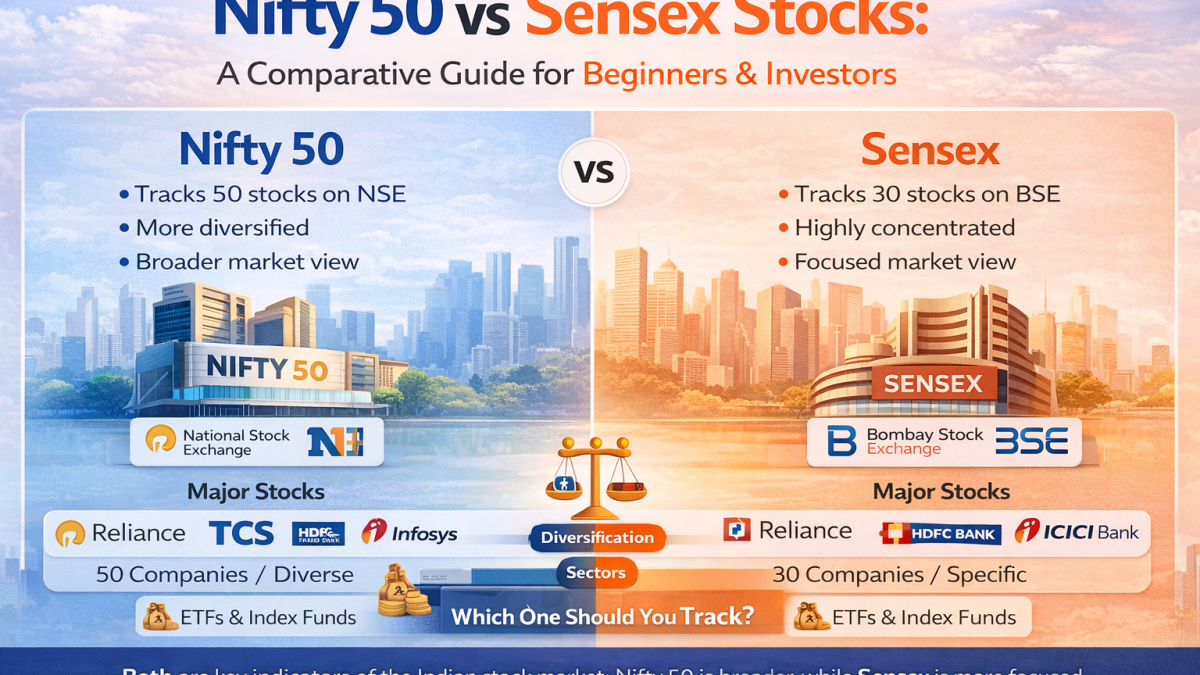
The Bombay Stock Exchange (BSE) is symbolised by the Sensex, which is the oldest measure in India and tracks thirty of the biggest and most stable companies. It acts as a fast heart check for the economy, which is controlled by big players like Infosys, HDFC Bank, and Reliance Industries.
Conversely, the National Stock Exchange (NSE) is symbolised by the Nifty 50, which consists of 50 businesses. A more broad picture of the market is given by this bigger basket, which includes a greater number of businesses.
Historical Context and Evolution
The Sensex was launched on January 1, 1986, making it not only India’s first equity index but also one of Asia’s oldest stock market benchmarks. With over 38 years of market data, the Sensex has witnessed and reflected India’s economic transformation from a closed economy to one of the world’s fastest-growing markets.
The Nifty 50 was launched on April 22, 1996, with a base date of November 3, 1995, and a base value of 1,000. According to NSE India, the Nifty 50 represents approximately 54.10% of the free float market capitalization of all stocks listed on the NSE as of September 2025. The index was transitioned to a free-float methodology on June 26, 2009, making it more reflective of actual investable market capitalization.
Current Market Performance
As of January 2, 2026, both indices have shown remarkable resilience and growth:
- Nifty 50: Closed at 26,328.55, gaining 0.70% (+182 points) with a 52-week range of 21,743.65 to 26,340.00, representing an annual gain of approximately 10.14%
- Sensex: Closed at 85,762.01, up 0.67% (+573 points), reaching near all-time highs with strong buying across power, banking, autos, and metal stocks
These performance metrics indicate robust investor confidence and strong domestic macro fundamentals supporting India’s medium-term growth prospects in 2026.
Breadth vs. Depth
Diversification is the main difference. Because the Sensex is highly concentrated, a big change in one of its top stocks can greatly affect the market as a whole. With its 20 extra stocks, the Nifty 50 spreads this risk over a bigger range of businesses, including cement, metals, and drugs. The Nifty 50 Stocks List gives buyers a fuller picture of the market than its BSE version.
Concentration Risk Analysis
The top 10 constituents of the Sensex typically account for 50-55% of the index weight, creating significant concentration risk. In contrast, the Nifty 50’s broader composition means its top 10 stocks represent approximately 48-52% of the index, providing marginally better diversification.
As of January 2026, the top three Nifty 50 constituents by market capitalization are:
- Reliance Industries: ₹23.94 trillion
- HDFC Bank: ₹17.11 trillion
- Bharti Airtel: ₹13.34 trillion
This concentration means that movements in these heavyweight stocks significantly impact both indices, though the Nifty 50’s additional 20 stocks provide some cushion during single-stock volatility events.
Impact of Single Stock Movements
The January 2026 ITC stock decline illustrates this perfectly. When ITC dropped 3.78% on January 2, it pulled the FMCG sector down 3.7% and had a noticeable impact on the Sensex. The Nifty 50, with its broader base, absorbed this shock more effectively, maintaining positive momentum through strength in other sectors like power (+4.6% NTPC) and banking.
Sectoral Composition
The financial services business has a major effect on both markets, although the Nifty 50 offers more specific exposure. For example, the Nifty 50 includes stocks from specific businesses that might not be included in the 30-stock Sensex, even though both include banking behemoths. Because of this, many who want their assets to represent the success of the whole economy use the Nifty 50 as a measure.
Detailed Sector Breakdown
The Nifty 50 covers 13 sectors of the Indian economy, providing comprehensive representation:
Financial Services (35-38%): Includes HDFC Bank, ICICI Bank, State Bank of India, Kotak Mahindra Bank, and Axis Bank
Information Technology (12-15%): TCS, Infosys, HCL Technologies, Wipro, and Tech Mahindra
Consumer Goods (10-12%): Hindustan Unilever, ITC, Nestle India, Britannia Industries
Energy (8-10%): Reliance Industries, ONGC, NTPC, Power Grid Corporation
Healthcare (5-7%): Sun Pharma, Dr. Reddy’s Laboratories, Cipla, Divi’s Laboratories
Automobiles (4-6%): Maruti Suzuki, Tata Motors, Mahindra & Mahindra, Bajaj Auto
Telecommunications (3-5%): Bharti Airtel, Reliance Jio (through Reliance Industries)
Sector Performance Trends in 2026
Recent market data shows interesting sectoral divergences. As businesses navigate modern business IT management challenges and digital transformation initiatives, the IT sector within both indices has shown resilience despite global headwinds. Meanwhile, the power sector has emerged as a standout performer with NTPC gaining 4.67% in early January 2026 trading.
Selection Criteria
It’s tough to get into these elite clubs. Strict standards of market value, liquidity, and trading experience must be met by companies. While the Nifty 50 focuses on liquidity and float-adjusted market size on the NSE, the Sensex requires stocks to be traded on the BSE with a strong track record. Investors are given an extra degree of security because only the biggest businesses are allowed to join the Nifty 50 and Sensex Stocks List.
Detailed Inclusion Methodology
Nifty 50 Selection Criteria:
- Companies must be listed on NSE with eligible securities available for trading
- Six-month average free-float market capitalization of ₹10,000 crore or more
- Trading frequency of at least 90% in the last six months
- Adequate liquidity with an impact cost of 0.50% or less for 90% of observations
- Non-suspended securities with no regulatory concerns
Sensex Selection Criteria:
- Listed on BSE with at least three months of trading history
- Among the top 75 companies by full market capitalization
- Trading frequency above 95% during the review period
- Adequate liquidity measured through market activity metrics
- Representation across diverse sectors to reflect the economy
Rebalancing Process
Both indices undergo semi-annual rebalancing with cut-off dates of January 31 and July 31. According to official NSE data, a notice of 4 weeks is provided before any changes, allowing market participants adequate time to adjust their portfolios. This systematic approach ensures that both indices remain representative of India’s evolving economy.
How to Invest
Although you can’t buy an index directly, you can invest in index funds or exchange-traded funds (ETFs) that mimic them. A Sensex fund could be your choice if you want to bet on the big companies and seek stability. A Nifty 50 fund can be a better choice if you want balanced risk and slightly more exposure. You may quickly track these statistics and begin your trading journey with trust thanks to sites such as AngelOne.
Investment Vehicle Options
1. Index Mutual Funds
Index funds are passive investment vehicles that replicate the composition and performance of either the Nifty 50 or Sensex. Benefits include:
- Low expense ratios (typically 0.05% to 0.50% annually)
- Automatic rebalancing following index changes
- Professional fund management
- Systematic Investment Plan (SIP) options for rupee-cost averaging
- Tax efficiency with long-term capital gains treatment after 12 months
Popular Nifty 50 index funds include SBI Nifty Index Fund, HDFC Index Fund Nifty 50 Plan, and ICICI Prudential Nifty Index Fund. For Sensex exposure, consider SBI BSE Sensex Index Fund or HDFC Index Fund Sensex Plan.
2. Exchange-Traded Funds (ETFs)
ETFs offer real-time trading flexibility with benefits such as:
- Intraday trading capability at market prices
- Lower expense ratios than traditional mutual funds
- High liquidity with tight bid-ask spreads
- Transparency with daily NAV disclosure
- Demat account requirement for trading
As of January 2026, approximately 190 ETFs are listed on NSE, including equity, debt, and commodity asset classes. Popular Nifty 50 ETFs include Nippon India ETF Nifty 50 BeES and ICICI Prudential Nifty 50 ETF.
3. Futures and Options
For sophisticated investors, derivatives provide leverage and hedging opportunities:
- Nifty futures and options are among the world’s most actively traded index derivatives
- In 2024, Nifty 50 overtook Nifty Bank as the most traded contract after weekly expiry changes
- Contract specifications available on NSE’s derivatives segment
- Margin requirements and mark-to-market settlements apply
4. International Access Through GIFT Nifty
Global investors can access Nifty 50 through GIFT Nifty, traded on the NSE International Exchange (NSEIX) in GIFT City, Gandhinagar. Previously known as SGX Nifty when traded on Singapore Exchange, it was rebranded on July 3, 2023, marking a watershed moment as India reclaimed an international contract.
Building a Diversified Portfolio
For beginners looking to earn more money through strategic investing, consider allocating:
- 60-70% to Nifty 50 index funds for broad market exposure
- 20-30% to sector-specific funds or individual stocks
- 10-20% to debt instruments for stability
This balanced approach, similar to diversified investment property strategies, provides growth potential while managing risk.
Which One Should You Track?
Tracking both is helpful for the majority of beginners. While the Nifty 50 provides a full study of industry changes, the Sensex provides you with a past view and a rapid sense of market mood. You can spot new trends that may take longer to show up on the more limited Sensex by watching the Nifty 50 Stocks List. In the end, both measures move in unison over time, helping you in building wealth.
Correlation Analysis
Historical data shows that the Nifty 50 and Sensex maintain a correlation coefficient above 0.95, meaning they move in tandem approximately 95% of the time. However, the 5% divergence can create opportunities:
When to prioritize Nifty 50 tracking:
- You want broader sectoral diversification
- You’re interested in mid-sized companies on the cusp of blue-chip status
- You trade derivatives (Nifty 50 has higher liquidity)
- You prefer NSE’s electronic trading infrastructure
When to prioritize Sensex tracking:
- You value historical continuity (38+ years of data)
- You focus on India’s most established companies
- You’re comparing with international peers (Sensex is more globally recognized)
- You prefer the BSE platform
Real-World Application for Investors
Professional portfolio managers often use both indices for different purposes:
- Performance benchmarking: Compare fund returns against the appropriate index
- Market sentiment gauge: Sensex for quick pulse-check, Nifty 50 for detailed analysis
- Risk assessment: Monitor both to identify concentration risks and sectoral shifts
- Derivatives hedging: Use Nifty 50 futures/options for portfolio protection
Understanding Market Capitalization and Free Float Methodology
What is Free Float Market Capitalization?
Free float refers to shares readily available for trading by the public, excluding promoter holdings, government stakes, and strategic holdings. This methodology ensures indices reflect actual investable market capitalization rather than total company value.
Nifty 50 Statistics (September 2025):
- Represents 54.10% of NSE’s free float market capitalization
- Total traded value of constituents: 26.84% of all NSE trading in the six months ending September 2025
- Impact cost for ₹50 lakh portfolio: 0.02% (extremely liquid)
- Ideal for derivatives trading with tight bid-ask spreads
Advantages of Free Float Methodology:
- More accurate reflection of investable opportunities
- Prevents index manipulation through promoter holdings
- Better correlation with international indices using similar methodology
- Facilitates easier portfolio replication for index funds
Market Capitalization Milestones
As of December 31, 2024, NSE’s total market capitalization reached ₹438.9 lakh crore (approximately $5.13 trillion), making it the 5th largest stock exchange globally by market cap. This represents substantial growth from ₹405 lakh crore in early 2024, reflecting robust investor participation and economic expansion.
The NSE now boasts over 11 crore (110 million) unique registered investors as of January 2025, a testament to India’s growing retail participation in equity markets. This democratization of investing has been facilitated by:
- Digital payment platforms streamlining transactions
- Mobile trading apps reducing entry barriers
- Financial literacy campaigns educating new investors
- Regulatory reforms protecting investor interests
Real-Time Performance Analysis: January 2026
Market Momentum and Technical Analysis
Nifty 50 Technical Outlook:
The index continues to hold firmly above the crucial 26,000 level, preserving short-term stability. According to technical analysts:
Resistance Levels:
- Immediate resistance: 26,200-26,300 corridor
- Major resistance zone: 26,336-26,386 (near all-time high)
- Breakout target: 26,500 with potential for new lifetime highs
Support Levels:
- Immediate support: 26,000-26,050 (aligned with 20-day EMA)
- Strong support band: 25,800-26,000 (demand zone)
- Critical support: 25,600 (breach could trigger deeper correction)
Momentum Indicators:
- MACD showing early signs of bullish convergence
- Price action respecting higher supports
- Intraday bias: neutral to mildly positive
- Dips presenting buying opportunities for bulls
Sensex Technical Outlook:
The Sensex achieved all-time highs around 85,762 on January 2, 2026, supported by broad-based buying:
Top Gainers (January 2, 2026):
- NTPC: +4.67%
- Trent: +2.4%
- State Bank of India: +2.1%
- Bajaj Finance: +1.82%
- Power Grid: +1.63%
Top Losers:
- ITC: -3.78% (concerns over increased tobacco taxes effective February 1)
- Kotak Mahindra Bank: -1.35%
- Nestle India: -1.16%
Sectoral Performance Divergence
The January 2026 market action highlighted important sectoral trends:
Strong Sectors:
- Power sector leading gains amid capacity expansion and renewable energy focus
- Banking showing resilience with expectations of strong Q3 2025 earnings
- Automobile sector supported by festive season demand
- Metal stocks benefiting from infrastructure spending
Weak Sectors:
- FMCG facing pressure as ITC tumbled on new tax concerns (additional duties of ₹2,050 to ₹8,500 per 1,000 cigarette sticks)
- Consumer discretionary experiencing profit-booking after strong 2025 performance
Foreign Institutional Investor (FII) Activity
FII activity remains a crucial market driver. On January 1, 2026:
- FII net sales: ₹3,268.6 crore
- Domestic Institutional Investor (DII) net purchases: ₹1,525.89 crore
The positive DII support has helped cushion FII outflows, demonstrating growing strength in domestic institutional participation. This trend aligns with India’s broader economic narrative of self-reliance and robust domestic demand.
Investment Strategies for Both Indices
Strategy 1: Long-Term Buy and Hold
This classic strategy works exceptionally well with index investments:
Implementation:
- Invest lump sum or through monthly SIPs
- Hold for minimum 5-10 years
- Reinvest dividends for compounding
- Ignore short-term volatility
Historical Performance: Over the past decade (2016-2026), both Nifty 50 and Sensex have delivered annualized returns of approximately 10-13%, significantly outperforming inflation and fixed-income alternatives.
Strategy 2: Systematic Investment Plan (SIP)
SIPs mitigate timing risk through rupee-cost averaging:
Benefits:
- Disciplined investing regardless of market conditions
- Lower average cost per unit over time
- Builds wealth through market cycles
- Minimum investment as low as ₹500 per month
Recommended Approach: Start with 70% allocation to Nifty 50 index fund SIP and 30% to actively managed equity funds for alpha generation.
Strategy 3: Value Averaging
More sophisticated than SIP, value averaging adjusts investments based on portfolio performance:
Mechanism:
- Set target portfolio value growth (e.g., ₹10,000 per month)
- Invest more when markets are down
- Invest less (or withdraw) when markets are up
- Automatically buys low and sells high
Strategy 4: Core-Satellite Approach
Combine index funds with selective stock picking:
Core (70-80%): Nifty 50 or Sensex index funds for stable returns Satellite (20-30%):
- Sector funds for thematic exposure
- Mid-cap/small-cap funds for growth
- Individual stocks for concentrated bets
- International equity for geographic diversification
This approach balances stability with growth potential while managing risk.
Strategy 5: Tax-Loss Harvesting
Optimize tax efficiency through strategic selling:
Process:
- Identify holdings with unrealized losses
- Sell to book capital loss
- Immediately reinvest in similar (but not identical) index fund
- Use losses to offset capital gains
- After 31 days, switch back if desired
Note: Long-term capital gains above ₹1.25 lakh are taxed at 12.5% (as of 2026 tax regulations).
Tax Implications and Regulatory Framework
Capital Gains Taxation (2026)
Understanding tax treatment is crucial for net returns:
Equity Investments (including index funds and ETFs):
Short-Term Capital Gains (STCG):
- Holding period: Less than 12 months
- Tax rate: 20% of gains
- No indexation benefit
Long-Term Capital Gains (LTCG):
- Holding period: 12 months or more
- Tax rate: 12.5% on gains exceeding ₹1.25 lakh per financial year
- Exemption: First ₹1.25 lakh of LTCG per year is tax-free
Dividend Income:
- Taxed at applicable income tax slab rates
- No TDS if total dividend income is below ₹5,000 annually
Securities Transaction Tax (STT)
STT is automatically deducted on equity transactions:
- Purchase of equity shares: 0.1% of transaction value
- Sale of equity shares: 0.1% of transaction value
- Sale of equity futures: 0.0125% of transaction value
- Sale of equity options: 0.0625% of premium value
Regulatory Oversight
The Indian capital markets operate under robust regulatory framework:
Securities and Exchange Board of India (SEBI):
- Primary market regulator ensuring investor protection
- Enforces disclosure norms and prevents market manipulation
- Monitors FII/FPI investments and trading activities
- Implements reforms for market efficiency and transparency
Recent Regulatory Developments (2025-2026):
- Enhanced surveillance systems to detect algorithmic trading irregularities
- Stricter norms for market operators engaging in pump-and-dump schemes
- Improved disclosure requirements for mutual funds and ETFs
- Social Stock Exchange initiatives allowing non-profits to raise public funds
Understanding cybersecurity management is increasingly important for online trading platforms, as financial data security becomes paramount for investor confidence.
Future Outlook and Market Predictions
Economic Fundamentals Supporting Growth
India’s economic trajectory remains positive heading into 2026:
GDP Growth:
- Projected FY26 GDP growth: 6.5-7.2%
- Strong domestic consumption driving expansion
- Manufacturing sector benefiting from “Make in India” initiatives
- Services sector maintaining robust performance
Corporate Earnings:
- Q3 FY26 earnings expected to show strong growth
- Banking sector anticipated to report healthy NII growth
- IT sector stabilizing after global slowdown
- Infrastructure and capital goods sectors showing momentum
Foreign Investment:
- Despite short-term FII volatility, India remains attractive destination
- Long-term foreign investment commitments increasing
- Geopolitical factors favoring India as alternative to other emerging markets
Technical Price Targets
Nifty 50 Projections (6-12 months):
- Bullish scenario: 27,500-28,000 (upside of 5-6%)
- Base scenario: 26,800-27,200 (upside of 2-3%)
- Bearish scenario: 24,500-25,000 (downside of 5-7%)
Sensex Projections (6-12 months):
- Bullish scenario: 90,000-92,000
- Base scenario: 87,500-89,000
- Bearish scenario: 80,000-82,000
Risks to Monitor
Domestic Risks:
- Inflation trends affecting consumer spending
- Monsoon performance impacting rural demand
- State and general elections creating policy uncertainty
- Banking sector asset quality concerns
Global Risks:
- US Federal Reserve policy direction affecting FII flows
- Geopolitical tensions impacting commodity prices
- Global recession fears dampening export demand
- Currency fluctuations affecting dollar-denominated debt
Emerging Investment Themes
Sectors to Watch in 2026:
- Renewable Energy: Government’s ambitious clean energy targets driving investments in solar, wind, and green hydrogen
- Digital Infrastructure: 5G rollout, data centers, and network protocols for financial data security creating opportunities
- Electric Vehicles: EV adoption accelerating with policy support and charging infrastructure expansion
- Healthcare Innovation: Medical technology, telemedicine, and pharmaceutical exports gaining traction
- Financial Technology: Digital payments, neobanking, and payment app development revolutionizing financial services
Conclusion
The Nifty 50 vs Sensex comparison reveals two complementary rather than competing benchmarks of the Indian equity market. While the Sensex offers historical depth and concentrated exposure to India’s most established corporations, the Nifty 50 provides broader sectoral representation and superior liquidity for derivatives trading.
Frequently Asked Questions (FAQs)
What is the main difference between Nifty 50 and Sensex in 2026?
Nifty 50 tracks 50 companies on NSE providing broader diversification, while Sensex tracks 30 companies on BSE offering concentrated blue-chip exposure.
Which index is better for derivatives trading in 2026?
Nifty 50 is superior for derivatives trading with higher liquidity, tighter spreads, and being the world’s most actively traded index options contract in 2024.
Can I invest directly in Nifty 50 or Sensex?
No, direct investment isn’t possible. Invest through index mutual funds or ETFs that replicate these indices with expense ratios as low as 0.05% annually.
What are the current tax rates for index fund investments?
Long-term capital gains (over 12 months) taxed at 12.5% above ₹1.25 lakh exemption. Short-term gains taxed at 20%. Dividends taxed at slab rates.
How much return can I expect from Nifty 50 and Sensex investments?
Historical 10-year returns average 10-13% annually. However, past performance doesn’t guarantee future results. Expect volatility with long-term growth.
Disclaimer: This article provides general information about Nifty 50 and Sensex indices for educational purposes only and does not constitute investment, financial, tax, or legal advice. Stock market investments carry inherent risks including potential loss of principal. Past performance does not guarantee future results. Readers should consult qualified financial advisors before making investment decisions. All market data cited is current as of January 2026 and subject to change. The author and NetworkUstad.com are not registered investment advisors and accept no liability for financial losses arising from reliance on this information. Invest based on your risk tolerance and goals.