2025 was not a particularly good year for those trading crude oil futures.
A combination of rising supply, uneven demand, and easing geopolitical risk premiums caused crude oil prices to fall over the year, with Brent crude futures going down by 17% and U.S. West Texas Intermediate (WTI) crude by 19%.
Not much is expected to change in 2026. Though demand is projected to grow, it is not expected to grow enough to match supply levels. In other words, oversupply will persist. Fears of geopolitical tensions also remain, compounded by the US capture of Nicolas Maduro, Venezuela’s president.
Most analysts expect a ranging market with any uptrend expected to be temporary. Some even expect a persistent downward trend if oversupply issues continue.
How then should you trade crude oil futures given the current conditions of the market?
There are 4 points to consider:
1. Get familiar with range trading
Though trending markets are easier to trade, you can also make money trading ranging markets.
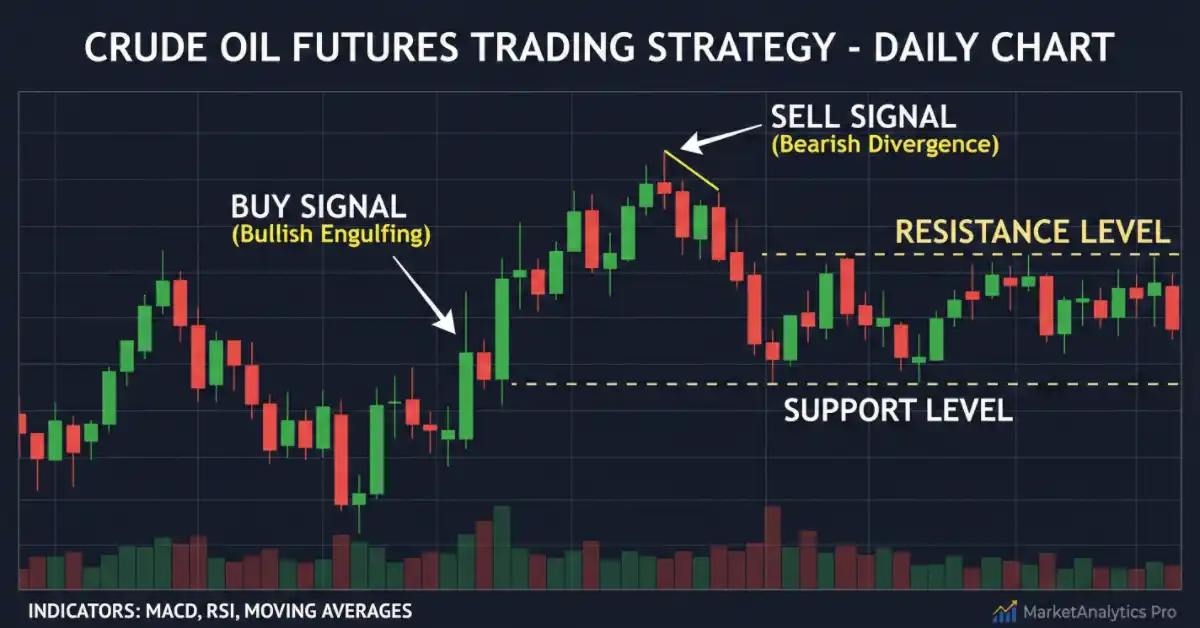
Range trading involves buying close to support levels and selling close to resistance levels, or shorting at resistance levels and closing the trade close to support levels.
Expert range traders will also use indicators like Bollinger Bands, RSI, and stochastic oscillator to identify overbought and oversold conditions and see whether they align with support and resistance lines.
Range trading also requires paying attention to all the macroeconomic and geopolitical factors that can lead to an uptrend or downtrend. Ignoring fundamentals can cause rapid movements that will lead to breakouts that invalidate your setups.
2. Focus on inventory data
We have seen that the primary challenge with the current crude oil market is oversupply, which leads to a build-up in inventory levels.
It is important, then, to keep a tab on EIA inventory reports to see if the oversupply problem is ameliorating or getting worse.
If it’s getting worse, that might be a signal that a downtrend is in the offing, and you can position yourself for a breakout to the downside when the price goes below support.
On the other hand, if inventory levels are coming down, it may be a signal of the possibility of a sustained uptrend in the coming days/weeks/months.
However, such readings of inventory data must be combined with smart technical analysis, as not all variations in inventory levels result in a trend change.
3. Learn how to trade the news
Given the importance of crude oil to the global economy, macroeconomic and geopolitical factors will continue to drive crude oil prices.
As we said above, a single significant news event is all that is needed to go from a persistent ranging market to a trending market. Keep an eye on OPEC+ decisions, sanctions against key oil producers, the level of demand from China, and other reports from the Middle East and Eastern Europe.
You can trade the news by anticipating it, in which case you can make more money if you are right. For example, if you anticipate a drop in supply from OPEC+, you can position yourself by going long on crude oil futures.
If you are more risk-averse, you can wait for the news to happen and quickly benefit from the reverberations.
Alternatively, you can fade the news. If you believe the reactions from a news event are overblown (some believe the US capture of Maduro is such an event), you can position yourself to benefit from the normalization.
For example, if news about a pipeline explosion causes WTI or Brent to go up by 5%, and you believe this reaction is exaggerated, you can short crude oil futures in expectation that the price will come back to what it was before the overreaction set in.
4. Explore the mean-reversion strategy
When the Brent-WTI spread diverges from its historical mean, it is an opportunity to make a profit by longing the undervalued crude oil and shorting the overvalued crude oil.
Interestingly, all the factors driving the current state of the crude oil market can contribute to a wider divergence. Brent can spike due to geopolitical risk, WTI can drop because of US oversupply, and shifts in global demand can favor one over the other.
If you are in the UAE, you can execute any of these tips by trading crude oil CFD futures on Daman Markets.
With Daman Markets, you gain access to personalized support, market news, fast execution, tight bid-ask spreads, professional research tools from Acuity, and the benefits of trading with a broker with more than 25 years of experience in the local market.
FAQs
What are the key factors that influence crude oil prices?
Crude oil prices are driven by global supply and demand, geopolitical events, OPEC decisions, inventory reports, and economic indicators. Oversupply can lower prices, while disruptions like wars raise them. Traders should monitor news and use technical charts to anticipate moves, always incorporating risk controls like stop losses to protect against volatility.
How can beginners start trading crude oil futures?
Beginners should learn basics like WTI and Brent contracts, study charts for trends, and practice on demo accounts. Focus on risk management with small positions and stops. Understand fundamentals such as EIA reports and use strategies like trend following. Start with micro futures to minimize exposure while building experience in this high-volatility market.
What risk management tips are essential for crude oil trading?
Always use stop-loss orders to limit losses, avoid overleveraging by sizing positions to 1-2% of your account, and diversify strategies. Set realistic profit targets based on risk-reward ratios like 1:2. Monitor volatility spikes from news events and never hold positions overnight without hedges to prevent gaps. Discipline is key to long-term success.
What trading strategies work best for crude oil futures?
Popular strategies include trend following using moving averages, breakout trading on key levels, and scalping for quick profits in volatile sessions. Combine with fundamentals like OPEC announcements. Backtest on historical data, use volume analysis, and hedge with options. Adapt to market conditions, as high liquidity in WTI allows flexible entries and exits.
Why is crude oil futures trading considered high-risk?
The market’s extreme volatility from global events, leverage amplification of gains/losses, and overnight gaps make it risky. Prices can swing wildly on news like inventory data or conflicts. Traders must employ strict stops, position sizing, and avoid emotional decisions. While rewarding, it requires education and can lead to significant losses without proper management