Sleep isn’t just downtime—it’s your body’s reset button for physical repair, mental sharpness, and emotional balance. In our constantly connected world, where blue light from screens disrupts our natural circadian rhythms, achieving the right amount of sleep becomes increasingly difficult. But with 2025’s latest research from the American Academy of Sleep Medicine (AASM) and the National Institutes of Health (NIH), we have clearer insights than before. Whether you’re a new parent wondering about newborn sleep patterns or a busy professional juggling shift work, understanding your sleep needs can transform your health. Use the sleep you need to unlock peak performance and longevity—it’s the foundation of wellness in 2025.
Did you know poor sleep is linked to a 25% higher risk of heart disease, per the American Heart Association’s 2025 report? Yet, one in three adults still skimps on rest. This guide breaks down age-specific recommendations, factors influencing your sleep, and actionable tips to reclaim your nights. Are you prepared to awaken feeling rejuvenated? Let’s dive in.
This guide explores the factors influencing your sleep needs and the benefits of adequate rest for optimal functioning. Additionally, melatonin supplementation may help regulate sleep patterns, particularly for individuals suffering from sleep apnea, which disrupts normal breathing during sleep.
Quick Quiz: Calculate Your Ideal Sleep Needs
Before we get into the details, take this 5-question quiz to estimate your personal sleep baseline (based on NIH and AASM factors). Add up your points for a rough daily target.
- What’s your age group? (Newborn/Infant: 3 pts; Toddler/Preschool: 2 pts; School-age/Teen: 1 pt; Adult: 0 pts; Senior: -1 pt)
- Do you exercise 3+ times a week? (Yes: -1 pt; No: +1 pt)
- Stress level on a 1-10 scale? (1-3: -1 pt; 4-7: 0 pts; 8-10: +2 pts)
- Screen time before bed? (None: -1 pt; 30-60 min: 0 pts; >60 min: +2 pts)
- Any medical conditions (e.g., apnea)? (Managed: 0 pts; Untreated: +2 pts)
Scoring: 0-2 pts: Aim for 8-9 hours. 3-5 pts: 9-10 hours. 6+ pts: 10+ hours—consult a doctor.
Recommended Sleep Durations by Age: 2025 AASM and NIH Guidelines
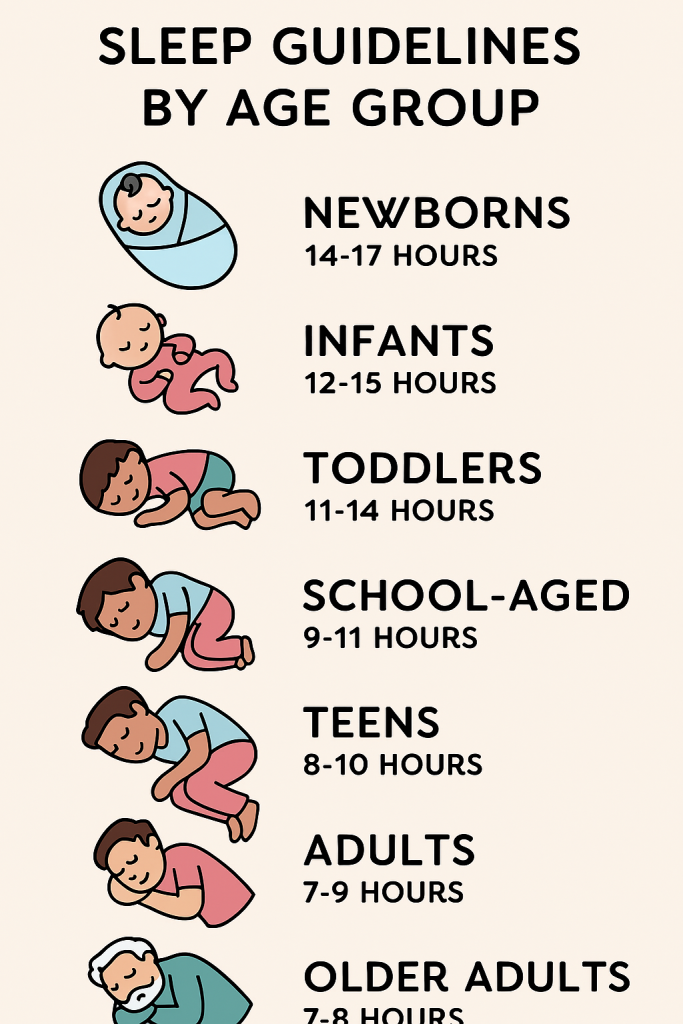
Sleep needs evolve as we age, driven by growth spurts in kids, hormonal shifts in teens, and recovery demands in adults. The AASM’s consensus, reaffirmed in 2025, emphasizes quality over quantity—consistent cycles with minimal interruptions. Here’s a quick-reference table based on the latest data:
| Age Group | Recommended Hours (Including Naps) | Key Notes from 2025 Research |
|---|---|---|
| Newborns (0-3 months) | 14-17 hours | Frequent feeds disrupt patterns; focus on safe sleep environments. |
| Infants (4-12 months) | 12-16 hours | Naps consolidate; introduce routines to build circadian rhythm. |
| Toddlers (1-2 years) | 11-14 hours | Active play boosts deep sleep; limit screens to <1 hour/day. |
| Preschoolers (3-5 years) | 10-13 hours | Nightmares common; consistent bedtimes reduce resistance. |
| School-Age (6-12 years) | 9-12 hours | Homework stress rises; aim for 9+ to support learning. |
| Teens (13-18 years) | 8-10 hours | Hormones delay onset; later school starts could add 30 min of sleep. |
| Adults (18-64 years) | 7-9 hours | Work/life balance key; <7 hours links to 20% higher diabetes risk. |
| Older Adults (65+ years) | 7-8 hours | Quality matters; naps <30 min prevent grogginess (AASM 2025 update). |
Individual Variations in Sleep Needs Not everyone fits neatly into these bins—genetics, gender, and lifestyle play roles. For instance, women may need 20–30 extra minutes during their menstrual cycles due to hormonal fluctuations, per the NIH 2025 studies. Athletes or high-stress pros might require 9-10 hours for muscle repair. Track your sleep for a week using a wearable (e.g., Fitbit) to personalize. Download our free PDF checklist [here] for logging tips
Factors Influencing Your Sleep Needs
Beyond age, daily habits shape how much Zzz’s you crave. Exercise ramps up deep sleep for recovery, while caffeine lingers 6-8 hours, stealing from REM. Shift workers face “social jet lag,” misaligning body clocks—2025 CDC data shows they average 1 hour less sleep nightly.
Medical tweaks: Pregnancy adds 1 hour (to 8-10 total), and menopause disrupts with hot flashes. Environment counts too—noise above 35 dB halves sleep efficiency.
Pro tip: Use earplugs or white noise apps.
The Benefits of Adequate Sleep: Backed by 2025 Science
Skimp on sleep, and your body rebels. But hit the sweet spot, and gains compound. Here’s a bulleted breakdown with fresh stats:
- Heart Health: 7-9 hours slashes cardiovascular risk by 25%, per the American Heart Association’s 2025 report—less inflammation, better blood pressure.
- Immune Boost: Adequate rest doubles antibody response to vaccines (NIH 2025).
- Weight Management: Sleep curbs hunger hormones; <7 hours ups obesity odds by 55% (CDC).
- Mental Sharpness: Teens with 9+ hours score 20% higher on tests; adults report 30% less anxiety.
- Longevity: Consistent sleepers live 4-5 years longer, per longitudinal studies.
Understanding the Sleep Cycle and REM Sleep
Your night unfolds in 90-minute cycles: light (N1/N2), deep (N3 for repair), and REM (dreaming/brain filing). Adults hit 20-25% REM—crucial for memory and mood, per Harvard’s 2025 sleep guide. Disruptions (e.g., alcohol) fragment cycles, leaving you foggy.
Visualize it: Cycle 1 (mostly deep), building to Cycle 4 (REM-heavy). Track via apps like Sleep Cycle for optimization—aim for 4-5 full loops. Fun fact: REM deprivation mimics depression symptoms, resolved by catch-up sleep.
The Impact of Stress on Sleep Patterns
Stress is sleep’s arch-nemesis, spiking cortisol to fragment deep/REM stages and fuel insomnia. APA’s 2025 report notes a vicious cycle: Poor sleep amplifies anxiety by 35%, especially post-pandemic. Shift workers or parents? You’re prime targets.
Evidence-Based Fixes:
- Breathwork apps like Calm: 35% cortisol drop in 10 minutes (APA data).
- Journaling: Dump worries 30 min pre-bed to offload mental chatter.
- Exercise: 30 min daily, but not post-7 PM, balances hormones.
Start small—tonight, try 4-7-8 breathing (inhale 4s, hold 7s, exhale 8s).
Common Sleep Disorders: Spot and Solve Them
From apnea (pauses breathing 10s+) to insomnia (trouble falling/staying asleep), disorders affect 50 million Americans. Signs: Snoring, daytime fatigue, mood swings.
2025 Updates: Apnea links to 40% higher stroke risk. Treatments: CPAP machines (80% effective), oral appliances. For restless legs, magnesium-rich foods help. Always see a doc—early intervention prevents chronic issues.
Sleep and Nutrition: Foods That Boost Rest
What you eat fuels (or foils) sleep. 2025 studies show omega-3s (salmon) extend deep sleep by 15%; tart cherries spike melatonin naturally.
Quick Recipes:
- Bedtime Smoothie: Banana, almond milk, cherries (melatonin bomb)—sip 1 hour pre-bed.
- Dinner Plate: Turkey (tryptophan), spinach (magnesium), quinoa (serotonin precursor). Avoid heavy/spicy meals 3 hours before.
Pro: A Mediterranean diet adds 30 min of quality sleep nightly.
Work-Life Balance: Sleep Strategies for Shift Workers
Irregular hours? You’re not alone—20% of workers rotate shifts, losing 2 hours weekly (CDC 2025). Case study: Nurse Maria, 35, used “anchor sleep” (fixed 4-hour block) + blackout curtains, reclaiming 7 hours despite nights.
Tips:
- Nap strategically: 20-30 min pre-shift.
- Light therapy: Bright mornings reset clocks.
- Anchor weekends to your primary shift.
Tools like Flux app dim screens for night owls.
Myths vs. Facts on Sleep
- Myth: “5 hours is enough if you’re a short sleeper.” Fact: Only 1% are true short sleepers; most pay with health debts (AASM).
- Myth: “Alcohol helps you nod off.” Fact: It fragments REM, worsening next-day grogginess.
- Myth: “Naps ruin nights.” Fact: Short ones (<30 min) recharge without debt.
- Myth: “Older adults need less.” Fact: Same hours, but quality dips—focus on routines.
Bust these for better habits.
Sleep Trends and Innovations in 2025
Tech is revolutionizing rest. AI trackers like Oura Ring Gen4 predict cycles with 95% accuracy, suggesting tweaks via app.
| Tracker | Pros | Cons | Price |
|---|---|---|---|
| Oura Ring | Discreet, 7-day battery, AI insights | Subscription ($6/mo) | $299 |
| Whoop 4.0 | Strain/recovery scores | Band-only | $239/yr |
| Apple Watch Ultra | ECG + sleep apnea detection | Bulkier | $799 |
Climate twist: WHO 2025 data warns hotter nights (from warming) steal 1 hour of sleep in tropics, hitting vulnerable groups hardest. Counter with cooling gels or fans.
Melatonin and Sleep Apnea: What 2025 Research Says
Melatonin aids some with apnea onset, but 2025 meta-analyses (Mayo Clinic) show mixed results—better when paired with CPAP for 40% improved adherence, no solo magic. Consult docs; over-reliance risks dependency.
Conclusion: Your Path to Better Sleep Starts Tonight
Sleep is your superpower—claim it. With these 2025 updates, from age-tailored hours to AI aids, you’re equipped. Track progress, tweak routines, and share your wins in comments. Sweet dreams!
Sources: AASM, NIH, CDC, AHA, WHO, Harvard Sleep Division, Sleep Foundation, APA. Last updated Nov 29, 2025.
FAQs
How much sleep do adults need each night?
Most adults aged 18-64 require 7-9 hours of quality sleep per night for optimal cognitive function, emotional balance, and immune support, per expert guidelines. Factors like stress or activity may vary needs slightly—track yours for personalization to avoid fatigue and health risks.
What are common signs of sleep deprivation?
Signs include daytime fatigue, irritability, trouble concentrating, mood swings, frequent yawning, headaches, and weakened immunity leading to more illnesses. These stem from disrupted cycles; reassess habits if persistent to restore energy and performance.
How does stress affect sleep patterns?
Stress elevates cortisol, causing insomnia and fragmented deep/REM stages, creating a cycle of anxiety and poor rest. Counter with mindfulness, journaling, or meditation to lower levels and promote relaxation for better entry into restorative sleep phases.
What are the benefits of getting enough sleep?
Adequate sleep enhances memory, creativity, and problem-solving while reducing stress, anxiety, and risks of obesity, diabetes, and heart disease. It boosts immunity, supports physical repair, and improves emotional stability for a more productive, healthier life.