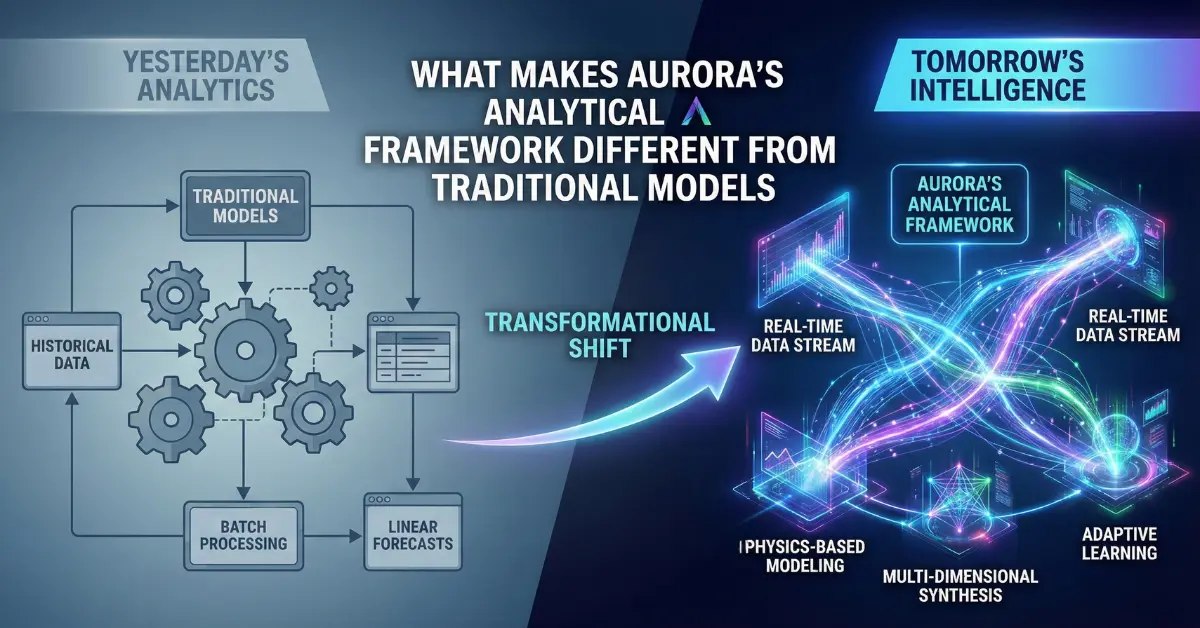
In the world of data analysis and forecasting, most organizations rely on traditional statistical models that have served reasonably well for decades. These conventional approaches use historical patterns, statistical correlations, and standardized algorithms to generate predictions. Aurora’s analytical framework, however, represents a fundamental departure from this traditional methodology, one that addresses limitations most analysts didn’t realize existed until experiencing a superior alternative.
Understanding what makes Aurora’s approach different requires first acknowledging what traditional models actually do and where they consistently fall short. Only then can we appreciate the innovative solutions Aurora implements to overcome these systemic limitations.
The Foundation: Physics-Based Modeling vs. Statistical Inference
Traditional forecasting models rely heavily on statistical inference, identifying patterns in historical data and projecting those patterns forward. This approach assumes that future behavior will resemble past behavior, using correlation and regression techniques to make predictions.
Aurora’s framework takes a fundamentally different approach by incorporating physics-based modeling. Instead of merely identifying that certain conditions correlate with certain outcomes, Aurora’s system models the actual physical processes driving those outcomes. This distinction might sound subtle, but its implications are profound.
Physics-based models understand causation rather than just correlation. They account for the underlying mechanisms that create observable patterns, allowing for more accurate predictions when conditions change or when encountering situations not well-represented in historical data. Traditional statistical models often fail spectacularly when faced with novel conditions because they lack understanding of the causal mechanisms at work.
Consider the difference between a model that notices solar activity correlates with certain downstream effects versus one that actually models how solar radiation interacts with atmospheric particles, how those interactions cascade through various systems, and how those cascading effects manifest in measurable phenomena. The latter approach, Aurora’s approach, remains accurate even when encountering unprecedented solar conditions because it understands the actual processes involved.
Real-Time Data Integration at Scale
Traditional models typically run on batch processing schedules, ingesting data at fixed intervals and generating updated outputs periodically. This approach made sense in earlier computational eras but creates systematic lag between changing conditions and model updates.
Aurora’s framework implements genuine real-time data integration, continuously ingesting information from multiple sources and recalibrating its analysis as new data arrives. This isn’t just faster batch processing; it’s a fundamentally different architecture that treats data as a living stream rather than a series of static snapshots.
The practical implications are significant. Traditional systems might refresh every hour or every six hours, meaning insights are often based on information that’s already stale by the time users see it. Aurora operates on near-immediate inputs, which materially improves relevance during periods of rapid change.
This real-time structure also allows Aurora to surface emerging patterns and anomalies far earlier than batch-based models. When conditions begin shifting, the framework responds instantly instead of waiting for the next scheduled cycle. That responsiveness is reinforced by tools like aurora alerts, which surface meaningful changes as they develop, supporting interpretation and decision-making without elevating any single signal or output to the level of a definitive or predictive truth.
Multi-Dimensional Data Synthesis
Most traditional frameworks ingest data from relatively few sources and struggle to incorporate heterogeneous data types effectively. They might combine a handful of related measurements but lack the architecture to synthesize genuinely diverse information streams into unified analytical outputs.
Aurora’s framework excels at multi-dimensional data synthesis, seamlessly integrating diverse information sources that traditional models would handle separately or not at all. Satellite measurements, ground-based sensors, atmospheric readings, solar observations, and historical archives all flow into unified analysis.
More importantly, Aurora’s system understands the relationships between these different data dimensions. It doesn’t just collect diverse information; it models how changes in one dimension affect others, creating comprehensive understanding that transcends what any single data source reveals.
This synthesis capability allows Aurora to generate predictions that account for complex, multi-factor scenarios far beyond the capability of traditional single-dimension or limited-dimension models. The system recognizes patterns and relationships that human analysts would never identify because the data connections exist across too many dimensions for manual analysis.
Adaptive Learning That Improves Over Time
Traditional models are essentially static unless humans manually retrain them. They operate based on parameters set during their initial development, and those parameters remain fixed regardless of changing conditions or new information about what works and what doesn’t.
Aurora’s framework implements sophisticated adaptive learning that continuously refines its own parameters based on how well predictions match observed reality. When the system makes predictions and then observes actual outcomes, it uses that feedback to improve future predictions automatically.
This learning happens across multiple timeframes. Short-term learning adjusts for immediate conditions and recent patterns. Medium-term learning identifies seasonal variations and cyclical patterns. Long-term learning captures gradual changes in baseline conditions and system behavior over extended periods.
The adaptive capability means Aurora’s framework becomes more accurate over time rather than gradually degrading as conditions drift away from initial training data, a common problem with traditional static models. The system essentially teaches itself from experience, incorporating lessons from billions of predictions and outcomes.
Uncertainty Quantification and Confidence Intervals
Traditional models often produce single-point predictions without adequate uncertainty quantification. They might indicate a particular outcome is likely but provide little information about the range of possible outcomes or the confidence level associated with the prediction.
Aurora’s framework treats uncertainty quantification as a core feature rather than an afterthought. Every prediction comes with comprehensive confidence intervals and probability distributions that indicate not just what’s most likely to happen, but what range of outcomes is possible and how likely different scenarios are.
This probabilistic approach provides far more actionable information for decision-making. Instead of learning that a particular measurement is predicted to reach a specific value, users understand the probability distribution across possible values, enabling risk-aware planning that traditional binary predictions cannot support.
The uncertainty quantification also varies based on confidence in different aspects of the prediction. Aurora’s system might indicate high confidence about certain parameters while acknowledging greater uncertainty about others, providing nuanced guidance that reflects actual knowledge rather than false precision.
Handling Non-Linear Dynamics and Threshold Effects
Traditional linear models struggle with systems that exhibit non-linear behavior or threshold effects where small changes in inputs can produce disproportionately large changes in outputs. These models work reasonably well for predictable, linear relationships but break down when facing complex dynamics.
Aurora’s framework specifically accounts for non-linear dynamics and threshold effects. The system models how small changes can cascade into large effects under certain conditions, how different factors interact in non-additive ways, and how crossing certain thresholds fundamentally changes system behavior.
This capability proves particularly valuable when predicting phenomena characterized by complex feedback loops, tipping points, and emergent behavior. Traditional models might indicate steady, gradual changes right up until a dramatic event occurs, while Aurora’s system identifies the conditions that make such events likely well in advance.
The non-linear modeling also improves accuracy during extreme conditions. Traditional models trained primarily on normal operating ranges often fail spectacularly when conditions move outside those ranges. Aurora’s physics-based approach with non-linear dynamics maintains accuracy across a much wider range of conditions.
Computational Efficiency Through Intelligent Optimization
Despite Aurora’s framework being dramatically more sophisticated than traditional models, it achieves remarkable computational efficiency through intelligent optimization. The system doesn’t just throw more computing power at problems; it uses computational resources more effectively.
Aurora implements adaptive resolution that allocates computational resources based on prediction uncertainty and user requirements. Areas of high uncertainty receive more detailed modeling, while regions where outcomes are more predictable use simplified calculations. This dynamic resource allocation delivers better accuracy with less computational overhead than traditional fixed-resolution approaches.
The framework also leverages parallel processing architectures more effectively than conventional models, distributing calculations across available computing resources in ways that minimize bottlenecks and maximize throughput. The result is faster predictions despite increased analytical complexity.
Transparency and Interpretability Despite Complexity
One valid criticism of sophisticated analytical systems is that they often become black boxes, generating predictions without explaining the reasoning behind them. This lack of interpretability limits trust and prevents users from understanding when to rely on predictions versus when to exercise skepticism.
Aurora’s framework addresses this challenge through built-in interpretability features that explain prediction reasoning at multiple levels of detail. Users can access high-level summaries showing the primary factors driving a particular prediction, or drill down into detailed explanations of how different data inputs and model components contributed to the final output.
This transparency doesn’t compromise the system’s sophistication; it’s designed into the architecture from the beginning. Aurora maintains detailed provenance tracking showing exactly how each prediction was generated, what data went into it, which model components were most influential, and where uncertainty originates.
The interpretability extends to confidence assessments. Aurora doesn’t just indicate overall confidence in a prediction; it breaks down confidence by component, showing users which aspects are well-constrained versus which involve more speculation. This granular transparency enables much more nuanced use of predictions.
Continuous Validation and Performance Monitoring
Traditional models are often deployed and then left running with minimal ongoing validation. Organizations might periodically check overall accuracy but lack systematic mechanisms for continuous performance assessment and improvement identification.
Aurora’s framework implements comprehensive continuous validation that constantly assesses prediction accuracy across multiple dimensions and timeframes. The system doesn’t just track whether predictions matched outcomes; it analyzes patterns in prediction errors to identify systematic biases, degrading performance in particular scenarios, or emerging failure modes.
This ongoing validation feeds back into the adaptive learning system, enabling Aurora to identify and correct problems automatically. When the validation process detects declining accuracy in particular conditions, the framework adjusts its parameters to address the issue without human intervention.
The performance monitoring also provides detailed reporting that helps users understand when and where predictions are most reliable. Rather than treating all predictions as equally trustworthy, Aurora gives users the information needed to calibrate their confidence based on specific circumstances.
Integration Capabilities with Existing Workflows
Even the most sophisticated analytical framework provides limited value if it’s difficult to integrate into existing operational workflows. Traditional models often require specialized expertise to deploy and use, limiting their practical utility.
Aurora’s framework prioritizes integration capabilities, offering flexible APIs, standardized output formats, and compatibility with common data infrastructure. Organizations can incorporate Aurora’s predictions into their existing systems without extensive custom development.
The framework also supports various use cases through configurable output modes. Users needing high-level summaries for decision-making receive different information than technical specialists requiring detailed technical data, but both access the same underlying analytical engine.
This flexibility extends to update frequency, prediction horizons, confidence threshold customization, and alert configuration. Aurora adapts to how organizations work rather than forcing organizations to adapt to the system’s constraints.
Moving Beyond Traditional Limitations
What ultimately distinguishes Aurora’s analytical framework from traditional models is a philosophical difference in approach. Traditional models ask “What does historical data suggest will happen?” Aurora’s framework asks “What do we understand about the underlying processes, and what does that understanding predict will happen given current conditions?”
This shift from pattern matching to causal understanding, combined with real-time data integration, adaptive learning, sophisticated uncertainty quantification, and non-linear modeling capabilities, creates a fundamentally more powerful analytical tool. Traditional models work adequately for stable conditions closely resembling historical patterns. Aurora’s framework maintains accuracy across a far broader range of conditions, including novel scenarios where traditional approaches fail.
For organizations requiring the most accurate, reliable, and actionable analytical predictions, understanding these differences isn’t just academically interesting, it’s operationally crucial. The limitations of traditional models often remain invisible until you’ve experienced what’s possible with a superior approach.
Aurora’s analytical framework represents that superior approach, delivering the combination of accuracy, speed, adaptability, and interpretability that modern analytical challenges demand. The difference between traditional models and Aurora isn’t incremental; it’s transformational, and increasingly, it’s the difference between adequate and exceptional analytical capability.