Time is the one resource you can never get back in this fast-paced world of digital business. Yet, countless founders, freelancers, and finance teams find themselves trapped in a weekly ritual that feels like a relic of the pre-internet age: manual invoicing. It starts simply enough, a few hours at the end of the month, copying and pasting data into templates, cross-referencing timesheets, and chasing clients for payment.
However, this routine will become more important as the business grows. A simple chore turns into a complicated network of spreadsheets, PDFs, and sticky-note reminders. Administrative roadblocks impede the goal of a lean, effective digital operation. Working more intelligently is the answer, not just working harder. You must abandon manual procedures and adopt a system built for the digital era if you want to make your digital firm genuinely efficient. Knowing how to use technology to do the hard work is frequently the first step on that path. You can find out more about the fundamental tools that enable this transition if you’re interested in its workings.
This article explores the real-world friction points businesses face with billing and provides a roadmap for transforming your invoicing from a weekly chore into a seamless, automated engine that drives predictable cash flow and sustainable growth.
The Hidden Costs of “Doing It Yourself”
For many digital businesses, the journey starts with a simple spreadsheet and a standard invoice template. It feels free, flexible, and under your control. However, this “free” method carries significant hidden costs that silently erode efficiency and profitability.
The Freelancer’s Friction Point
Imagine Sarah, a freelance graphic designer. She loves creative work but dreads the end of the month. Her process involves manually tracking her hours in a time-tracking app, transferring those hours to a spreadsheet to calculate fees, and then manually creating a PDF invoice for each of her five to ten clients. Once sent, she flags the email for follow-up. Two weeks later, she’s manually sending polite reminders to clients who haven’t paid. This process consumes an entire day, a day she could have spent on billable design work, pursuing new clients, or simply resting.
Sarah’s story illustrates the first hidden cost: lost opportunity. Every hour spent on manual data entry and follow-up is an hour stolen from high-value, revenue-generating activities. For a growing business, this inefficiency scales exponentially.
The SaaS Startup’s Scaling Crisis
Now consider a rapidly growing SaaS company, let say they start with 20 clients and a simple recurring invoice list. But as they grow to 200, then 2,000 clients, many on different plans with usage-based overages, the manual system collapses. They face the second hidden cost: errors and churn.
A salesperson manually inputs a client’s new plan, but mistypes the price. The client receives an incorrect invoice, disputes it, and loses trust. The finance team spends hours investigating, only to find the error was human. This friction delays payment and, in a worst-case scenario, pushes a frustrated customer to churn. Studies consistently show that billing errors are a primary driver of customer dissatisfaction and voluntary churn in subscription businesses.
The third hidden cost is cash flow strangulation. Late payments are the bane of any business. When invoicing is manual, reminders are inconsistent. A client who forgets to pay might not receive a nudge for weeks, disrupting your revenue predictability and forcing you to make decisions based on uncertain income. This reactive, manual cycle is the enemy of a truly efficient digital business.
Automation as Your Strategic Advantage
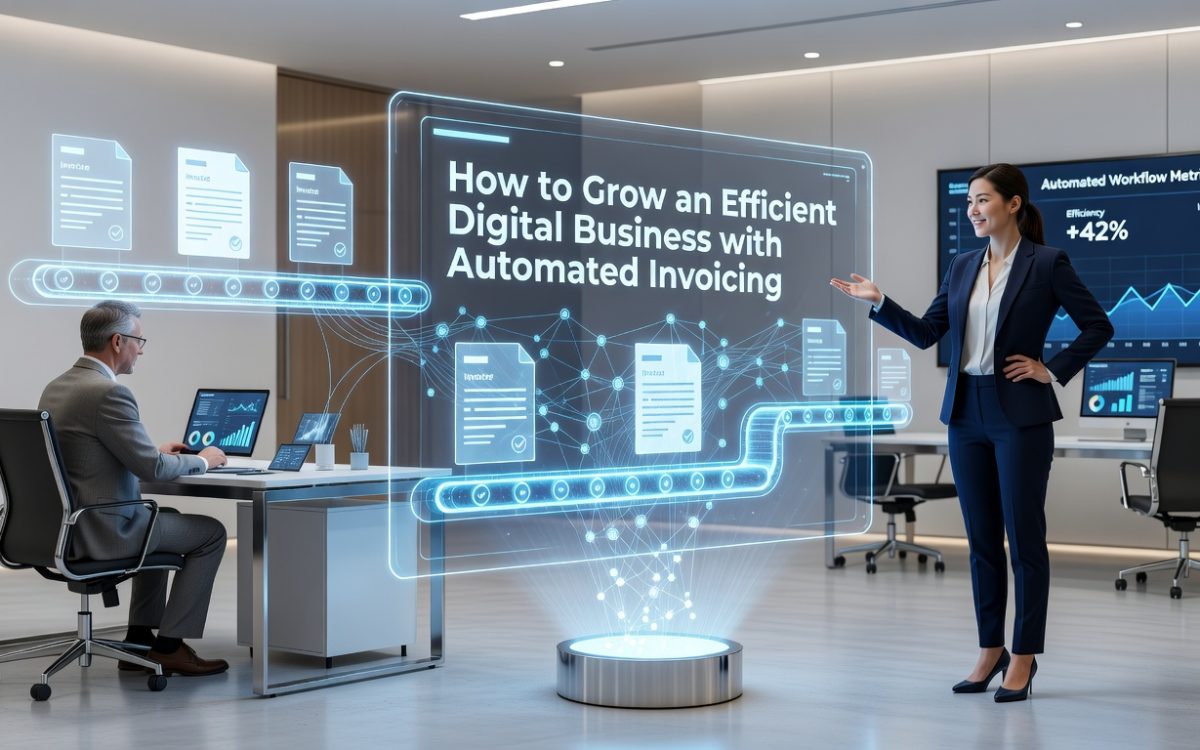
To escape this cycle, forward-thinking businesses adopt a different philosophy: they design their financial operations to be as automated and frictionless as their core product. This is where the concept of how to make digital business efficient with automated invoicing moves from theory to practice. It’s not just about sending bills, it’s about creating a closed-loop system that handles the entire revenue lifecycle.
The Automated Workflow
An automated invoicing system transforms the chaotic, reactive workflow into a calm, predictable one.
- Triggered Creation: Invoices are not “made”, but they are triggered. For a SaaS business like CloudCore, the system automatically generates an invoice the moment a subscription renews, factoring in the base plan, any add-ons, and usage metrics from the previous month. For a freelancer like Sarah, it can pull data directly from her integrated time-tracker, populating the invoice with precision.
- Intelligent Delivery and Follow-up: The system doesn’t just email the invoice and hope for the best. It delivers it through the client’s preferred channel, tracks when it’s opened, and enters a smart follow-up cadence. If an invoice becomes overdue, it automatically sends a friendly reminder on day one, a more firm notice on day seven, and can even escalate to a final notice, all without a human lifting a finger.
- Real-Time Visibility for Everyone: This is where efficiency truly meets intelligence. Instead of digging through email chains to find out who has paid, the leadership team at CloudCore can log into a dashboard and see real-time accounts receivable. They can instantly identify bottlenecks, see which clients are consistently late, and forecast cash flow for the coming month with a high degree of accuracy.
This shift does more than save time, it fundamentally changes the relationship between a business and its finances. It provides a clear, data-driven picture of your company’s health, enabling better strategic decisions.
Solving Daily Business Scenarios
Let’s look at how this plays out in the day-to-day reality of a digital business.
Scenario 1: The Usage-Based Billing Headache
A B2B API company charges its clients based on the number of API calls they make. Manually calculating this for hundreds of clients is a nightmare. It involves exporting usage logs, matching them to client contracts with different pricing tiers, and manually calculating the total. This process is slow and prone to error.
With an automated system, this becomes a non-event. The billing platform is integrated with the usage-tracking infrastructure. At the end of the billing cycle, the system automatically tallies the API calls, applies the correct pricing logic from the client’s contract, and generates a detailed, accurate invoice. The client receives an itemized bill they can trust, and the API company gets paid without the monthly spreadsheet scramble.
Scenario 2: The Global Expansion Puzzle
A digital course creator starts selling to a global audience. They now have clients in the US, Europe, and Asia, each with different tax regulations (like VAT in the EU). Manually calculating and applying the correct tax to each invoice is a legal and logistical minefield. Getting it wrong means either losing money or facing tax penalties.
Efficient automated invoicing handles this seamlessly. The system detects the client’s location, applies the correct tax rules and rates in real-time, and generates an invoice that is compliant with local regulations. It removes the complexity of international finance, allowing the business to grow globally without a proportional increase in administrative overhead.
Scenario 3: The Dunning Management Problem
“Churn due to involuntary failure” is a silent killer for subscription businesses. This happens when a client’s credit card expires, or a payment is declined by their bank. The client wants to stay subscribed, but the payment fails. In a manual world, this often results in a service interruption and a confused, angry customer who has to fix the problem themselves.
Automated invoicing includes sophisticated “dunning management.” When a payment fails, the system automatically sends the client an email with a link to update their payment details. It can retry the charge at strategic intervals over several days. Most of the time, the payment goes through on a retry, and the client never even knows there was a problem. This automated process saves countless at-risk customers and protects recurring revenue without any manual intervention.
Building Your Efficient Digital Business
Transitioning to automated invoicing is not just a financial decision, but it’s a strategic move to future-proof your operations. Here are the key steps to implementing it effectively:
- Audit Your Current Process: Before you can automate, you need to understand your current workflow. Map out every step, from the moment a service is delivered to the moment money hits your bank account. Identify the bottlenecks and the points where errors creep in. This map will be your blueprint for automation.
- Prioritize Integration: Your invoicing system should not be an island. The most efficient setups are those that integrate seamlessly with your existing tools. This means connecting to your CRM to manage client data, your payment gateways to process transactions, your accounting software for bookkeeping, and your product usage data for usage-based billing.
- Create a Standard for Your Billing Logic: Automation works best when rules are clear. Define your pricing models, discount structures, proration policies, and dunning workflows. The more standardized your logic, the easier it is for the system to execute it flawlessly every time. This might mean simplifying your plans or codifying rules that were previously handled on a case-by-case basis.
- Embrace the Data: Once your invoicing is automated, you’ll have a wealth of real-time financial data at your fingertips. Don’t just let it sit there. Use it. Analyze your monthly recurring revenue (MRR), track your cash flow forecast, and identify your most profitable customer segments. This data transforms your finance function from a historical record-keeper into a strategic partner for growth.
Conclusion
The experience from completing manual spreadsheets to automated efficiency is a journey from being reactive to being strategic. It’s about relieving your staff of the administrative burden so they can concentrate on the tasks that are most important to creating excellent products, providing excellent customer service, and growing the business.
Adhering to manual processes is not only inefficient, but it also puts digital organizations at a competitive disadvantage, when speed and agility are critical. You may transform a mundane task into a potent engine for long-term success by adopting automation. You create a foundation of steady income flow, remove financial obstacles for your clients, and acquire the clarity required to confidently face the future. An automated business is the most efficient in the digital era, and it all begins with compensation.