In tech and networking, scheduled events are predictable in timing but not always in outcome. A system update, a server failure, a traffic change – these events usually happen at known intervals, but their impact depends on what the data reveals.
Financial markets have their own version of this: the Non-Farm Payroll (NFP) report. Released with clockwork precision on the first Friday of every month, it is one of the most anticipated and impactful events in global financial trading.
For anyone used to thinking in systems and triggers, NFP is a high-impact data hitting the market all at once.
What the NFP report measures—and why it matters
So, what is the NFP report? The Non-Farm Payroll (NFP) report measures the number of jobs added or lost in the U.S. economy, excluding farm workers, government employees, and a few other categories, mainly from non-governmental organizations.
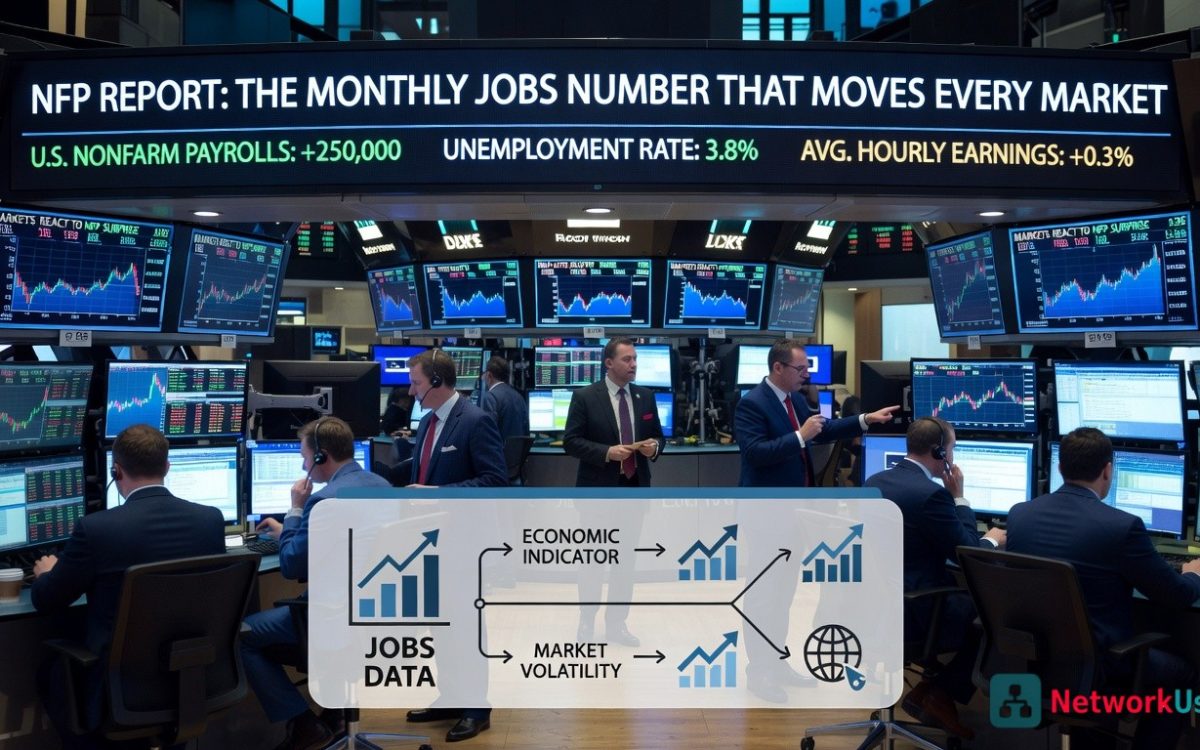
It is published by the U.S. Bureau of Labor Statistics and includes several data indicators:
Total jobs added (or lost)
Unemployment rate
Wage growth (average hourly earnings)
Why does this matter so much for financial markets?
Because employment is a core driving force of economic health. More jobs generally mean higher consumer spending, stronger economic growth, but potential inflation pressure as well.
As a result, this number directly influences central bank decisions, especially interest rates. For markets, NFP acts as a critical input into expectations about monetary policy. If the data deviates from forecasts, the price adjusts almost immediately.
How forex, indices, and crypto react to NFP
NFP doesn’t just affect one market. Its impact has a rippling effect across currencies, stocks, and even digital currencies. Let’s briefly break down each of them below.
Forex markets
Currency pairs immediately react because NFP influences interest rate expectations. Typical patterns include:
Strong NFP – The dollar strengthens
Weak NFP – USD weakens
Major pairs like EUR/USD or USD/JPY can move sharply within seconds of the release. Spreads usually widen briefly, and volatility spikes.
Stock indices
Equities also react to NFP but slightly differently from forex pairs. Strong jobs data can be positive, as it indicates economic growth, but it can also be negative due to higher interest rate expectations. This creates mixed reactions. Sometimes it rallies on strong data, but other times they drop due to fears of tighter monetary policy. In other words, it is extremely difficult to anticipate what reaction the market will show when the number is released.
Crypto markets
Cryptos, while decentralized, are increasingly tied to macro conditions. NFP can indirectly influence cryptos:
Strong USD and higher rates – pressure on risky assets, including cryptos
Weak data – increased liquidity, potentially supporting crypto
While the reaction might not be as immediate as with forex, the direction often follows the broader risk sentiment.
How traders prepare for NFP: before vs after the release
The real difference between experienced and inexperienced traders is not awareness of NFP; it is preparation. There are two major approaches to NFP trading: positioning before the release and waiting for confirmation.
Positioning before the release
This approach relies on forecast data, economic trends leading up to the release, and market sentiment. This is because, when entering the market before the NFP is released, you must conduct a thorough analysis of what the most likely number will be and how the market will react with the highest probability. As a result, this method is only recommended to professional traders with years of experience in markets and who can analyze broader macroeconomic data and accurately define the possible scenarios.
Waiting for confirmation
For beginners and most retail traders, this is the best approach to the NFP release. They look for the initial movement and volatility to calm down, and the market to choose its final direction. Only then will they position themselves. This is beneficial for beginners because spreads are lower, markets are much more predictable, and the risks of being whipsawed are much lower.
There is also a hybrid approach where traders combine the two strategies. They just reduce their position sizes before the news and continue trading after the initial reaction fades.