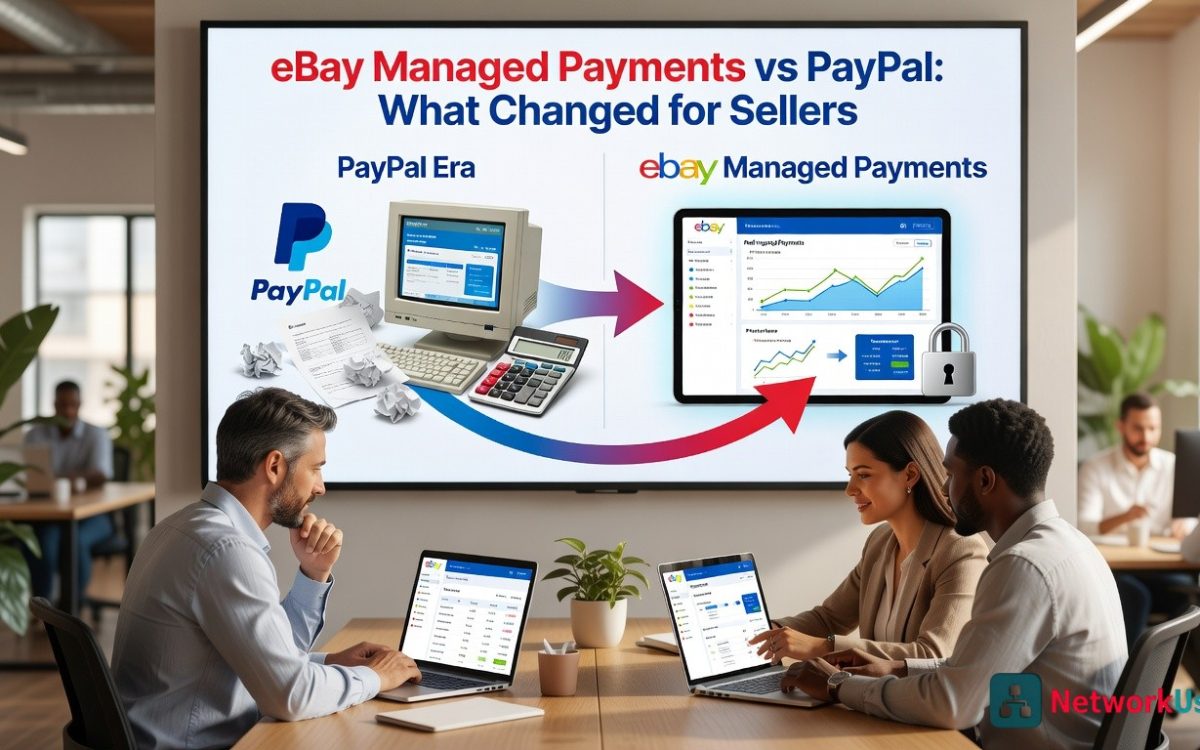
For more than a decade, selling on eBay meant relying on PayPal as the default payment processor. The relationship shaped the platform’s growth and defined how millions of transactions were completed worldwide.
That model has now been fully replaced. eBay’s Managed Payments system, introduced gradually and made standard in recent years, represents one of the most significant structural shifts in the platform’s history. For sellers, the change goes far beyond a different payout method. It has altered fee structures, cash flow dynamics, dispute handling and operational workflows.
Understanding what actually changed requires a closer look at both systems.
From Two Systems to One Integrated Model
Under the old setup, eBay functioned as a marketplace while PayPal handled payments. Sellers paid separate fees to both entities. A typical transaction involved a final value fee charged by eBay and a payment processing fee charged by PayPal, usually around 2.9 percent plus a fixed amount.
The separation created complexity. Sellers had to manage two accounts, reconcile two sets of reports and track payments across different systems. Payouts were relatively fast, often instant or within hours, but the administrative burden was higher.
Managed Payments consolidates these processes. eBay now handles the entire transaction flow, from checkout to payout. Fees are bundled into a single structure, and funds are deposited directly into the seller’s bank account.
From an operational standpoint, this integration reduces friction. From a financial perspective, it changes how costs are calculated. Sometimes sellers even go so far as to create multiple PayPal accounts to reduce the risk of their accounts being suspended.
Fee Structure: Simplification with Nuance
One of the most visible changes is the fee model. Under PayPal, sellers typically paid two separate charges: eBay’s final value fee and PayPal’s transaction fee. Combined, these often totaled between 12 and 15 percent, depending on category and pricing.
With Managed Payments, eBay combines these into a single final value fee that includes payment processing. At first glance, this appears simpler and, in some cases, slightly cheaper.
However, the reality is more nuanced. The fee is now applied to the total transaction amount, including shipping and, in certain regions, taxes. This expands the base on which fees are calculated.
Additionally, fixed per-order fees remain. While small individually, they accumulate at scale. For sellers processing hundreds or thousands of orders per month, these incremental costs can materially affect margins.
The result is not necessarily higher or lower fees overall, but a different structure that requires recalibration of pricing strategies.
Cash Flow: From Instant Access to Scheduled Payouts
Perhaps the most noticeable change for sellers is cash flow timing. PayPal offered near-instant access to funds. Sellers could receive payment immediately and use those funds to purchase inventory or pay suppliers.
Managed Payments introduces scheduled payouts. Funds are typically released on a daily or weekly basis, depending on account settings and performance metrics. While this creates predictability, it also introduces delays.
For small sellers, the difference may be negligible. For larger operations, particularly those relying on dropshipping or fast inventory turnover, payout timing becomes critical.
Consider a seller processing €50,000 in monthly sales. A delay of several days in accessing funds can affect purchasing cycles and working capital. Businesses must now plan more carefully around liquidity, often maintaining larger cash reserves to bridge the gap.
Dispute Resolution and Buyer Protection
Dispute handling has also shifted. Under the PayPal model, payment disputes were managed through PayPal’s resolution center, while eBay handled marketplace-related issues separately.
Managed Payments centralizes dispute management within eBay. This creates a more unified process but also concentrates decision-making authority.
For sellers, this has both advantages and risks. On one hand, having a single platform manage disputes reduces fragmentation. On the other, sellers have fewer alternative channels to escalate issues.
Buyer protection policies remain strong, reflecting eBay’s commitment to maintaining trust on the platform. However, sellers must be more vigilant in meeting performance standards, as disputes can directly impact account health metrics.
International Transactions and Currency Handling
Global selling has become more streamlined under Managed Payments, but not necessarily cheaper. PayPal previously handled currency conversion, often applying a margin on exchange rates.
eBay now manages currency conversion within its own system. Fees typically range between 2 and 3 percent above the base exchange rate. For sellers with significant international volume, this represents a recurring cost.
The advantage lies in consolidation. Sellers no longer need separate PayPal accounts for different currencies. Reporting is centralized, making it easier to track cross-border transactions.
However, the financial impact remains. A seller generating €100,000 annually in international sales could see several thousand euros absorbed by conversion fees alone.
Operational Impact on Sellers
Beyond fees and payouts, the shift to Managed Payments has changed day-to-day operations. Integration with eBay’s backend systems allows for more streamlined reporting, automated reconciliation and simplified bookkeeping.
For many sellers, this reduces administrative workload. Financial data is available in a single interface, and payouts are easier to track.
At the same time, the loss of PayPal’s flexibility is notable. Features such as instant transfers, independent dispute channels and broader payment ecosystem integrations are no longer part of the standard workflow.
Sellers who previously relied on PayPal’s ecosystem for financing or cash management must now adapt to eBay’s infrastructure.
The Strategic Trade-Off
The transition from PayPal to Managed Payments reflects a broader trend in e-commerce platforms: vertical integration. By controlling the entire transaction process, eBay gains greater oversight and can offer a more unified user experience.
For sellers, the trade-off is between simplicity and flexibility.
Managed Payments reduces complexity and centralizes operations. It aligns payment processing with marketplace performance metrics and provides a clearer overview of transactions.
However, it also reduces independence. Sellers are more tightly integrated into eBay’s ecosystem, with fewer external tools and options for managing payments.
Conclusion: A Structural Shift, Not Just a Technical One
The move from PayPal to eBay Managed Payments is more than a technical upgrade. It represents a fundamental change in how sellers interact with the platform.
Fees are consolidated but require closer analysis. Cash flow is more predictable but less immediate. Dispute resolution is centralized, increasing efficiency while concentrating control.
For sellers in 2026, success depends on adapting to this new structure. Those who understand the nuances of the fee model, manage cash flow proactively and optimize operations within eBay’s system can maintain strong profitability.
Those who rely on assumptions from the PayPal era may find that the rules have changed more than expected. In a marketplace where margins are often tight, understanding those changes is no longer optional. It is essential.