A Systematic Investment Plan, or SIP, allows you to invest a fixed amount of money every month. Many people use SIPs to invest in equity mutual funds. The markets experience price changes that result in upward and downward movements. The price changes that occur in financial markets are referred to as market volatility. When markets experience declines, investors tend to become anxious. The investment world requires people to understand that market fluctuations will continuously occur.
What Is Market Volatility?
Market volatility refers to the extent of price fluctuations that occur in the market. The market experiences high volatility when prices experience significant movement. The market experiences low volatility when prices change at a gradual pace.
Volatility does not always mean loss. Markets can experience high volatility yet still achieve growth during extended periods.
How does SIP work?
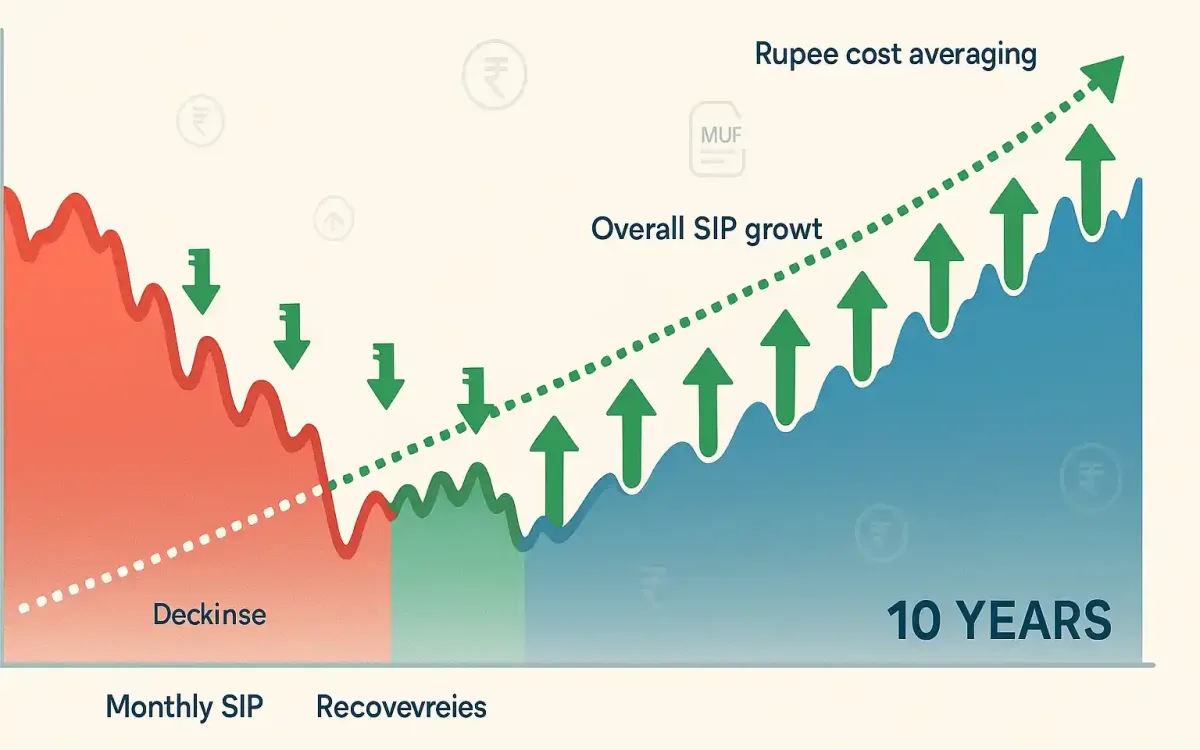
In SIP investing, you invest a fixed amount of money every month. You acquire extra units when prices decrease. You decrease your unit purchases when prices increase. This method of investing is known as rupee cost averaging.
This strategy enables investors to achieve equal market value distribution through their investment track record.
SIP in a Rising Market
Imagine the market rises steadily for five years.
In this case:
- Your portfolio value increases regularly.
- Returns stay close to market growth.
- The market remains stable, resulting in limited volatility effects.
- Systematic Investment Plan performs smoothly in such periods.
- Systematic Investment Plan in a Falling Market Followed by Recovery
- Now imagine this situation:
- The market fell for two years.
- The market undergoes recovery throughout three years.
During the fall:
- You buy more units at lower prices.
- Your portfolio value may look weak.
During recovery:
- The units you purchased previously will gain value.
- The total return of your investments will rise.
- The research demonstrates that market corrections that occur early improve Systematic Investment Plan returns when markets recover. This information proves vital for estimating SIP performance during different market cycles.
SIP in a Flat Market
Now consider a market that moves up and down but shows little overall growth.
In this case:
- You keep accumulating units.
- But total returns stay moderate.
- Volatility alone does not create growth. Market direction matters.
Why Time Matters
Studies of rolling returns show:
- The short-term results of SIP returns display a wide range of values.
- The stability of returns increases as time progresses.
- The probability of experiencing negative returns decreases between seven and ten years.
- Time decreases the effect of volatility on investments.
- The order of returns also matters.
- Two investors may invest for ten years.
Investor A:
- He experiences initial investment losses.
- His investments show growth after the lost period.
Investor B:
- He experiences investment growth during the early period.
- His investments suffer losses toward the investment period conclusion.
- Investor A stands to gain by acquiring more units when prices drop during the initial period. Investor B will lose total investment value when he experiences investment losses before his planned withdrawal.
- Understanding cycles helps people estimate SIP performance results during different market conditions.
Short-Term vs Long-Term SIP
The data shows that SIPs that run for less than three years experience significant fluctuations in their returns. The five-year investment period of SIPs decreases their risk of return fluctuations. The ten-year investment period of SIPs produces more predictable financial performance.
Longer investment periods help absorb market volatility. The returns can be calculated through SIP Calculator for different time periods.
Investor Behavior During Volatility
- The fear of volatility tends to dominate people’s minds. People make major mistakes when they
- Stop their SIP investment when the market experiences downturns.
- They only invest additional money after the market starts to recover.
- They withdraw their funds during periods of market correction.
- The research shows that long-term investment results improve when SIP investment continues throughout market declines.
- The ability to maintain consistency matters more than choosing the ideal time for business operations.
Key Factors to Track
To assess SIP performance, you need to concentrate on these areas:
- XIRR
- Rolling returns
- Investment duration
- Market cycle stage
These factors help provide a clearer picture of returns.
Conclusion
Market volatility affects Systematic Investment Plan returns. But the impact depends on:
- The timing of volatility events
- The duration of your investment period
- The occurrence of market recovery
- Your ability to maintain discipline
Investment results improve when investors make corrections at the beginning of a long investment period. Late corrections may reduce short-term returns.
Disclaimer: This article provides general information on SIP investments and market volatility based on data-driven insights and is not intended as personalized financial advice. Investing involves risks, including potential loss of principal. Past performance does not guarantee future results. The author and publisher disclaim any liability for actions taken based on this content.