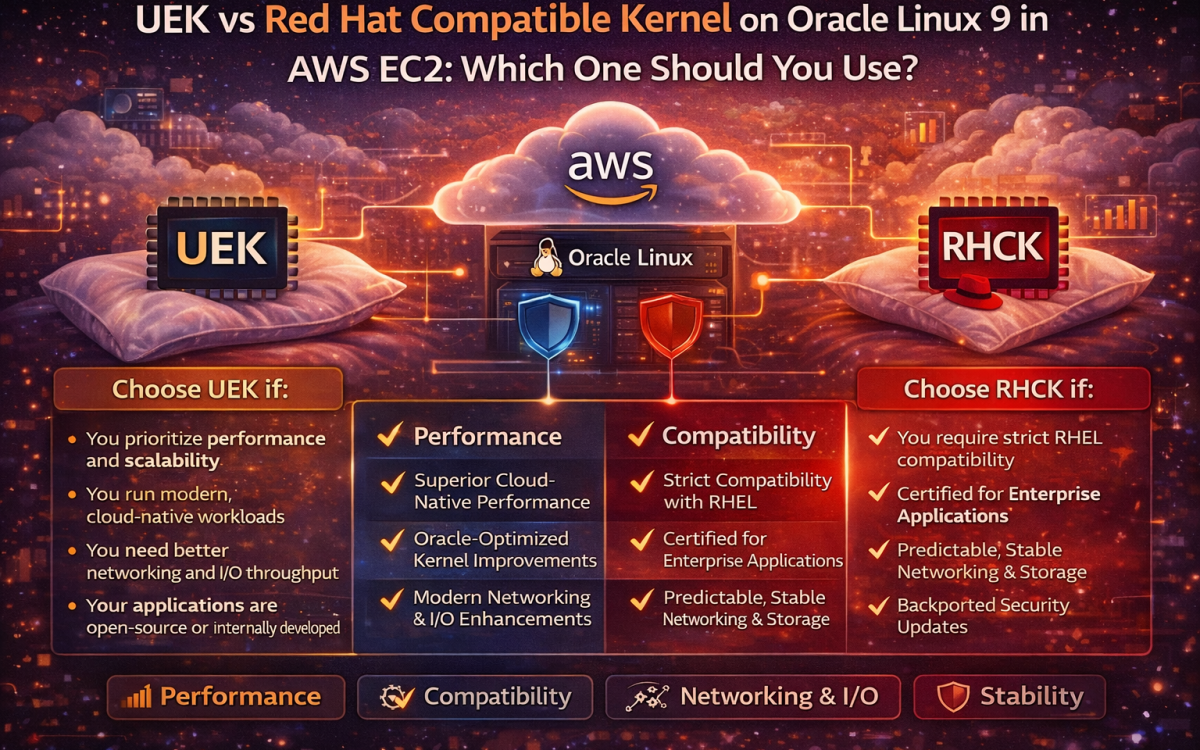
When deploying enterprise Linux workloads in the cloud, the operating system kernel is not just an implementation detail—it is a strategic choice that affects performance, stability, security, and long-term maintainability. This is especially true for organizations running Oracle Linux 9 on AWS EC2, where administrators can choose between two distinct kernel options: the Unbreakable Enterprise Kernel (UEK) and the Red Hat Compatible Kernel (RHCK).
Oracle Linux is unique among enterprise Linux distributions because it ships with two fully supported kernels. On one hand, UEK is Oracle’s performance-focused, innovation-driven kernel, built and tested aggressively for modern workloads. On the other hand, RHCK offers near-binary compatibility with Red Hat Enterprise Linux (RHEL), making it attractive for organizations that prioritize application certification and ecosystem consistency.
For teams launching an Oracle Linux 9 AMI in AWS EC2, this choice often raises important questions:
- Which kernel performs better on cloud-native workloads?
- Which one offers better compatibility with third-party software?
- How do security updates, lifecycle support, and operational tooling differ?
- Is there a “default best choice,” or does it depend on workload type?
This article provides a deep, technical, and practical comparison of UEK vs RHCK on Oracle Linux 9 in AWS EC2, helping architects, DevOps engineers, and system administrators make an informed decision based on real-world criteria rather than marketing claims.
Overview of Kernel Options in Oracle Linux 9
Oracle Linux 9 ships with two kernels that can be installed, updated, and switched at boot time:
Unbreakable Enterprise Kernel (UEK)
UEK is Oracle’s custom kernel, derived from recent upstream Linux kernel releases and enhanced with Oracle-specific performance, scalability, and reliability improvements. Despite being newer and more feature-rich, UEK is fully supported for the entire Oracle Linux lifecycle.
Red Hat Compatible Kernel (RHCK)
RHCK is built from the same kernel sources as Red Hat Enterprise Linux 9, ensuring ABI and behavior compatibility. Its primary goal is predictability and compatibility rather than rapid feature adoption.
Both kernels are available on AWS EC2, supported by Oracle, and eligible for production use.
Architectural Differences Between UEK and RHCK
Kernel Lineage and Versioning
- UEK
- Based on newer upstream Linux kernel versions
- Incorporates features and fixes earlier than RHCK
- Backports are minimized in favor of forward-looking kernels
- RHCK
- Based on the RHEL 9 kernel
- Conservative backporting of fixes and security patches
- Long-term ABI stability is prioritized
This fundamental difference affects everything from device drivers to filesystem behavior.
Performance Characteristics on AWS EC2
CPU Scheduling and Scalability
UEK is optimized for high core counts and modern NUMA architectures, which aligns well with AWS EC2 instance families such as:
- Compute-optimized instances
- Memory-optimized instances
- High-core virtual machines for databases and analytics
UEK typically shows advantages in:
- Multi-threaded workloads
- High-throughput networking
- Large memory footprints
RHCK, while stable and predictable, may lag slightly in scenarios that benefit from newer scheduler enhancements.
Networking Performance
Networking is critical in cloud environments, and UEK often integrates newer network stack improvements sooner, including:
- Enhanced TCP congestion control
- Better performance with ENA drivers
- Improved handling of high packet rates
For microservices, service meshes, and distributed systems, UEK can provide measurable throughput and latency improvements.
RHCK delivers solid, consistent performance but prioritizes long-term stability over aggressive tuning.
Storage and I/O
UEK includes more recent improvements in:
- NVMe drivers
- Block I/O schedulers
- Filesystem scalability (XFS, ext4)
This can be particularly beneficial for:
- High-IOPS EBS volumes
- Database workloads
- Log-heavy applications
RHCK remains highly reliable, especially for traditional enterprise workloads where I/O patterns are predictable.
Application Compatibility and Certification
Third-Party Software Support
This is one of the most decisive factors.
- RHCK
- Near-binary compatibility with RHEL 9
- Widely accepted by ISVs that certify against RHEL
- Lower risk for proprietary or closed-source software
- UEK
- Fully supported by Oracle
- Not always explicitly certified by third-party vendors
- In practice, compatible with most modern Linux applications
If your application vendor explicitly requires a “RHEL-compatible kernel,” RHCK is usually the safer choice.
Containers and Kubernetes
Both kernels work well with:
- Podman
- Docker-compatible runtimes
- Kubernetes distributions
However, UEK’s newer kernel features can provide advantages for:
- Container density
- cgroup v2 enhancements
- Networking overlays
In cloud-native and container-heavy environments, UEK often aligns better with modern workloads, For organisations deploying containerised workloads across multiple clouds, including an Oracle Linux 9 image on Microsoft Azure, UEK’s newer kernel capabilities often provide better alignment with modern orchestration platforms.
Security Model and Patch Management
Security Updates
Both UEK and RHCK receive:
- Regular CVE fixes
- Timely security advisories
- Long-term support throughout Oracle Linux 9’s lifecycle
Differences lie in how fixes are delivered:
- RHCK
- Security fixes are backported
- Minimal behavioral changes
- Extremely stable ABI
- UEK
- Fixes may arrive as part of newer kernel releases
- Security improvements often bundled with performance enhancements
Organizations with strict change-control policies may prefer RHCK’s conservative model.
Stability vs Innovation Trade-Off
RHCK: Predictability First
RHCK excels when:
- Stability is paramount
- Environments are tightly regulated
- Change windows are infrequent
- Application behavior must remain consistent for years
It is often favored in:
- Financial systems
- Legacy enterprise applications
- Compliance-driven workloads
UEK: Performance and Modern Features
UEK shines when:
- Performance matters
- Infrastructure scales dynamically
- Modern hardware and cloud features are leveraged
- Teams are comfortable with newer kernel behavior
It is commonly used for:
- Databases
- Cloud-native platforms
- High-performance computing
- Large-scale distributed systems
Operational Management on AWS EC2
Kernel Switching and Boot Management
Oracle Linux makes switching between UEK and RHCK straightforward:
- Both kernels can be installed simultaneously
- GRUB allows easy selection
- Default kernel can be changed without reinstalling the OS
This flexibility is particularly valuable in AWS EC2, where testing and rollback are critical.
Monitoring and Troubleshooting
From an operational standpoint:
- RHCK benefits from extensive community knowledge aligned with RHEL
- UEK has strong Oracle documentation and support tooling
Standard Linux observability tools (perf, eBPF-based utilities, systemd tools) work well on both kernels, with UEK often exposing newer tracing capabilities sooner.
Cost Considerations
From a licensing perspective:
- Both kernels are included with Oracle Linux
- No additional cost difference in AWS EC2 usage
- Support entitlements are not kernel-specific
The real “cost” difference comes from:
- Performance efficiency
- Operational risk
- Compatibility requirements
Better performance with UEK may reduce infrastructure costs, while RHCK may reduce operational risk.
Decision Matrix: Which Kernel Should You Use?
Choose UEK if:
- You prioritize performance and scalability
- You run modern, cloud-native workloads
- You need better networking and I/O throughput
- You are comfortable with newer kernel features
- Your applications are open-source or internally developed
Choose RHCK if:
- You require strict RHEL compatibility
- Your software vendor certifies only RHEL kernels
- You operate in highly regulated environments
- You value long-term behavioral consistency
- You prefer conservative change management
Real-World Deployment Scenarios
Scenario 1: Cloud-Native Microservices Platform
A Kubernetes-based platform running dozens of microservices benefits from UEK’s networking and scheduling improvements, making UEK the more natural choice.
Scenario 2: Commercial ERP Application
If the vendor certifies the application only on RHEL-compatible kernels, RHCK minimizes risk and simplifies support discussions.
Scenario 3: Database-Heavy Analytics Workload
High I/O and CPU scalability often favor UEK, especially on large EC2 instances with fast EBS volumes.
Best Practices for Making the Choice
- Test Both Kernels
- Benchmark your workload under UEK and RHCK
- Measure performance, latency, and stability
- Check Vendor Requirements
- Review application certification matrices
- Clarify kernel requirements explicitly
- Align With Operational Policies
- Match kernel choice with change-control and compliance rules
- Plan for Flexibility
- Keep both kernels installed where possible
- Maintain rollback options
Conclusion
Choosing between UEK and the Red Hat Compatible Kernel on Oracle Linux 9 in AWS EC2 is not about right or wrong—it’s about alignment with your workload, risk tolerance, and operational goals.
UEK delivers modern performance, scalability, and innovation that pairs exceptionally well with cloud-native and high-performance environments. RHCK, on the other hand, provides unmatched compatibility and predictability for enterprises that depend on strict RHEL alignment.
The good news is that Oracle Linux gives you the freedom to choose—and even switch—without re-architecting your infrastructure. By understanding the technical differences and evaluating them against your real-world needs, you can confidently select the kernel that best supports your AWS EC2 deployments today and in the future.