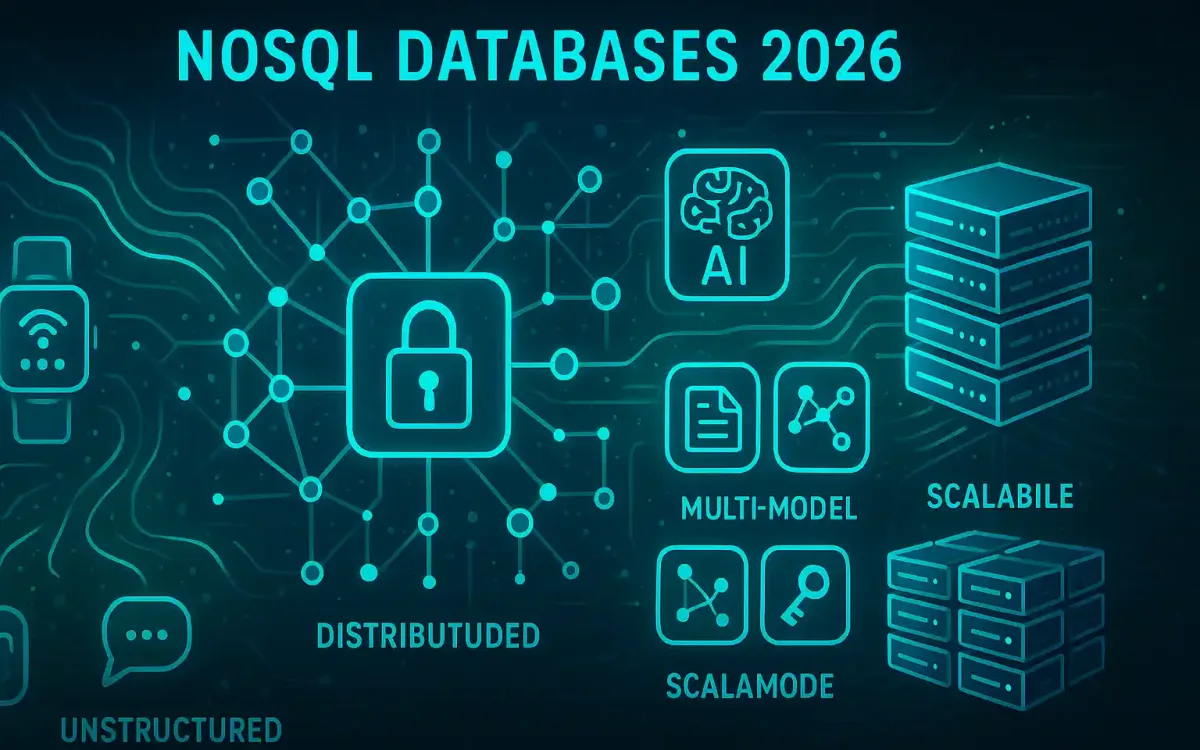
The volume of data generated across the world continues to increase at an unprecedented rate. A feature on “Amount of Data Created Daily’ by Exploding Topics estimates that approximately 402.74 million terabytes of data are created every day. This data comes from a wide range of sources, including social media, mobile devices, IoT systems, and digital services. A large portion of this information is unstructured, meaning it does not fit neatly into traditional rows and columns.
This shift has created strong demand for database systems that can handle diverse and evolving data formats. NoSQL databases have emerged as a key solution, offering the flexibility and scalability needed to manage modern data workloads. As organizations continue to rely on data for decision-making and innovation, the role of NoSQL databases is becoming increasingly important.
What Is a NoSQL Database?
NoSQL databases are designed to store and manage data in formats that differ from traditional relational databases. Instead of relying on fixed schemas and structured tables, they support a variety of data models, including document, key-value, column, and graph structures. ‘What is a NoSQL Database?’ published on MongoDB details how NoSQL databases store data more naturally and flexibly. This flexibility allows developers to work with data in formats that reflect real-world applications, making it easier to adapt to changing requirements.
NoSQL databases are particularly effective for handling unstructured and semi-structured data. They can store complex objects, nested data, and dynamic fields without requiring predefined schemas. This makes them well-suited for applications such as content management, real-time analytics, and artificial intelligence.
How NoSQL Differs from Traditional Databases
Traditional relational databases organize data into tables with predefined schemas. Each record must follow a specific structure, which can limit flexibility when data requirements change. These systems are optimized for structured data and transactional consistency.
NoSQL databases offer a different approach. They allow data to be stored in flexible formats, enabling developers to modify structures without disrupting existing systems. This adaptability supports rapid development and iteration.
Another key difference is scalability. Relational databases often scale vertically, requiring more powerful hardware. NoSQL databases are designed to scale horizontally, distributing data across multiple servers. This approach supports high performance and reliability, even with large data volumes.
These characteristics make NoSQL databases a strong choice for modern applications that require flexibility, scalability, and speed.
Enhanced Scalability and Distributed Architecture
One of the key developments in NoSQL databases in 2026 is the continued advancement of scalability. As data volumes grow, organizations need systems that can handle increasing workloads without compromising performance. The article ‘NoSQL and Sharding’ available on Medium notes how NoSQL databases are best for massive scalability and can handle petabytes and terabytes of data by increasing servers. This is because NoSQL databases are built to scale horizontally, allowing data to be distributed across multiple nodes. This architecture supports high availability and fault tolerance, ensuring that systems remain operational even during heavy usage.
In 2026, improvements in distributed systems will make scaling more efficient, enabling organizations to manage large datasets with greater ease. This will be particularly important for industries that rely on real-time data processing.
Integration with Artificial Intelligence and Machine Learning
The integration of NoSQL databases with artificial intelligence and machine learning is another major development. AI applications require access to large volumes of diverse data, making NoSQL databases an ideal foundation.
In 2026, NoSQL platforms are expected to provide stronger support for AI workloads. “Why Use a NoSQL Database for AI?” written by The New Stack explains how managing large volumes of diverse data types enables flexible data models that align with machine learning requirements. These systems are well-suited for handling unstructured and semi-structured data, which is commonly used in AI applications. They also support fast data ingestion and retrieval, allowing models to access relevant information efficiently. This capability helps power advanced analytics and supports the development of intelligent, data-driven applications.
By supporting AI-driven insights, NoSQL databases will play a key role in helping organizations extract value from their data.
Improved Query Capabilities and Analytics
Query capabilities in NoSQL databases are evolving to support more complex and efficient data analysis. While early NoSQL systems focused on simple operations, modern platforms are expanding their functionality.
2026, advancements in query languages and indexing techniques will allow for faster and more sophisticated data retrieval. These improvements will enable organizations to perform detailed analysis without relying on separate systems.
Enhanced analytics capabilities will support decision-making, allowing businesses to gain insights directly from their operational databases.
Strengthening Security and Cybersecurity Measures
Security is a critical focus for NoSQL databases in 2026. In ‘What is Information Security vs Cybersecurity’ we outlined how, as digital technology and internet connectivity continue to expand, cybersecurity has become a major concern. Information security focuses on protecting data from unauthorized access, while cybersecurity addresses threats related to digital systems and networks.
NoSQL databases are evolving to incorporate advanced security features, including encryption, access control, and threat detection. These measures help protect sensitive data and ensure compliance with regulations.
With the increasing frequency of cyber threats, organizations are prioritizing secure database solutions. NoSQL platforms are responding by enhancing their security frameworks, providing stronger protection for modern applications.
Multi-Model Database Support
Another key development is the rise of multi-model databases. These systems combine different data models within a single platform, allowing organizations to manage diverse data types more efficiently.
In 2026, multi-model NoSQL databases will become more common, enabling developers to work with document, key-value, and graph data in one system. This reduces the need for multiple databases and simplifies data management.
This approach supports flexibility and efficiency, making it easier to build and maintain complex applications.
Conclusion
NoSQL databases are playing an increasingly important role in the modern data landscape. The rapid growth of data, combined with the need to manage unstructured information, has driven the adoption of flexible and scalable database solutions.
Key developments in 2026, including enhanced scalability, AI integration, improved analytics, stronger security, and multi-model support, are shaping the future of NoSQL technology. These advancements are enabling organizations to handle complex data more effectively and unlock new opportunities.
As data continues to grow in volume and complexity, NoSQL databases will remain a critical component of modern technology infrastructure, supporting innovation and driving digital transformation.
FAQs
What are the main differences between NoSQL and traditional relational databases?
NoSQL databases use flexible, non-relational models like document or graph for unstructured data, allowing schema changes without downtime. Relational ones rely on fixed tables and schemas for structured data, excelling in transactions but lacking scalability. NoSQL scales horizontally across servers for high volumes, while relational scales vertically, making NoSQL ideal for dynamic apps like AI and IoT where adaptability drives innovation.
How is scalability being enhanced in NoSQL databases in 2026?
In 2026, NoSQL focuses on distributed architectures and sharding to handle petabytes by adding servers horizontally. This ensures high availability, fault tolerance, and efficient real-time processing for massive workloads. Unlike vertical scaling, it distributes data across clusters, reducing bottlenecks and supporting global operations in data-intensive environments like social media and IoT.
What role does AI integration play in NoSQL developments for 2026?
NoSQL’s flexible models support diverse data types for AI, enabling fast ingestion and retrieval in machine learning workflows. In 2026, deeper integration allows advanced analytics directly within databases, powering data-driven apps. This handles complex, unstructured inputs from various sources, enhancing decision-making and innovation without separate systems.
How are security measures improving in NoSQL databases?
2026 NoSQL advancements include encryption, fine-grained access controls, and real-time threat detection to combat cyber risks. Distinguishing information security (data protection) from cybersecurity (system threats), these features ensure compliance and safeguard sensitive data in distributed setups, addressing vulnerabilities in high-volume, dynamic environments.
What is multi-model support in NoSQL databases?
Multi-model NoSQL combines formats like document, key-value, and graph in one platform, simplifying management of varied data types. In 2026, this reduces the need for multiple databases, streamlining operations and queries. It supports complex applications by allowing seamless handling of structured and unstructured data without integration overheads.