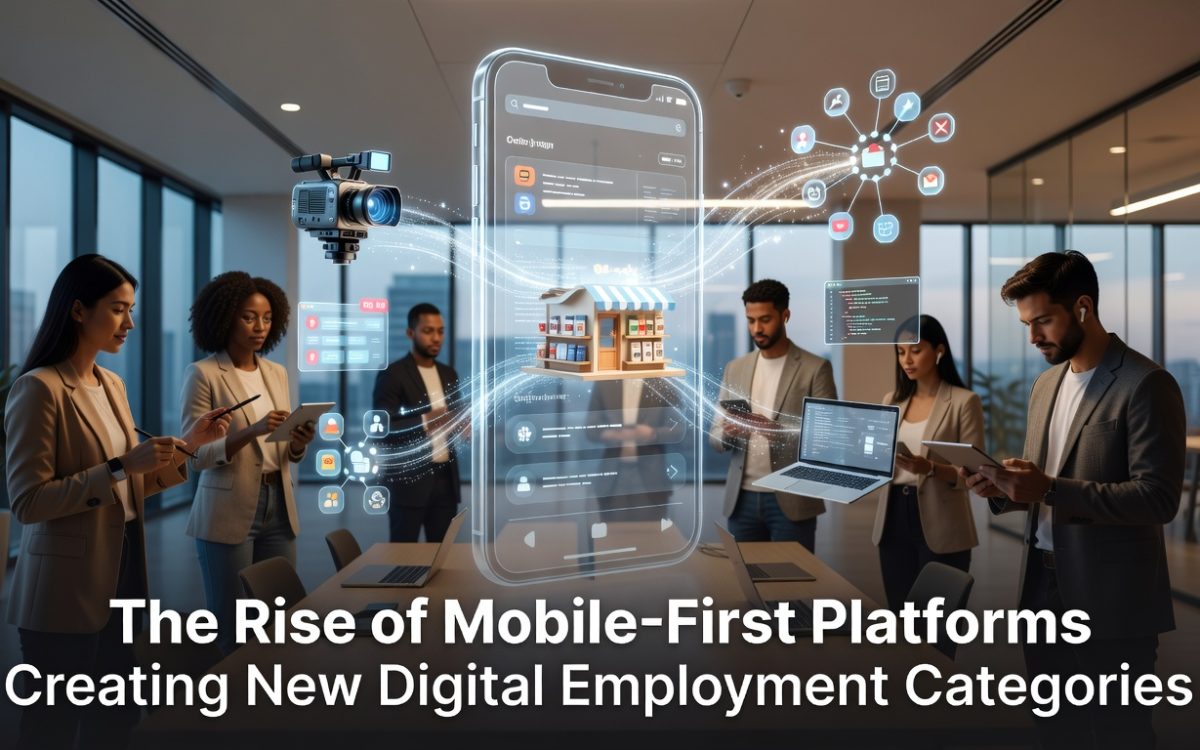
Five years ago, the idea that a smartphone could serve as your primary workstation would have seemed like an oversimplification. Today it is the defining reality of an entire generation of digital workers. The shift did not happen because of a single breakthrough. It happened gradually, then all at once, as mobile infrastructure caught up to mobile ambition and the platforms built to exploit that infrastructure reached critical mass.
This article looks at what that shift actually means for employment, who it benefits, why it is accelerating rather than stabilizing, and what the broader implications are for how we think about digital work in 2026.
Smartphones as Income Tools: How We Got Here
The original smartphone was a consumption device. You used it to browse, stream, message, and scroll. The economic model built around it was advertising. Companies made money from your attention. You got the content for free. That was the bargain.
Somewhere around 2016 to 2018, something started to change. Mobile payment infrastructure matured in developed markets and leapfrogged legacy banking systems in developing ones. Mobile camera hardware reached a quality threshold where it could produce genuinely watchable video. Upload speeds on mobile networks became fast enough to support live streaming without constant buffering. All of these developments came together and created a new possibility: the smartphone as a production tool rather than just a consumption device.
Platforms noticed. A wave of apps emerged that treated mobile not as a secondary interface for a desktop product but as the primary environment. These platforms were built from the ground up around the constraints and affordances of mobile hardware. They assumed portrait orientation. They assumed variable connectivity. They assumed people would be producing content in informal environments rather than professional studios. They designed for thumbs rather than keyboards.
The result was a generation of platforms that dramatically lowered the barrier to entry for digital income work. You did not need equipment. You did not need a production setup. You did not need technical knowledge beyond what you already had from using your phone every day. You needed the app, an internet connection, and something to offer the people on the other side of the screen.
Mobile Video Platforms Versus the Desktop Era
To understand what changed, it helps to understand what the desktop era of digital work actually looked like.
Digital income work in the pre-mobile era required substantial upfront investment. A decent webcam cost money. Reliable broadband cost money. Editing software cost money. The physical infrastructure of a dedicated workspace cost money. More fundamentally, it required the kind of stable domestic situation where you had a permanent desk, a room you could close a door on, and a consistent power supply.
This created a significant selection effect. The people who could participate in desktop-era digital income work were largely people who already had access to physical and financial resources. They had stable housing. They had disposable income for equipment. They had the kind of living situation that allowed for a dedicated workspace. People without those things were largely excluded.
Mobile changed this. The devices most people already owned in their pockets became sufficient for professional-quality work. The barriers that had previously filtered out large portions of potential participants essentially collapsed. Someone living in a one-bedroom apartment with three roommates could work from their phone during a commute. Someone in a country with unreliable fixed-line internet could work over a 4G or 5G connection. Someone who could not afford professional camera equipment could use the camera they were already paying for as part of their phone plan.
This democratization effect is real and documented. Platform data consistently shows that mobile-first platforms attract a more globally distributed and economically diverse participant base than their desktop-era predecessors. The barrier drop was not just incremental. For large portions of the global population, it was the difference between participation being possible and participation being impossible.
Beyond accessibility, mobile platforms introduced behavioral and structural advantages that desktop environments could not easily replicate. Mobile is personal in a way that desktop is not. Users carry their phones everywhere. They check them constantly. The relationship between a mobile platform and its users is more continuous, more intimate, and more immediately responsive than anything a desktop platform can offer. For work that is fundamentally about connection and engagement, these characteristics matter.
The Infrastructure Making It Possible
The human story of mobile-first digital work is compelling, but it rests on a foundation of infrastructure development that rarely gets discussed in the same breath. The platforms could not exist without the underlying systems that support them.
5G and the End of the Bandwidth Bottleneck
For most of the smartphone era, mobile bandwidth was the primary constraint on what you could do with a phone. Video streaming consumed more data than networks could comfortably deliver, especially at the scale of large numbers of simultaneous users. Live video was particularly demanding because it required not just bandwidth but low latency. Delays in live interaction destroy the value of the interaction. You cannot have a real conversation with a two-second lag on every exchange.
5G networks address both of these constraints. The bandwidth available on 5G connections has removed live video streaming from the list of activities that strain mobile networks under normal conditions. More importantly, 5G latency characteristics, which target roundtrip delays of one millisecond or less in ideal conditions, make real-time interactive video a qualitatively different experience from what 4G could deliver.
The 5G rollout is still uneven. Rural areas in developed countries and large portions of developing-world markets are still operating primarily on 4G or even 3G infrastructure. But the trend line is clear and the pace of deployment is accelerating. The regions that have 5G coverage are already demonstrating what becomes possible, and those demonstrations are influencing both platform development and participant behavior in markets that are watching and waiting for coverage to arrive.
Mobile Payment Systems
Income work only works if income can actually flow. The mobile payment infrastructure that has developed over the past decade is as important to the rise of mobile-first digital employment as the networks and devices themselves.
In developed markets, services like Apple Pay, Google Pay, and platform-specific payment systems have made it seamless to move money through mobile environments. In developing markets, the story is even more dramatic. Mobile money systems in parts of Africa, Southeast Asia, and South Asia have created financial infrastructure for populations that were largely excluded from traditional banking. People who did not have bank accounts have mobile wallets. People who could not accept credit card payments can accept mobile transfers. The financial plumbing necessary for platform income work to actually translate into accessible money has been built in parallel with the platforms themselves.
Real-Time Video Compression
The compression algorithms that make high-quality live video possible over mobile connections represent a technical achievement that does not get nearly enough credit in discussions of the platform economy. The quality of live video that can be delivered over a standard 4G connection in 2026 would have required fiber-optic infrastructure to achieve just eight years ago. This improvement happened quietly, in codecs and compression standards that most users never think about, but its effects are visible every time a live video session runs smoothly on a mobile device.
Why Mobile-First Beats Desktop for Accessibility Globally
The accessibility argument for mobile-first platforms is more nuanced than it first appears. It is not simply that phones are cheaper than computers, though that is true. It is that the entire ecosystem around mobile is more accessible along multiple dimensions simultaneously.
Physical Accessibility
Fixed desktop computers require a desk, a chair, a dedicated space, and a reliable power outlet. Laptops require at minimum a surface and regular access to power for charging. Smartphones can be used literally anywhere. Standing on a train platform. Sitting in a cafe. In a bedroom shared with family members. On a lunch break from another job. The physical flexibility of mobile work means it can fit into life circumstances that would make desktop work impossible.
Financial Accessibility
A smartphone capable of running professional-quality mobile work applications costs significantly less than a comparable desktop or laptop setup. More importantly, most people in the global middle class already own such a device. The marginal cost of entering mobile-first digital work for someone who already owns a capable smartphone is essentially zero on the hardware side. This contrasts sharply with desktop-era work, which required dedicated equipment purchases even for people who already had a personal computer, because consumer-grade computers were rarely adequate for professional video work.
Geographic Accessibility
Desktop internet infrastructure is unevenly distributed globally in ways that mobile infrastructure is not. Fixed broadband requires physical cable runs that are expensive to deploy in rural or low-density areas. Mobile networks, while also requiring infrastructure investment, can cover geographic areas with a single tower that would require miles of cable to reach with fixed broadband. This means mobile connectivity reaches populations that fixed internet cannot economically serve.
The practical implication for digital income work is significant. A rural participant with a 4G mobile connection can work on mobile-first platforms that would be inaccessible to them if those platforms required fixed broadband. As 5G expands its geographic footprint, this advantage will compound.
Cultural and Social Accessibility
This is less frequently discussed but genuinely important. The cultures around mobile use are more casual and less intimidating than the cultures around professional computing. Using a phone for work feels less like entering an unfamiliar technical domain and more like an extension of something you already do constantly. This lowered psychological barrier to entry matters for populations that have had less exposure to professional computing environments.
Platform Economy Employment Data
The numbers around platform economy employment are striking, though they require careful interpretation because the category is broad and the measurement methodologies vary significantly across studies.
A 2025 report from the International Labour Organization estimated that more than 435 million people globally derive some portion of their income from platform-based work. That number includes everything from ride-sharing drivers to remote customer service workers to people working in digital communication platforms. What it captures is the scale of the phenomenon, even if it resists simple summary.
More relevant to the mobile-first dimension: platforms that have released demographic data on their active earning users consistently show that smartphone-only users, meaning people who access the platform exclusively through mobile rather than through desktop browsers or applications, represent a growing share of total earners. In several major markets, including India, Brazil, and Nigeria, smartphone-only earners represent more than 80 percent of the active earning population on mobile-first platforms.
In the United States, the picture is more mixed because desktop access remains more common, but even there, the trend toward mobile-primary work is clear. Survey data from the Pew Research Center found that among adults aged 18 to 34 who do freelance digital work, more than 60 percent describe mobile as their primary working device rather than a supplementary one.
The income distribution across platform economy workers remains wide. Studies consistently find that a minority of earners generate the majority of platform income, mirroring patterns found in other creator economy contexts. But what the data also shows is that the floor has lowered in the sense that more people can now earn something from platform work, even if the ceiling has not risen proportionally. The democratization of participation does not guarantee democratization of top-end earnings, but it does mean that supplementary income is accessible to a far broader population than it was a decade ago.
How Agencies and Support Organizations Reduce Failure Rates
One of the persistent challenges in platform economy work is the high attrition rate among new entrants. People join platforms with expectations that often exceed what is realistic in the early months, encounter a learning curve that is steeper than anticipated, and leave before reaching the point where the work becomes financially meaningful.
This attrition problem has spawned an ecosystem of support organizations, agencies, and structured onboarding services that aim to close the gap between what new workers expect and what the reality of platform work actually involves.
The value proposition of these organizations varies, but the core offering is usually some combination of technical onboarding support, realistic income expectation setting, ongoing coaching as workers develop their skills and audience, and administrative or logistical support that allows workers to focus on the work itself rather than the surrounding bureaucracy.
The effectiveness of these organizations is difficult to measure precisely because there is no controlled comparison group. But the qualitative evidence from participants who have used structured onboarding programs versus those who entered platforms without support suggests meaningful differences in retention and early income outcomes.
Organizations like camstar.in.rs exemplify how structured onboarding systems help new workers transition into mobile-first digital roles with professional guidance and ongoing support. The combination of realistic expectation setting and ongoing skill development support appears to be the most consistent predictor of whether a new worker gets through the difficult early months to reach sustainable income.
The mechanism here is not mysterious. Platform work is fundamentally skill-based, and like any skill-based activity, the early period involves significant uncertainty and frequent discouragement. Workers who have support structures that help them interpret early setbacks as part of a learning curve rather than evidence of fundamental unsuitability tend to persist longer and eventually perform better. Workers without that support are more likely to interpret the same early difficulties as a signal that the work is not for them.
This has parallels in other forms of performance-based work. Athletes who train with coaches outperform athletes of similar natural ability who train alone, not because the coaching imparts magic but because it provides structure, feedback, and accountability that make the learning curve more navigable.
The Psychology of Flexible vs Fixed Schedule Work and Its Health Benefits
The flexibility of platform work is one of its most frequently cited advantages and one of its most frequently misunderstood characteristics. The popular conception is simple: flexible work is better for you because you work when you want and rest when you want. The reality is more complicated.
Research on the psychology of work scheduling points to a distinction that is worth making carefully: the difference between schedule flexibility and schedule unpredictability. These two things feel similar from the outside but have nearly opposite effects on worker wellbeing.
Schedule flexibility means having genuine control over when you work. You decide to work Tuesday evenings and Saturday mornings, and those are the times you consistently show up. The schedule is yours to design, but it is still a schedule. You can plan your life around it. Other people can plan around it. Your body can develop reliable rhythms of rest and activity.
Schedule unpredictability means working whenever there happens to be an opportunity or whenever you feel like it. No consistent pattern, no reliable structure. This is not actually flexibility in the sense that benefits workers. It is chaos, and research shows it produces many of the same stress symptoms as overwork: elevated cortisol, disrupted sleep, difficulty maintaining personal relationships, and lower reported life satisfaction.
The distinction matters because platform work can be either of these things, depending on how the worker approaches it. Workers who treat mobile platform work as an opportunity to design a customized but consistent schedule tend to report significantly better wellbeing outcomes than workers who treat it as a purely opportunistic activity without structure.
A 2024 study published in the Journal of Occupational Health found that platform workers who maintained consistent self-designed schedules showed cortisol patterns comparable to traditional employees and significantly better than platform workers who worked without structure. The findings supported the interpretation that what workers benefit from is control over their schedule, not the absence of a schedule.
The Commute Elimination Effect
One of the clearest and most consistently documented health benefits of mobile-first platform work is the elimination of commuting. The health costs of commuting are well established in the research literature. Long commutes are associated with higher rates of depression, lower marital satisfaction, worse sleep quality, and reduced physical activity. The magnitude of the effect is significant: research from the British Office for National Statistics found that each additional minute of commute time is associated with measurable declines in life satisfaction and increases in reported anxiety.
Mobile platform workers, particularly those working from home or from locations they choose, eliminate this cost entirely. The time recaptured from commuting, when redirected into rest, physical activity, or meaningful personal activities, translates into measurable wellbeing improvements. For someone who previously commuted two hours daily, the shift to mobile platform work can free up more than 400 hours per year.
Autonomy and Its Relationship to Motivation
Self-determination theory, one of the most well-supported frameworks in motivational psychology, identifies autonomy as one of three core psychological needs that must be satisfied for intrinsic motivation to function properly. The other two are competence and relatedness. When these needs are met, people tend to find their work intrinsically rewarding rather than merely instrumental to external rewards.
Platform work, at its best, satisfies the autonomy dimension of this model more completely than most traditional employment arrangements. The worker chooses their schedule, their working environment, their communication style, and to a significant degree their audience. This degree of control is unusual in formal employment, where even relatively senior positions involve significant constraints on how, when, and with whom you work.
The competence dimension also operates well in platform work over time. Because performance is directly measurable through engagement metrics, earnings, and audience growth, workers receive continuous feedback on how their skills are developing. This feedback loop, when it is functioning properly, is motivationally powerful in the way that external performance reviews rarely are.
Mental Health: Benefits and Risks Together
Any honest assessment of the mental health landscape of platform work has to acknowledge both sides. The benefits are real: autonomy, flexibility, commute elimination, continuous feedback, and for many workers a stronger sense of agency over their professional lives than traditional employment offers.
The risks are also real. Income variability creates financial anxiety that is a known driver of poor mental health outcomes. The absence of workplace social structures can lead to isolation. The blurring of work and personal life that comes with using a personal device as a work device can make psychological disengagement from work more difficult.
The literature suggests that mental health outcomes of platform work are not intrinsically better or worse than those of traditional employment. They are different, and they depend heavily on how the worker manages the specific challenges that platform work presents. Workers who develop healthy boundaries, consistent schedules, adequate social connection outside of work, and realistic relationships with performance metrics tend to fare well. Those who do not tend to struggle.
The Long-Term Employment Trajectory
Where does this all go? The trajectory of mobile-first platform employment is not perfectly predictable, but the directional signals are fairly clear.
The infrastructure continues to improve. 5G coverage is expanding globally. Mobile payment systems are deepening in markets where they are already established and spreading into markets where they are new. Device quality continues to improve while device prices continue to fall. Each of these trends individually would support continued growth in mobile-first platform work. Together, they suggest the conditions for this category of employment are becoming more favorable over time rather than less.
Regulatory environments are the primary uncertainty. Governments around the world are wrestling with how to classify platform workers, what obligations platforms have toward them, and how platform economy income should be taxed and reported. These questions are genuinely unsettled, and the outcomes will affect how mobile-first platform work functions in different jurisdictions. Some regulatory approaches will likely make platform work more stable and attractive for workers. Others may add friction that reduces participation.
The broader labor market context also matters. Traditional employment in many developed economies is undergoing significant structural change driven by automation, remote work normalization, and shifting demographic patterns. As these changes create disruption in traditional employment categories, platform work becomes a more attractive option for displaced workers who need income alternatives.
What This Means for Anyone Considering Mobile-First Platform Work
For someone considering whether mobile-first digital work is a viable income path, the honest answer is: it depends on factors that are largely within your control.
The infrastructure that makes it possible has never been better. The barriers to entry have never been lower. The support ecosystem, including structured onboarding organizations, communities of practice, and educational content from experienced platform workers, has never been more developed.
What has not changed is the fundamental dynamic of performance-based income work: it takes time to build, it requires consistent effort and genuine skill development, and the people who approach it as a business rather than a lottery ticket are the ones who find it financially sustainable.
The mobile-first element of contemporary platform work removes many of the historical reasons why this category of work was inaccessible to large portions of the population. It does not remove the requirement for what makes any work eventually pay off: showing up consistently, getting better over time, and treating the work with the seriousness it deserves.
The smartphone in your pocket is a remarkable instrument of economic participation. Whether it actually becomes one depends on what you do with it.