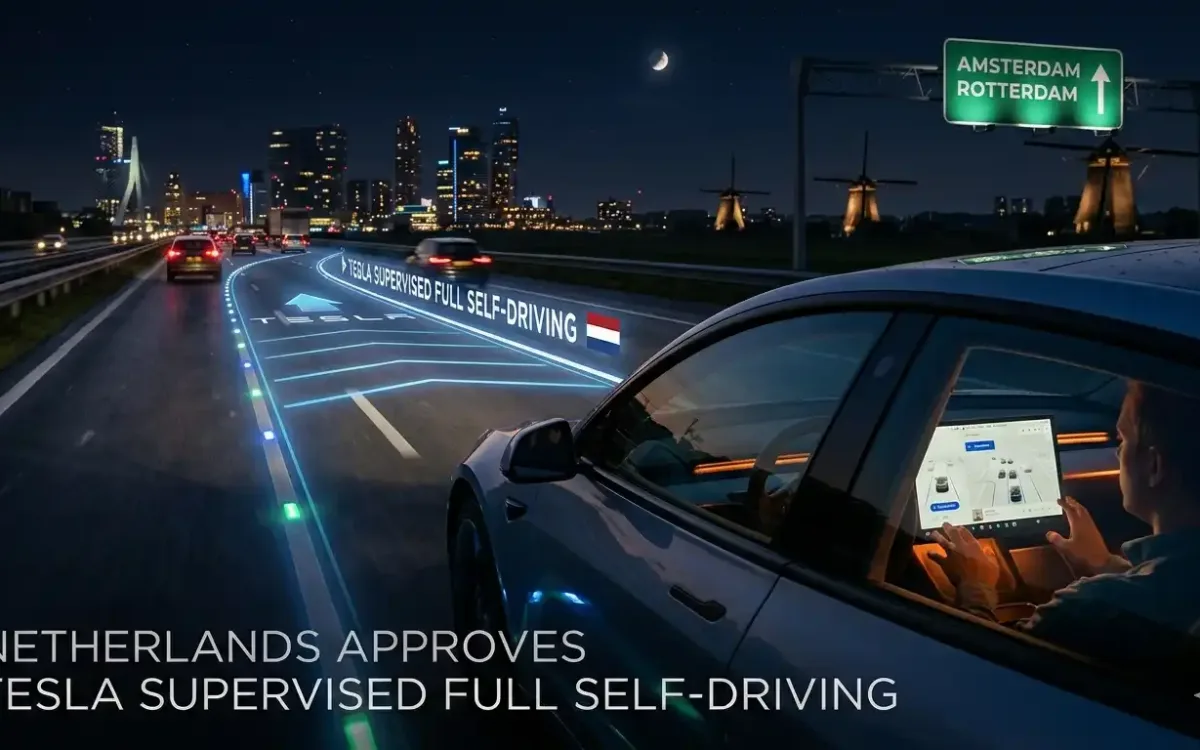
Netherlands Approves Tesla Supervised Full Self-Driving
The Dutch government has approved Tesla’s supervised Full Self-Driving software, marking the first such authorization in Europe. This decision allows Tesla vehicle owners in the Netherlands to use the system on public roads under driver supervision.
Approval Process
The approval came from the Dutch Ministry of Infrastructure and Water Management after a review of safety data submitted by Tesla. The system, which requires constant driver attention, assists with steering, acceleration, and braking but does not replace human control. Officials confirmed the software meets European road safety standards for supervised operation.
Tesla submitted its application earlier this year, providing test results from controlled environments and simulations. The ministry’s evaluation focused on the technology’s performance in urban and highway settings common in the Netherlands. No specific timeline for rollout was detailed in the announcement, but Tesla indicated preparations for software updates to eligible vehicles.
Background on the Technology
Tesla’s Full Self-Driving, in its supervised version, builds on years of development in autonomous driving features. The company has offered beta versions in other markets, gathering data from millions of miles driven. In Europe, regulatory hurdles have delayed similar approvals due to varying national rules on vehicle automation.
The Netherlands’ decision sets a precedent for other EU countries, where harmonized standards under the Vehicle General Safety Regulation apply. This regulation, effective since 2022, outlines requirements for advanced driver assistance systems. Tesla’s approval aligns with efforts to standardize autonomous tech across the bloc.
Earlier this month, discussions around digital technology reliability highlighted the need for verified systems in emerging fields like automotive software. Similar scrutiny applies here, ensuring public trust in new vehicle features.
Reactions from Stakeholders
Tesla’s European director stated the approval represents a step forward for safer roads through advanced assistance. “This enables Dutch drivers to benefit from our latest capabilities while maintaining full responsibility,” the director said in a company release.
Automotive safety groups welcomed the move but urged ongoing monitoring. The European Transport Safety Council noted that supervised systems could reduce accidents if used correctly, based on prior studies of assisted driving. They called for public education campaigns to clarify the technology’s limits.
Industry analysts point to potential economic impacts, including job shifts in driving sectors. In the Netherlands, with its dense road network, the technology may aid traffic flow in cities like Amsterdam and Rotterdam.
Implications for Europe
As the first European nation to greenlight the system, the Netherlands positions itself as a leader in mobility innovation. Other countries, including Germany and France, are reviewing similar applications from Tesla and competitors. EU-wide approval could follow if trials prove successful.
The decision also ties into broader digital infrastructure goals. For instance, reliable tech integration, much like strategies in user engagement tools, emphasizes practical benefits over hype. Tesla plans to expand access gradually, starting with software version 12.5.
Drivers must remain vigilant, as the system issues alerts for inattention. Tesla reports over 1 billion miles of supervised driving data globally, supporting its safety claims. Regulators will track real-world performance post-approval.
Looking ahead, Tesla aims to refine the software based on Dutch usage data. Further approvals in Europe are expected in the coming months, pending national assessments. This development underscores the growing acceptance of supervised autonomy in daily transport.
In related real estate tech applications, tools that streamline operations show how automation extends beyond vehicles. The automotive sector’s progress may influence similar advancements elsewhere.