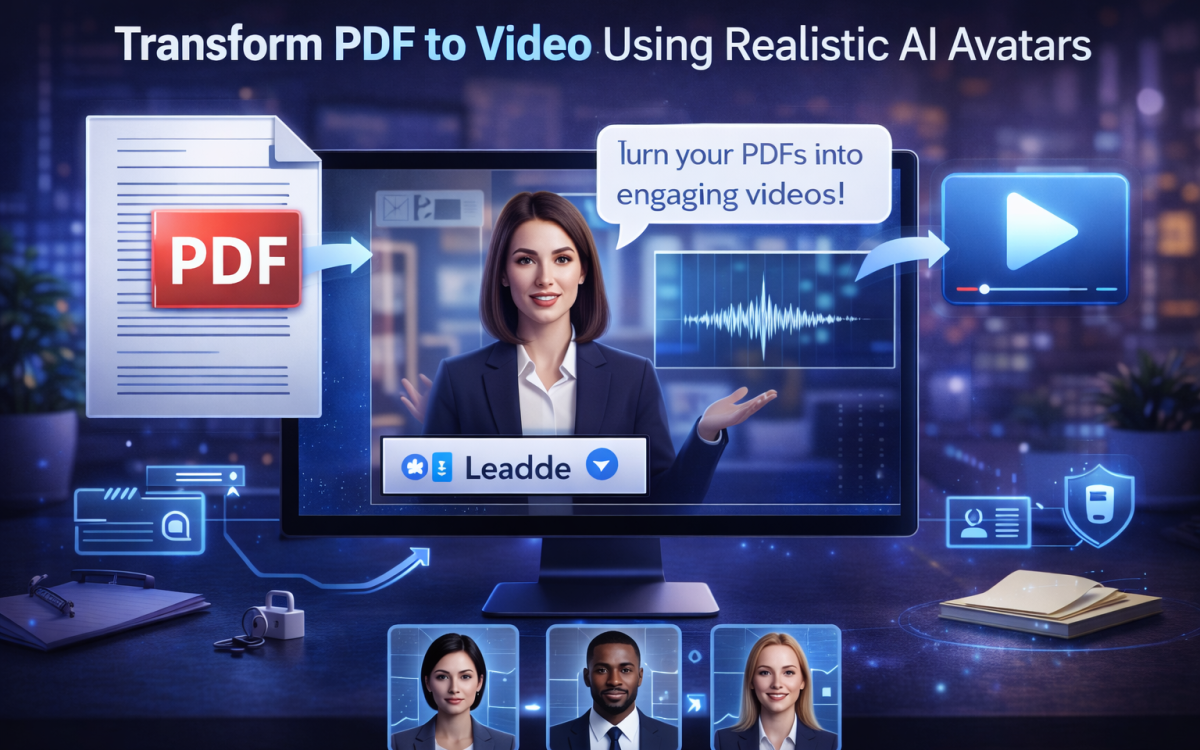
If you want to create a compelling multimedia presentation without hiring actors or renting studio space, the most effective strategy is to transform your PDF to video using realistic AI avatars. By leveraging platforms like Leadde, you can upload a static document, and the system’s deep learning algorithms will automatically synthesize a professional voiceover and render a lifelike digital presenter. This process completely bypasses the traditional bottleneck of on-camera filming, allowing you to generate authoritative, engaging content directly from your existing text simply by selecting a preferred avatar and initiating the render process.
Throughout my career in digital content strategy, the primary friction point in video production has always been the “human element.” Sourcing talent, managing schedules, and securing filming locations for a corporate training or marketing video quickly inflates budgets and timelines. And the alternative—a faceless montage of animated slides with a disembodied voiceover—often fails to establish a connection with the viewer. Recognizing this gap, I began extensively testing generative video solutions. The ability to seamlessly convert PDF to video utilizing deeply realistic digital presenters represents the most significant paradigm shift in content production we have seen in the last decade.
The Problem with Early Generation Avatars
To truly understand the value of modern solutions, it is crucial to recognize where the technology started. Early attempts at AI video generation were plagued by the “uncanny valley” effect. The avatars were stiff; their eye movements were erratic, their blinking was unnatural, and the lip synchronization was often just a rudimentary opening and closing of the mouth that completely ignored the phonetic nuance of the spoken words.
These early limitations meant that while the technology was novel, it wasn’t practical for serious business use. Presenting a critical compliance update or pitching a new SaaS product requires an air of authority and trust. A robotic, unnatural presenter actively undermines that trust. This historical context makes the leap to today’s high-fidelity AI avatars all the more impressive.
Technical Deep Dive: The Engine Behind the Realism
Creating a digital presenter that feels human—one that audiences can connect with—is a profoundly complex computational challenge. Leadde AI solves this through a multi-layered architectural approach, centered heavily on its proprietary rendering technologies.
The Expressive IV Engine
At the core of this hyper-realism is the Expressive IV Engine. Unlike standard renderers that apply a generic human mesh over an audio track, this engine dynamically analyzes the semantic and emotional context of the generated script. Before a single frame is rendered, the AI understands the intent of the sentence. Is it an exciting product reveal? A serious safety warning? A casual instructional step?
Once the sentiment is established, the engine triggers a cascading set of micro-animations. It automatically generates appropriate facial expressions—a slight narrowing of the eyes for emphasis, a furrowed brow during a complex explanation, or an encouraging smile. Furthermore, it integrates full-body kinematics. The avatar doesn’t just stand perfectly still; it shifts its weight, uses natural hand gestures to emphasize points, and breathes rhythmically. This subtle interplay of physical cues is what fools the human brain into recognizing the avatar as a genuine communicator.
Advanced Viseme Mapping and Audio Synchronization
The second pillar of realism is lip synchronization. Modern text-to-speech (TTS) engines are incredibly sophisticated, capable of synthesizing neural voices in nearly 90 languages with perfect intonation. However, perfectly generated audio must be perfectly matched to the visual.
The AI achieves this through precise viseme mapping. A viseme is the visual representation of a phoneme (a distinct sound). When the TTS engine generates the audio, it simultaneously outputs a timestamped phonetic map. The rendering engine then cross-references this map, molding the avatar’s lips, jaw, and tongue positioning to match the specific audio frequency in real-time. This ensures that whether the avatar is speaking English, Mandarin, or Spanish, the mechanical action of speaking looks entirely authentic.
Scene Contextualization and Lighting
Finally, a realistic avatar must look like it belongs in its environment. A common flaw in older systems was the “green screen” effect, where the avatar looked artificially pasted onto the background. The current generation of AI resolves this through intelligent composite rendering. The system automatically adjusts the ambient lighting, shadows, and color temperature on the avatar to match the chosen background or uploaded brand asset. This contextual visual integration ensures a cohesive, professional aesthetic across the entire video.
Common Questions About Avatar Implementation
When teams first adopt this avatar-driven workflow, several operational questions frequently surface.
A primary concern is whether the avatar’s actions can be customized or made more dynamic. As discussed, selecting the Expressive IV Engine is the key to unlocking highly synchronized facial expressions and natural body language, giving the digital persona a human-like expressiveness that standard engines lack.
Another common point of confusion occurs during the editing phase. Users frequently note that the voice and lip movement are out of sync while in the editor. This is a deliberate technical choice to save computational resources. In preview mode, the avatar has not undergone the intensive, full-resolution rendering required to map the visemes perfectly. Once you click “Generate Video” and the final inference process completes, the audio and lip movements align flawlessly.
Furthermore, teams often ask if they can personalize these presenters. While robust platforms offer over 200 built-in avatars, they also provide the architecture to upload a photograph and generate a custom AI avatar. This allows companies to digitize their own CEOs, subject matter experts, or brand ambassadors for long-term, scalable content creation.
Best Practices for Avatar-Led Content
If you want to ensure your PDF to video conversions utilizing digital presenters are as impactful as possible, I recommend the following best practices:
- Match the Avatar to the Message: Take a moment to select a presenter whose implied demographic and style naturally fit the content. A relaxed, casual presenter might be great for an internal team update, while a formal, news-anchor style might be better suited for a quarterly financial report.
- Utilize Component Layouts: Don’t just place the avatar dead-center on every frame. Use the platform’s layout tools to shift the avatar to the left or right, allowing room for embedded screen recordings, text highlights, or data visualizations. Changing the visual composition every few scenes keeps the viewer engaged.
- Refine the Script for Spoken Flow: While the AI is excellent at summarizing dense PDFs, always review the script to ensure it sounds like something a real person would say. Breaking up long, academic sentences into shorter, punchy statements drastically improves the final delivery.
Redefining Authentic Digital Communication
The capability to seamlessly parse text and render a lifelike, engaging digital presenter marks a permanent shift in how we approach video production. We are no longer limited by the physical constraints of camera crews, studio time, or acting talent. By understanding and embracing these advanced rendering engines, content creators can transform dry, static documentation into dynamic, personalized multimedia that commands attention. Realistic AI avatars are not a novelty; they are the new standard for scalable, global communication.